
mindmapstudy.com
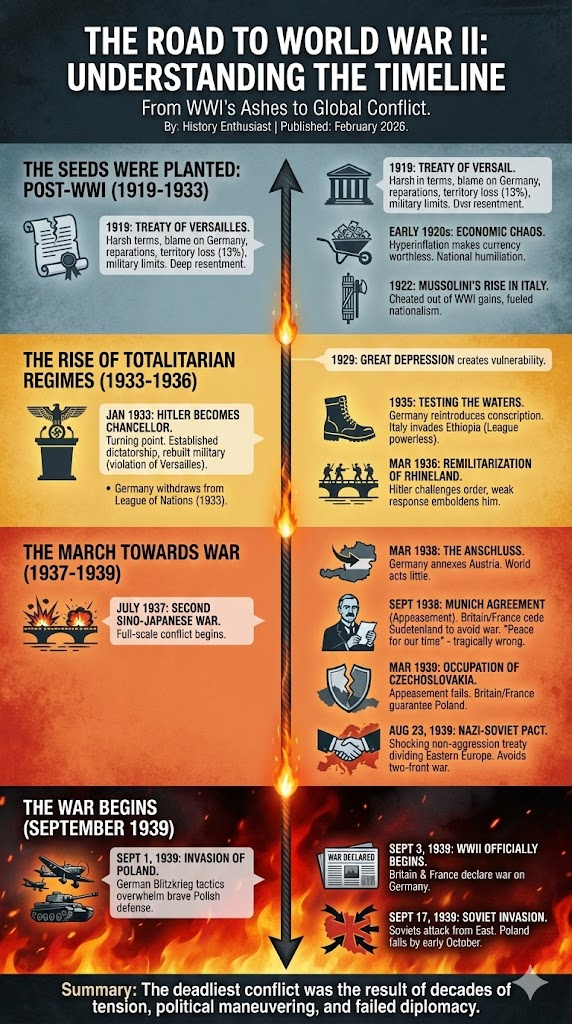
Timeline to World War II : Events Leading to World War II
Major Event
Political Shift
Critical Turning Point
PHASE I — POST-WAR SETTLEMENT (1919–1923)
28 JUNE 1919
Event 1 — Treaty of Versailles
Major Event
Germany accepted territorial losses, military restrictions, and heavy reparations after World War I.
Imp Analysis
The treaty created widespread resentment in Germany and weakened political stability. These conditions encouraged extremist movements seeking to overturn the settlement.
10 JANUARY 1920
Event 2 — League of Nations Begins
Political Shift
The League of Nations was established to promote collective security and peaceful dispute resolution.
Imp Analysis
The organization lacked strong enforcement powers and major participation from several leading powers. Weak responses to future crises reduced confidence in international cooperation.
PHASE II — RISE OF DICTATORSHIPS (1924–1934)
30 JANUARY 1933
Event 3 — Hitler Becomes Chancellor
Critical Turning Point
Adolf Hitler became Chancellor of Germany and rapidly consolidated authoritarian control.
Imp Analysis
The Nazi government rejected the post-war order and pursued expansionist goals. This transformed European diplomacy and increased international tension.
1933–1934
Event 4 — Germany Withdraws from International Agreements
Political Shift
Germany left the League of Nations and expanded military planning despite treaty limits.
Imp Analysis
The withdrawal signaled Germany's rejection of collective diplomacy. Other governments struggled to respond with a united strategy.
PHASE III — AGGRESSION EXPANDS (1935–1938)
16 MARCH 1935
Event 5 — German Rearmament
Major Event
Germany openly introduced conscription and rebuilt its armed forces in violation of the Treaty of Versailles.
Imp Analysis
Military rebuilding shifted the balance of power in Europe. Limited opposition encouraged further expansion.
7 MARCH 1936
Event 6 — Remilitarization of the Rhineland
Critical Turning Point
German troops entered the demilitarized Rhineland without military resistance from France or Britain.
Imp Analysis
The successful move strengthened Hitler's confidence. European governments increasingly relied on negotiation instead of confrontation.
SEPTEMBER 1938
Event 7 — Munich Agreement
Major Event
Britain, France, Germany, and Italy agreed to transfer the Sudetenland from Czechoslovakia to Germany.
Imp Analysis
The agreement reflected the policy of appeasement. Germany interpreted the concession as a sign that further expansion might face little resistance.
PHASE IV — FINAL ROAD TO WAR (1939)
23 AUGUST 1939
Event 8 — Molotov–Ribbentrop Pact
Political Shift
Germany and the Soviet Union signed a non-aggression pact with secret agreements dividing spheres of influence.
Imp Analysis
The agreement reduced Germany's fear of a two-front conflict. It cleared the way for military action against Poland.
1 SEPTEMBER 1939
Event 9 — Germany Invades Poland
Critical Turning Point
German forces invaded Poland using coordinated air and ground attacks, beginning the European conflict.
Imp Analysis
The invasion demonstrated that diplomacy had failed to contain aggression. It immediately triggered treaty obligations among European powers.
3 SEPTEMBER 1939
Event 10 — Britain and France Declare War
Political Shift
Britain and France declared war on Germany after the invasion of Poland, formally beginning World War II in Europe.
Imp Analysis
The declarations transformed a regional invasion into a global conflict involving major powers. Years of political tension, failed diplomacy, and territorial expansion culminated in World War II.