



Introduction
In this chapter, we will focus on a specific type of algebraic expression called polynomials and explore the terminology associated with them. We will learn about the Remainder Theorem and Factor Theorem, discover how to use these theorems for factorisation, and study additional algebraic identities that are fundamental to algebra.
Section 2.1: Understanding Polynomials in One Variable
What is a Variable?
A variable is a symbol that represents a quantity that can take different real values. We commonly use letters like x, y, z, t, u to represent variables.
Consider these algebraic expressions: 2x, 3x, -x, -x/2
All these expressions have the form: constant × variable
When we write an expression where we don’t know the constant value, we use letters like a, b, c. For instance, ax represents such a general expression.
Imp Difference Between Variables and Constants:
- Constants maintain the same value throughout a problem (their values do not change)
- Variables can take different values (their values keep changing)
Understanding Polynomials Through Examples
Let us consider a square with side length 3 units:
- Perimeter = 4 × 3 = 12 units
- Area = 3 × 3 = 9 square units
Now, if the side length is x units:
- Perimeter = 4x units
- Area = x × x = x² square units
The expression x² is an algebraic expression where the exponent of the variable x is a whole number.
Definition of Polynomial: A polynomial in one variable x is an algebraic expression where:
- Each term has the variable with whole number exponents
- The expression is a combination of constants and powers of the variable
- Can be written as: p(x) = aₙxⁿ + aₙ₋₁xⁿ⁻¹ + … + a₁x + a₀
where a₀, a₁, a₂, …, aₙ are constants and aₙ ≠ 0.
Examples of Polynomials and Non-Polynomials
Polynomials:
- x² + 2x + 1 (all exponents are whole numbers)
- 3y² – 5y + 7
- t⁴ – 4t + 2
- 2x⁵ – 3x³ + 7x – 2
Not Polynomials:
- x + 1/x (exponent of x is -1, which is not a whole number)
- √x + 3 (exponent is 1/2, which is not a whole number)
- y – 1/√y (fractional exponent)
Terms and Coefficients
In the polynomial x³ + 2x² – 7x + 2:
- Terms are: x³, 2x², -7x, 2
- Coefficient of x³ is 1 (note: x³ means 1·x³)
- Coefficient of x² is 2
- Coefficient of x is -7
- The constant term is 2
Imp Fact: In any term, the constant multiplying the variable is called the coefficient of that variable.
Classification of Polynomials Based on Number of Terms
Monomial: Polynomial with one term
- Examples: 5x, 3y², -2, x⁵
Binomial: Polynomial with two terms
- Examples: x + 1, 2x² – 3x, y² + 5
Trinomial: Polynomial with three terms
- Examples: x² + 2x + 1, 3y² – 5y + 7
Classification by Degree

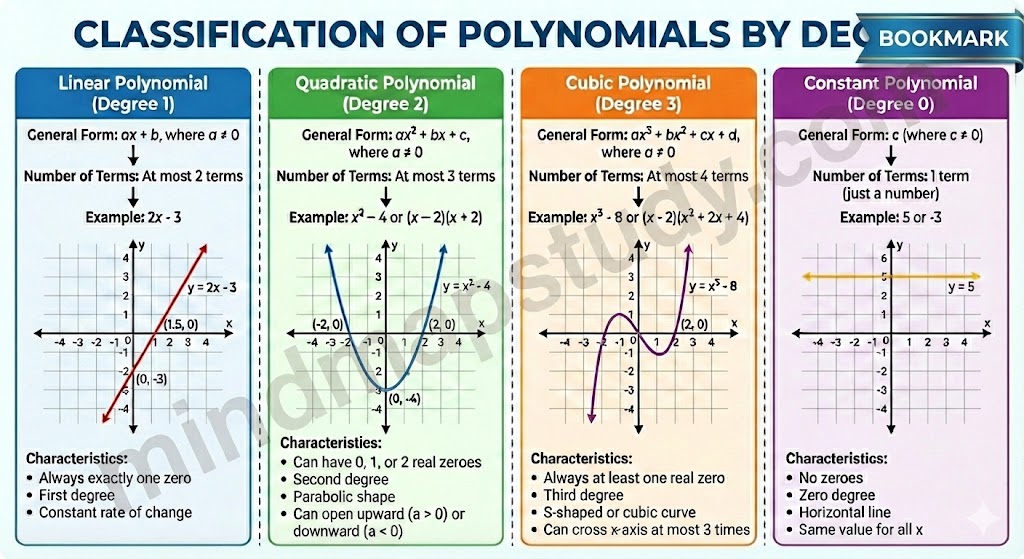
The degree of a polynomial is the highest power of the variable present in the polynomial.
Linear Polynomial (Degree 1):
- Form: ax + b, where a ≠ 0
- Examples: 2x – 3, 5y + 1, -3t + 7
- A linear polynomial has at most 2 terms
Quadratic Polynomial (Degree 2):
- Form: ax² + bx + c, where a ≠ 0
- Examples: x² + 2x + 1, 3y² – 5y, t² + 4
- A quadratic polynomial has at most 3 terms
Cubic Polynomial (Degree 3):
- Form: ax³ + bx² + cx + d, where a ≠ 0
- Examples: x³ – 2x² + 3x – 1, 2t³ + 5, y³ – 4y² + 6y + 8
- A cubic polynomial has at most 4 terms
Constant Polynomial:
- Form: c (a non-zero constant)
- Degree: 0
- Examples: 5, -3, 100
Zero Polynomial:
- The polynomial 0 (when all coefficients are zero)
- Degree: Not defined
Polynomials in Multiple Variables
While we focus on polynomials in one variable, polynomials can have multiple variables:
- x² + y² + z² (variables: x, y, z)
- p² + q¹⁰ + r (variables: p, q, r)
- u³ + v² (variables: u, v)

Section 2.2: Zeroes of a Polynomial
Finding the Value of a Polynomial
To find the value of a polynomial p(x) at a specific value of x, we substitute that value into the polynomial.
Example 1: Find the value of p(x) = 5x² + 3x + 2 at x = 1
p(1) = 5(1)² + 3(1) + 2 = 5 + 3 + 2 = 10
Example 2: Find the value of p(x) = 5x⁴ – 2x³ + 3x – 2 at x = -1
p(-1) = 5(-1)⁴ – 2(-1)³ + 3(-1) – 2 = 5(1) – 2(-1) – 3 – 2 = 5 + 2 – 3 – 2 = 2
Understanding Zeroes of a Polynomial
Definition: A zero of a polynomial p(x) is a number c such that p(c) = 0.
When we substitute this value into the polynomial, the entire expression equals zero.
Example 3: Is x = 2 a zero of p(x) = x² – 4?
p(2) = 2² – 4 = 4 – 4 = 0
Yes, x = 2 is a zero of the polynomial because p(2) = 0.
Example 4: Is x = -2 a zero of p(x) = x² – 4?
p(-2) = (-2)² – 4 = 4 – 4 = 0
Yes, x = -2 is also a zero of this polynomial.
Imp Observations About Zeroes
- A zero of a polynomial need not be zero itself (as seen in examples above)
- Zero (the number) can be a zero of a polynomial
- Example: p(x) = x² – 2x has a zero at x = 0
- p(0) = 0² – 2(0) = 0
- Every linear polynomial has exactly one zero
- Linear polynomial: p(x) = ax + b, a ≠ 0
- To find the zero: ax + b = 0 → x = -b/a
- A polynomial can have more than one zero
- Example: p(x) = x² – 4 has zeroes at x = 2 and x = -2
- A non-zero constant polynomial has no zero
- Example: p(x) = 5 (always equals 5, never equals 0)
- Every real number is a zero of the zero polynomial (by convention)
Connecting Zeroes to Roots
The zero of a polynomial p(x) is related to the root of the polynomial equation p(x) = 0.
If c is a zero of p(x), then c is a root of the equation p(x) = 0.
Section 2.3: Factorisation of Polynomials
The Remainder Theorem
When we divide a polynomial p(x) by a linear polynomial (x – a), we get: p(x) = (x – a) × q(x) + r
where q(x) is the quotient and r is the remainder.
The Remainder Theorem states: When a polynomial p(x) is divided by (x – a), the remainder is p(a).
This is extremely useful for finding remainders without actually performing long division.
Example 5: Find the remainder when p(x) = 2x³ + x² – 3x + 5 is divided by (x – 1)
By the Remainder Theorem: remainder = p(1) = 2(1)³ + (1)² – 3(1) + 5 = 2 + 1 – 3 + 5 = 5
The Factor Theorem
The Factor Theorem is a special case of the Remainder Theorem where the remainder is zero.
The Factor Theorem states:
- If p(a) = 0, then (x – a) is a factor of p(x)
- If (x – a) is a factor of p(x), then p(a) = 0
In other words: (x – a) is a factor of p(x) if and only if a is a zero of p(x).
Example 6: Determine if (x – 2) is a factor of p(x) = x³ – 3x² + 5x – 6
p(2) = 2³ – 3(2)² + 5(2) – 6 = 8 – 12 + 10 – 6 = 0
Since p(2) = 0, yes, (x – 2) is a factor of the polynomial.
Factorisation of Quadratic Polynomials
For polynomials of the form ax² + bx + c, we can factorise by:
Method 1: Splitting the Middle Term To factorise ax² + bx + c:
- Find two numbers p and q such that p + q = b and p × q = ac
- Write bx = px + qx
- Group and factor
Example 7: Factorise 6x² + 17x + 5
Here, a = 6, b = 17, c = 5 We need p + q = 17 and pq = 6 × 5 = 30 The numbers are 2 and 15 (since 2 + 15 = 17 and 2 × 15 = 30)
6x² + 17x + 5 = 6x² + 2x + 15x + 5 = 2x(3x + 1) + 5(3x + 1) = (3x + 1)(2x + 5)
Method 2: Using the Factor Theorem If the zeroes are a and b, then: ax² + bx + c = a(x – a)(x – b)
Factorisation of Cubic Polynomials
For cubic polynomials, we typically:
- Use the Factor Theorem to find at least one factor
- Divide the polynomial by this factor to get a quadratic
- Factorise the resulting quadratic
Example 8: Factorise x³ – 2x² – 3x + 6
Let p(x) = x³ – 2x² – 3x + 6
Testing divisors of the constant term (6):
- p(1) = 1 – 2 – 3 + 6 = 2 ≠ 0
- p(2) = 8 – 8 – 6 + 6 = 0 ✓
So (x – 2) is a factor.
Dividing p(x) by (x – 2): p(x) = (x – 2)(x² – 3)
Therefore: x³ – 2x² – 3x + 6 = (x – 2)(x² – 3)
Section 2.4: Algebraic Identities
Understanding Algebraic Identities
An algebraic identity is an algebraic equation that is true for all values of the variables appearing in it.
Imp Identities to Remember
Identity 1: (x + y)² = x² + 2xy + y²
Identity 2: (x – y)² = x² – 2xy + y²
Identity 3: (x + y)(x – y) = x² – y²
Identity 4: (x + a)(x + b) = x² + (a + b)x + ab
Identity 5: (x + y + z)² = x² + y² + z² + 2xy + 2yz + 2zx
Identity 6: (x + y)³ = x³ + y³ + 3xy(x + y)
Identity 7: (x – y)³ = x³ – y³ – 3xy(x – y)
Identity 8: x³ + y³ + z³ – 3xyz = (x + y + z)(x² + y² + z² – xy – yz – zx)
Applications of Identities
Identities are useful for:
- Finding products without direct multiplication
- Factorising algebraic expressions
- Computing values of large numbers
- Simplifying complex expressions
Example 9: Calculate 105 × 106 without multiplying directly
Using Identity 4 with x = 100, a = 5, b = 6: 105 × 106 = (100 + 5)(100 + 6) = 100² + (5 + 6)×100 + 5×6 = 10000 + 1100 + 30 = 11130
Example 10: Expand (3a – 4b + 5c)²
Using Identity 5: (3a – 4b + 5c)² = (3a)² + (-4b)² + (5c)² + 2(3a)(-4b) + 2(-4b)(5c) + 2(5c)(3a) = 9a² + 16b² + 25c² – 24ab – 40bc + 30ac
Example 11: Evaluate 99³ using an identity
99 = 100 – 1
Using Identity 7 for (x – y)³ where x = 100, y = 1: 99³ = (100 – 1)³ = 100³ – 1³ – 3(100)(1)(100 – 1) = 1000000 – 1 – 300(99) = 1000000 – 1 – 29700 = 970299
Factorisation Using Identities
Example 12: Factorise 49a² – 70ab + 25b²
Notice: 49a² = (7a)², 25b² = (5b)², 70ab = 2(7a)(5b)
This matches Identity 2: (x – y)² = x² – 2xy + y²
So: 49a² – 70ab + 25b² = (7a – 5b)²
Example 13: Factorise x³ – 8
x³ – 8 = x³ – 2³
Using Identity 7, we have x³ – y³ = (x – y)(x² + xy + y²) So: x³ – 8 = (x – 2)(x² + 2x + 4)
Exercise Solutions
Exercise 2.1
Question 1: Which expressions are polynomials?
i) 4x³ – 3x + 7
- Answer: Yes, this is a polynomial (all exponents are whole numbers)
ii) y + 2
- Answer: Yes, this is a polynomial
iii) 3√t + t²
- Answer: No, because √t = t^(1/2) has a non-whole exponent
iv) y – 1/y
- Answer: No, because 1/y has a negative exponent (-1)
Question 2: Write the coefficients of x² in each:
i) 2x³ + x² – 3
- Answer: Coefficient of x² is 1
ii) 2x² – x + 2
- Answer: Coefficient of x² is 2
iii) x³ + x
- Answer: Coefficient of x² is 0 (x² term is absent)
iv) 2x – 1
- Answer: Coefficient of x² is 0
Question 3: Examples of binomial of degree 35 and monomial of degree 100
- Binomial of degree 35: x³⁵ + 2x (or any x³⁵ term with one other term)
- Monomial of degree 100: x¹⁰⁰ (or any single term with degree 100)
Question 4: Write the degree of each polynomial:
i) 5x³ + 4x² – 7x
- Answer: Degree is 3
ii) 4 – y + y⁴
- Answer: Degree is 4
iii) 5t – 7
- Answer: Degree is 1
iv) 3
- Answer: Degree is 0
Question 5: Classify as linear, quadratic, or cubic:
i) x + x³ + 3
- Answer: Cubic (degree 3)
ii) x² – x + 1
- Answer: Quadratic (degree 2)
iii) y + y³ + 4
- Answer: Cubic (degree 3)
iv) 1 + x
- Answer: Linear (degree 1)
Exercise 2.2
Question 1: Find the value of 5x – 4x² + 3 at x = -1
p(-1) = 5(-1) – 4(-1)² + 3 = -5 – 4 + 3 = -6
Question 2: Find p(0), p(1), and p(2) for p(x) = x² – x + 1
- p(0) = 0² – 0 + 1 = 1
- p(1) = 1² – 1 + 1 = 1
- p(2) = 2² – 2 + 1 = 3
Question 3: Verify if the given values are zeroes:
i) p(x) = 3x + 1, x = 1/3
- p(1/3) = 3(1/3) + 1 = 1 + 1 = 2 ≠ 0
- Answer: Not a zero
ii) p(x) = 5x, x = 4/5
- p(4/5) = 5(4/5) = 4 ≠ 0
- Answer: Not a zero
iii) p(x) = x – 1, x = 1, -1
- p(1) = 1 – 1 = 0 ✓ (is a zero)
- p(-1) = -1 – 1 = -2 ≠ 0 (not a zero)
- Answer: x = 1 is a zero, x = -1 is not
Question 4: Find the zero of each polynomial:
i) p(x) = x + 5
- x + 5 = 0 → x = -5
ii) p(x) = x – 5
- x – 5 = 0 → x = 5
iii) p(x) = 2x + 5
- 2x + 5 = 0 → x = -5/2
iv) p(x) = 3x – 2
- 3x – 2 = 0 → x = 2/3
Exercise 2.3
Question 1: Determine which have (x + 1) as a factor (meaning x = -1 is a zero):
i) p(x) = x³ + x² + x + 1
- p(-1) = (-1)³ + (-1)² + (-1) + 1 = -1 + 1 – 1 + 1 = 0
- Answer: Yes, (x + 1) is a factor
ii) p(x) = x⁴ + x³ + x² + x + 1
- p(-1) = 1 – 1 + 1 – 1 + 1 = 1 ≠ 0
- Answer: No
Question 3: Find k if (x – 1) is a factor of p(x) = 4x³ + 3x² – 4x + k
For (x – 1) to be a factor, p(1) = 0: 4(1)³ + 3(1)² – 4(1) + k = 0 4 + 3 – 4 + k = 0 3 + k = 0 k = -3
Question 4: Factorise:
i) 12x² – 7x + 1
- Need two numbers that add to -7 and multiply to 12
- Numbers are -3 and -4
- 12x² – 7x + 1 = 12x² – 3x – 4x + 1 = 3x(4x – 1) – 1(4x – 1) = (4x – 1)(3x – 1)
ii) 2x² + 7x + 3
- Need two numbers that add to 7 and multiply to 6
- Numbers are 1 and 6
- 2x² + 7x + 3 = 2x² + x + 6x + 3 = x(2x + 1) + 3(2x + 1) = (2x + 1)(x + 3)
Question 5: Factorise cubic polynomials:
i) x³ + 2x² + x + 2
- p(-2) = -8 + 8 – 2 + 2 = 0, so (x + 2) is a factor
- Dividing: x³ + 2x² + x + 2 = (x + 2)(x² + 1)
- Answer: (x + 2)(x² + 1)
Exercise 2.4
Question 1: Use identities to find products:
i) (x + 4)(x + 10)
- Using Identity 4: (x + 4)(x + 10) = x² + (4 + 10)x + 4 × 10
- = x² + 14x + 40
ii) (x + 8)(x + 10)
- Using Identity 4: = x² + 18x + 80
- = x² + 18x + 80
Question 2: Evaluate without multiplying directly:
i) 103 × 107
- (100 + 3)(100 + 7) = 100² + 10(100) + 21 = 10000 + 1000 + 21
- = 11021
ii) 95 × 96
- (100 – 5)(100 – 4) = 100² – 9(100) + 20 = 10000 – 900 + 20
- = 9120
Question 3: Factorise using identities:
i) 9x² + 6xy + y²
- This is (3x)² + 2(3x)(y) + y² = (3x + y)²
- Answer: (3x + y)²
ii) 4y² – 4y + 1
- This is (2y)² – 2(2y)(1) + 1² = (2y – 1)²
- Answer: (2y – 1)²
Question 7: Evaluate using identities:
i) 99³
- Using Identity 7: (100 – 1)³ = 100³ – 1³ – 3(100)(1)(99)
- = 1000000 – 1 – 29700 = 970299
ii) 102³
- Using Identity 6: (100 + 2)³ = 100³ + 2³ + 3(100)(2)(102)
- = 1000000 + 8 + 61200 = 1061208
Download Free Mind Map from the link below
This mind map contains all important topics of this chapter
Visit our Class 9 Maths page for free mind maps of all Chapters