



Introduction to Quadrilaterals
A quadrilateral is a polygon with four sides, four angles, and four vertices. In Class VIII, you studied various types of quadrilaterals. This chapter focuses on the properties of parallelograms and related figures, and the important mid-point theorem applicable to triangles.
A parallelogram is a quadrilateral in which both pairs of opposite sides are parallel. This fundamental property gives rise to many other interesting characteristics that we will explore in detail.
8.1 Properties of a Parallelogram

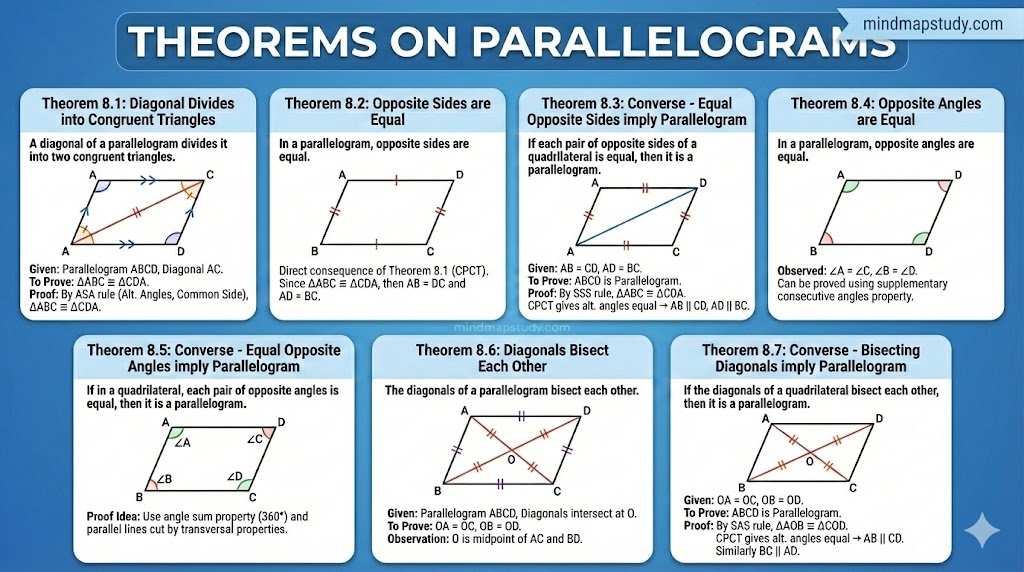
Understanding Parallelograms
When you cut a parallelogram along its diagonal, you obtain two triangles. If you place one triangle over the other and turn it around if necessary, you will observe that the two triangles cover each other completely—they are congruent!
This observation leads us to our first theorem about parallelograms.
Theorem 8.1: A Diagonal of a Parallelogram Divides It Into Two Congruent Triangles
Statement: A diagonal of a parallelogram divides it into two congruent triangles.
Given: ABCD is a parallelogram with diagonal AC.
To Prove: ∆ABC ≅ ∆CDA
Proof:
In ∆ABC and ∆CDA:
- Since BC || AD and AC is a transversal:
- ∠BCA = ∠DAC (pair of alternate angles)
- Since AB || DC and AC is a transversal:
- ∠BAC = ∠DCA (pair of alternate angles)
- AC = CA (common side)
By ASA rule, ∆ABC ≅ ∆CDA
Therefore, the diagonal AC divides the parallelogram ABCD into two congruent triangles ABC and CDA.
Theorem 8.2: In a Parallelogram, Opposite Sides are Equal
Statement: In a parallelogram, opposite sides are equal.
Imp Note: This is a direct consequence of Theorem 8.1. When two triangles are congruent, their corresponding parts are equal (CPCT).
From ∆ABC ≅ ∆CDA:
- AB = DC (corresponding sides)
- AD = BC (corresponding sides)
So in parallelogram ABCD: AB = DC and AD = BC
Theorem 8.3: If Opposite Sides of a Quadrilateral are Equal, Then It is a Parallelogram (Converse of Theorem 8.2)
Statement: If each pair of opposite sides of a quadrilateral is equal, then it is a parallelogram.
Given: ABCD is a quadrilateral where AB = CD and AD = BC.
To Prove: ABCD is a parallelogram (AB || CD and AD || BC).
Proof:
Draw diagonal AC.
In ∆ABC and ∆CDA:
- AB = CD (given)
- AC = CA (common)
- AD = BC (given)
By SSS rule, ∆ABC ≅ ∆CDA
From this congruence:
- ∠BAC = ∠DCA (CPCT) → These are alternate angles, so AB || CD
- ∠BCA = ∠DAC (CPCT) → These are alternate angles, so AD || BC
Therefore, ABCD is a parallelogram.
Theorem 8.4: In a Parallelogram, Opposite Angles are Equal
Statement: In a parallelogram, opposite angles are equal.
When you measure the angles of a parallelogram, you observe that:
- ∠A = ∠C (opposite angles)
- ∠B = ∠D (opposite angles)
This can be proved using the property that the consecutive angles in a parallelogram are supplementary (they add up to 180°).
Theorem 8.5: If Opposite Angles of a Quadrilateral are Equal, Then It is a Parallelogram (Converse of Theorem 8.4)
Statement: If in a quadrilateral, each pair of opposite angles is equal, then it is a parallelogram.
Proof Idea: Using the angle sum property of a quadrilateral (360°) and properties of parallel lines cut by a transversal, we can show that if opposite angles are equal, then opposite sides must be parallel.
Theorem 8.6: The Diagonals of a Parallelogram Bisect Each Other
Statement: The diagonals of a parallelogram bisect each other.
Given: ABCD is a parallelogram with diagonals AC and BD intersecting at point O.
To Prove: OA = OC and OB = OD (diagonals bisect each other)
Observation: When you measure the segments OA, OB, OC, and OD in various parallelograms, you will find that OA = OC and OB = OD. This means O is the midpoint of both diagonals.
Theorem 8.7: If the Diagonals of a Quadrilateral Bisect Each Other, Then It is a Parallelogram (Converse of Theorem 8.6)
Statement: If the diagonals of a quadrilateral bisect each other, then it is a parallelogram.
Given: ABCD is a quadrilateral where diagonals AC and BD intersect at O with OA = OC and OB = OD.
To Prove: ABCD is a parallelogram.
Proof:
In ∆AOB and ∆COD:
- OA = OC (given)
- OB = OD (given)
- ∠AOB = ∠COD (vertically opposite angles)
By SAS rule, ∆AOB ≅ ∆COD
From this congruence:
- ∠ABO = ∠CDO (CPCT) → These are alternate angles, so AB || CD
Similarly, we can show that BC || AD.
Therefore, ABCD is a parallelogram.
Special Types of Parallelograms
Rectangle
A rectangle is a parallelogram in which one angle is a right angle (90°).
Imp Property: Every angle of a rectangle is a right angle.
Proof: Let ABCD be a rectangle where ∠A = 90°.
Since AD || BC and AB is a transversal:
- ∠A + ∠B = 180° (co-interior angles)
- 90° + ∠B = 180°
- ∠B = 90°
Since opposite angles in a parallelogram are equal:
- ∠C = ∠A = 90°
- ∠D = ∠B = 90°
Important Property of Rectangle: The diagonals of a rectangle are equal and bisect each other.
Rhombus
A rhombus is a parallelogram in which all four sides are equal.
Imp Property: The diagonals of a rhombus are perpendicular to each other.
Proof: Let ABCD be a rhombus with diagonals AC and BD intersecting at O.
In ∆AOD and ∆COD:
- OA = OC (diagonals of a parallelogram bisect each other)
- OD = OD (common)
- AD = CD (all sides of rhombus are equal)
By SSS rule, ∆AOD ≅ ∆COD
From this congruence:
- ∠AOD = ∠COD (CPCT)
Since ∠AOD + ∠COD = 180° (linear pair):
- 2∠AOD = 180°
- ∠AOD = 90°
Therefore, the diagonals are perpendicular to each other.
Another Important Property of Rhombus: The diagonals of a rhombus bisect each other at right angles and vice-versa.
Square
A square is a rectangle with all sides equal (or equivalently, a rhombus with all angles equal to 90°).
Imp Properties:
- All sides are equal
- All angles are equal to 90°
- Diagonals are equal and bisect each other at right angles
- Diagonals bisect the angles of the square
Solved Examples
Example 1: Show That Each Angle of a Rectangle is a Right Angle
Problem: In rectangle ABCD with ∠A = 90°, prove that ∠B = ∠C = ∠D = 90°.
Solution:
Since ABCD is a rectangle (which is a parallelogram with one right angle):
Since AD || BC and AB is a transversal:
- ∠A + ∠B = 180° (co-interior angles on the same side of transversal)
- 90° + ∠B = 180°
- ∠B = 90°
Using the property that opposite angles in a parallelogram are equal:
- ∠C = ∠A = 90°
- ∠D = ∠B = 90°
Therefore, each angle of rectangle ABCD is a right angle.
Example 2: Show That the Diagonals of a Rhombus are Perpendicular
Problem: In rhombus ABCD, prove that the diagonals AC and BD are perpendicular to each other.
Solution:
In rhombus ABCD, all sides are equal: AB = BC = CD = DA
Let the diagonals intersect at O.
Consider ∆AOD and ∆COD:
- OA = OC (diagonals of a parallelogram bisect each other)
- OD = OD (common side)
- AD = CD (all sides of rhombus are equal)
By SSS congruence rule, ∆AOD ≅ ∆COD
From this congruence:
- ∠AOD = ∠COD (CPCT)
Since ∠AOD and ∠COD form a linear pair:
- ∠AOD + ∠COD = 180°
- 2∠AOD = 180°
- ∠AOD = 90°
Therefore, the diagonals of the rhombus are perpendicular to each other.
Example 3: Application of Parallel Lines and Angle Bisector
Problem: In ∆ABC, AB = AC (isosceles). AD bisects the exterior angle ∠PAC, and CD || AB. Show that (i) ∠DAC = ∠BCA and (ii) ABCD is a parallelogram.
Solution:
(i) Proving ∠DAC = ∠BCA:
Since AB = AC:
- ∠ABC = ∠ACB (angles opposite to equal sides)
The exterior angle ∠PAC equals the sum of the two non-adjacent interior angles:
- ∠PAC = ∠ABC + ∠ACB = 2∠ACB … (1)
Since AD bisects ∠PAC:
- ∠PAD = ∠DAC = (∠PAC)/2 = ∠ACB … (2)
Therefore, ∠DAC = ∠BCA (or ∠ACB)
(ii) Proving ABCD is a parallelogram:
From part (i), ∠DAC = ∠BCA.
These are alternate angles formed by transversal AC cutting lines AD and BC.
Since alternate angles are equal:
- AD || BC … (3)
Given in the problem:
- CD || AB … (4)
Since both pairs of opposite sides are parallel: ABCD is a parallelogram.
Example 4: Angle Bisectors in Parallel Lines
Problem: Two parallel lines l and m are intersected by a transversal p. The bisectors of the interior angles form quadrilateral ABCD. Show that ABCD is a rectangle.
Solution:
Given: l || m, transversal p intersects l at A and m at C.
- B is intersection of bisectors of ∠PAC and ∠ACQ
- D is intersection of bisectors of ∠ACR and ∠SAC
Step 1: Show ABCD is a parallelogram
Since l || m and p is a transversal:
- ∠PAC = ∠ACR (alternate angles)
Since AB and CD are bisectors:
- ∠PAC/2 = ∠ACR/2
- ∠BAC = ∠ACD
These are alternate angles with transversal AC, so:
- AB || CD … (1)
Similarly, considering bisectors of other angles:
- BC || AD … (2)
Therefore, ABCD is a parallelogram.
Step 2: Show ABCD is a rectangle
Since ∠PAC + ∠CAS = 180° (linear pair):
- (∠PAC)/2 + (∠CAS)/2 = 90°
- ∠BAC + ∠CAD = 90°
- ∠BAD = 90°
Since ABCD is a parallelogram with one angle equal to 90°: ABCD is a rectangle.
Example 5: Angle Bisectors in a Parallelogram Form a Rectangle
Problem: In parallelogram ABCD, the bisectors of angles ∠A and ∠B intersect at P, bisectors of ∠B and ∠C intersect at Q, bisectors of ∠C and ∠D intersect at R, and bisectors of ∠D and ∠A intersect at S. Show that PQRS is a rectangle.
Solution:
Consider ∆ASD where AS bisects ∠A and DS bisects ∠D:
- ∠DAS = (∠A)/2
- ∠ADS = (∠D)/2
In ∆ASD:
- ∠DAS + ∠ADS = (∠A)/2 + (∠D)/2 = (∠A + ∠D)/2
Since A and D are consecutive angles in a parallelogram:
- ∠A + ∠D = 180°
- ∠DAS + ∠ADS = 90°
Using angle sum property of triangle:
- ∠DAS + ∠ADS + ∠DSA = 180°
- 90° + ∠DSA = 180°
- ∠DSA = 90°
So ∠PSR = 90° (vertically opposite to ∠DSA)
Similarly:
- ∠SPQ = 90°
- ∠PQR = 90°
- ∠SRQ = 90°
Since PQRS has all angles equal to 90° and opposite angles are equal: PQRS is a parallelogram with a right angle, hence it is a rectangle.
Exercise 8.1: Solutions
Question 1: If the diagonals of a parallelogram are equal, then show that it is a rectangle.
Solution:
Let ABCD be a parallelogram with diagonals AC = BD.
In ∆ABC and ∆BAD:
- AB = AB (common)
- AC = BD (given)
- BC = AD (opposite sides of parallelogram)
By SSS rule, ∆ABC ≅ ∆BAD
From this congruence:
- ∠ABC = ∠BAD (CPCT)
Since these are consecutive angles and are equal:
- ∠ABC = ∠BAD
In parallelogram ABCD:
- ∠ABC + ∠BAD = 180° (co-interior angles)
- 2∠ABC = 180°
- ∠ABC = 90°
Since ABCD is a parallelogram with ∠ABC = 90°, ABCD is a rectangle.
Question 2: Show that the diagonals of a square are equal and bisect each other at right angles.
Solution:
Let ABCD be a square. All sides are equal and all angles are 90°.
Part 1: Diagonals are equal
Consider ∆ABC and ∆DCB:
- AB = DC (sides of square)
- BC = CB (common)
- ∠ABC = ∠DCB = 90° (angles of square)
By SAS rule, ∆ABC ≅ ∆DCB
- AC = DB (CPCT)
Therefore, the diagonals are equal.
Part 2: Diagonals bisect each other
Since ABCD is a square, it is also a parallelogram. By Theorem 8.6, the diagonals of a parallelogram bisect each other.
Therefore, the diagonals bisect each other.
Part 3: Diagonals are perpendicular
Since ABCD is a square, it is also a rhombus (all sides equal). By the property of rhombus, the diagonals are perpendicular to each other.
Therefore, the diagonals bisect each other at right angles.
Question 3: Diagonal AC of parallelogram ABCD bisects ∠A. Show that (i) it bisects ∠C also and (ii) ABCD is a rhombus.
Solution:
(i) AC bisects ∠C:
Since ABCD is a parallelogram and AC bisects ∠A:
- ∠BAC = ∠DAC … (1)
Since AB || DC and AC is a transversal:
- ∠BAC = ∠DCA (alternate angles) … (2)
Since AD || BC and AC is a transversal:
- ∠DAC = ∠BCA (alternate angles) … (3)
From (1), (2), and (3):
- ∠BCA = ∠DCA
Therefore, AC bisects ∠C.
(ii) ABCD is a rhombus:
From the above:
- ∠BAC = ∠BCA
In ∆ABC, since two angles are equal:
- AB = BC (sides opposite equal angles)
Since opposite sides of a parallelogram are equal:
- AB = DC and BC = AD
- Therefore, AB = BC = DC = AD
Since all four sides are equal, ABCD is a rhombus.
Question 4: ABCD is a rectangle in which diagonal AC bisects ∠A and ∠C. Show that (i) ABCD is a square and (ii) diagonal BD bisects ∠B and ∠D.
Solution:
(i) ABCD is a square:
Since ABCD is a rectangle:
- ∠A = ∠C = 90° (all angles of rectangle are 90°)
Since AC bisects ∠A:
- ∠BAC = ∠DAC = 45°
In ∆ABC:
- ∠BAC = 45° and ∠ABC = 90°
- ∠BCA = 180° – 45° – 90° = 45°
Since ∠BAC = ∠BCA = 45°:
- AB = BC (sides opposite equal angles)
Since ABCD is a rectangle with AB = BC: ABCD is a square (rectangle with all sides equal).
(ii) BD bisects ∠B and ∠D:
By similar reasoning (since ABCD is a square and diagonals bisect the angles of a square): BD bisects ∠B and ∠D.
Question 5: In parallelogram ABCD, points P and Q are on diagonal BD such that DP = BQ. Show that (i) ∆APD ≅ ∆CQB (ii) AP = CQ (iii) ∆AQB ≅ ∆CPD (iv) AQ = CP (v) APCQ is a parallelogram.
Solution:
(i) ∆APD ≅ ∆CQB:
In ∆APD and ∆CQB:
- AD = CB (opposite sides of parallelogram)
- DP = BQ (given)
- ∠ADP = ∠CBQ (alternate angles, since AD || BC and BD is transversal)
By SAS rule, ∆APD ≅ ∆CQB
(ii) AP = CQ:
From part (i), ∆APD ≅ ∆CQB
- AP = CQ (CPCT)
(iii) ∆AQB ≅ ∆CPD:
In ∆AQB and ∆CPD:
- AB = CD (opposite sides of parallelogram)
- BQ = DP (given)
- ∠ABQ = ∠CDP (alternate angles)
By SAS rule, ∆AQB ≅ ∆CPD
(iv) AQ = CP:
From part (iii), ∆AQB ≅ ∆CPD
- AQ = CP (CPCT)
(v) APCQ is a parallelogram:
From parts (ii) and (iv):
- AP = CQ and AQ = CP
Since both pairs of opposite sides are equal, APCQ is a parallelogram.
Question 6: ABCD is a parallelogram and AP and CQ are perpendiculars from vertices A and C to diagonal BD. Show that (i) ∆APB ≅ ∆CQD and (ii) AP = CQ.
Solution:
(i) ∆APB ≅ ∆CQD:
In ∆APB and ∆CQD:
- AB = CD (opposite sides of parallelogram)
- ∠APB = ∠CQD = 90° (given that AP ⊥ BD and CQ ⊥ BD)
- ∠ABP = ∠CDQ (alternate angles, since AB || CD and BD is transversal)
By AAS rule, ∆APB ≅ ∆CQD
(ii) AP = CQ:
From part (i), ∆APB ≅ ∆CQD
- AP = CQ (CPCT)
Question 7: ABCD is a trapezium with AB || CD and AD = BC. Show that (i) ∠A = ∠B (ii) ∠C = ∠D (iii) ∆ABC ≅ ∆BAD (iv) diagonal AC = diagonal BD.
Solution:
Extend AB to E such that CE || AD.
(i) ∠A = ∠B:
Since AECD is a parallelogram (AD || CE and AB || DC):
- AD = CE (opposite sides)
But AD = BC (given), so:
- BC = CE … (1)
In ∆BCE:
- BC = CE implies ∠CBE = ∠CEB (angles opposite equal sides)
Since AB || CE and AE is transversal:
- ∠BAD = ∠CED (corresponding angles)
In ∆BCE:
- ∠BCE + ∠CBE + ∠CEB = 180°
- Since ∠CBE = ∠CEB and ∠CBE = ∠ABE – ∠ABC
- We can show ∠DAB = ∠CBA or ∠A = ∠B
(ii) ∠C = ∠D:
Since AB || CD:
- ∠A + ∠D = 180° (co-interior angles)
- ∠B + ∠C = 180° (co-interior angles)
From part (i), ∠A = ∠B, so:
- ∠C = ∠D
(iii) ∆ABC ≅ ∆BAD:
In ∆ABC and ∆BAD:
- AB = BA (common)
- BC = AD (given)
- ∠ABC = ∠BAD (from part i)
By SAS rule, ∆ABC ≅ ∆BAD
(iv) AC = BD:
From part (iii), ∆ABC ≅ ∆BAD
- AC = BD (CPCT)
8.2 The Mid-point Theorem
Theorem 8.8: The Line Segment Joining the Mid-points of Two Sides of a Triangle is Parallel to the Third Side
Statement: The line segment joining the midpoints of two sides of a triangle is parallel to the third side and is half of it.
Given: ∆ABC with E as midpoint of AB and F as midpoint of AC.
To Prove: EF || BC and EF = BC/2
Activity: When you measure EF and BC in a triangle where E and F are midpoints, you will always find:
- EF = BC/2
- ∠AEF = ∠ABC (corresponding angles)
This means EF || BC.
Proof Sketch:
Extend AC to D such that CF = CD. Join BD.
Since E is midpoint of AB and CF = CD:
- In ∆AEF and ∆CDF, by ASA rule: ∆AEF ≅ ∆CDF
From this:
- EF = DF (CPCT)
- AE = DC (CPCT)
Since AE = EB (E is midpoint) and AE = DC:
- EB = DC, which means BEDC is a parallelogram
Therefore:
- EF || BC (since BEDC is parallelogram and EF = ED/2)
- EF = BC/2
Theorem 8.9: The Line Drawn Through the Mid-point of One Side of a Triangle, Parallel to Another Side Bisects the Third Side (Converse of Theorem 8.8)
Statement: If a line is drawn through the midpoint of one side of a triangle, parallel to another side, then it bisects the third side.
Given: ∆ABC with E as midpoint of AB. Line l passes through E and is parallel to BC, intersecting AC at F.
To Prove: F is the midpoint of AC (i.e., AF = FC).
Proof Idea: Using congruent triangles and the properties of parallel lines, we can show that if EF || BC and E is the midpoint of AB, then F must be the midpoint of AC.
Solved Examples on Mid-point Theorem
Example 6: Four Congruent Triangles from Mid-points
Problem: In ∆ABC, D, E, and F are respectively the midpoints of sides AB, BC, and CA. Show that ∆ABC is divided into four congruent triangles by joining D, E, and F.
Solution:
By Theorem 8.8:
- Since D and E are midpoints of AB and BC respectively: DE || AC and DE = AC/2
- Since E and F are midpoints of BC and CA respectively: EF || AB and EF = AB/2
- Since F and D are midpoints of CA and AB respectively: FD || BC and FD = BC/2
Therefore, ADEF, DBEF, and EFCE are all parallelograms.
Considering the diagonals:
- DE is a diagonal of parallelogram DBEF, so ∆BDE ≅ ∆FED
- DF is a diagonal of parallelogram ADEF, so ∆ADF ≅ ∆FED
- EF is a diagonal of parallelogram EFCE, so ∆EFC ≅ ∆FED
Therefore, all four triangles (∆BDE, ∆ADF, ∆EFC, and ∆DEF) are congruent to each other.
Example 7: Equal Intercepts on Parallel Lines
Problem: Three parallel lines l, m, and n are intersected by transversals p and q. If l, m, and n cut off equal intercepts AB and BC on transversal p, show that they cut off equal intercepts DE and EF on transversal q.
Solution:
Given: AB = BC on transversal p. To Prove: DE = EF on transversal q.
Join A to F, intersecting line m at G.
In ∆ACF:
- B is the midpoint of AC (since AB = BC)
- Line m passes through B and is parallel to line CF (since line m || line n)
By Theorem 8.9:
- G is the midpoint of AF
In ∆ABF:
- G is the midpoint of AF (from above)
- Line l passes through A and is parallel to line GE (since line l || line m)
By Theorem 8.9:
- E is the midpoint of BF
From the above:
- E is the midpoint of DF means DE = EF
Therefore, the three parallel lines cut off equal intercepts on the transversal q also.
Exercise 8.2: Solutions
Question 1: ABCD is a quadrilateral with P, Q, R, S as midpoints of sides AB, BC, CD, DA. AC is a diagonal. Show that (i) SR || AC and SR = AC/2 (ii) PQ = SR (iii) PQRS is a parallelogram.
Solution:
(i) SR || AC and SR = AC/2:
In ∆ACD:
- S is the midpoint of AD
- R is the midpoint of CD
By Theorem 8.8:
- SR || AC and SR = AC/2
(ii) PQ = SR:
In ∆ABC:
- P is the midpoint of AB
- Q is the midpoint of BC
By Theorem 8.8:
- PQ || AC and PQ = AC/2
From part (i):
- SR = AC/2
Therefore, PQ = SR
(iii) PQRS is a parallelogram:
We have shown:
- PQ || AC and SR || AC, so PQ || SR
- PQ = SR = AC/2
Since one pair of opposite sides is parallel and equal, PQRS is a parallelogram.
Question 2: ABCD is a rhombus and P, Q, R, S are midpoints of sides AB, BC, CD, DA. Show that PQRS is a rectangle.
Solution:
Since ABCD is a rhombus:
- The diagonals AC and BD are perpendicular to each other
By Theorem 8.8 and Exercise 8.2, Question 1:
- PQ || AC, SR || AC, PS || BD, QR || BD
- PQRS is a parallelogram
Since PQ || AC and PS || BD, and AC ⊥ BD:
- PQ ⊥ PS (adjacent sides are perpendicular)
Since PQRS is a parallelogram with a right angle: PQRS is a rectangle.
Question 3: ABCD is a rectangle and P, Q, R, S are midpoints of sides AB, BC, CD, DA. Show that PQRS is a rhombus.
Solution:
In ∆ABC:
- P is midpoint of AB
- Q is midpoint of BC
- PQ = AC/2 (by Theorem 8.8)
Similarly:
- QR = BD/2 (from ∆BCD)
- RS = AC/2 (from ∆ACD)
- SP = BD/2 (from ∆ABD)
Since ABCD is a rectangle:
- AC = BD (diagonals of a rectangle are equal)
Therefore:
- PQ = QR = RS = SP = AC/2
Since all sides are equal, PQRS is a rhombus.
Question 4: ABCD is a trapezium with AB || CD. BD is a diagonal and E is the midpoint of AD. A line through E parallel to AB intersects BC at F. Show that F is the midpoint of BC.
Solution:
Let the line through E parallel to AB intersect BC at F.
Since E is the midpoint of AD and EF || AB:
- By Theorem 8.9, EF bisects the side intersecting the triangle
Consider the triangle formed by the transversal and the parallel sides:
In the configuration with EF || AB and AB || CD:
- EF || AB || CD
Since E is the midpoint of AD and EF || AB || CD:
- The line EF divides BC in the same ratio as it divides AD
Since E is the midpoint of AD (ratio 1:1):
- F is the midpoint of BC (ratio 1:1)
Question 5: In parallelogram ABCD, E and F are midpoints of sides AB and CD. Show that line segments AF and EC trisect diagonal BD.
Solution:
In parallelogram ABCD:
- E is midpoint of AB
- F is midpoint of CD
Since AB || CD and AB = CD:
- AE = EB = CF = FD (since E and F are midpoints of equal sides)
Consider triangles formed by the diagonals:
In ∆ABD:
- E is midpoint of AB
- The line from E to F creates segments
By properties of midpoints and parallelograms, the line segments AF and EC intersect BD at points that divide BD into three equal parts.
Therefore, AF and EC trisect diagonal BD.
Question 6: ABC is a right-angled triangle with right angle at C. M is the midpoint of hypotenuse AB, and MD is parallel to BC with D on AC. Show that (i) D is the midpoint of AC (ii) MD || AC (iii) CM = MA = AB/2.
Solution:
(i) D is the midpoint of AC:
Draw a line through M parallel to BC. Since BC is perpendicular to AC:
- This line through M is parallel to BC
By Theorem 8.9 (converse of midpoint theorem):
- Since M is the midpoint of AB and MD || BC (which is perpendicular to AC)
- D is the midpoint of AC
Therefore, D is the midpoint of AC.
(ii) MD || AC:
Actually, this seems to be asking if MD ⊥ AC. Since ∠ACB = 90° and MD || BC:
- MD ⊥ AC
(iii) CM = MA = AB/2:
In right triangle ABC with right angle at C:
- M is the midpoint of the hypotenuse AB
- From geometry of right triangles, the midpoint of the hypotenuse is equidistant from all three vertices
By the property of right triangles:
- CM = AM = BM = AB/2 (the median to the hypotenuse equals half the hypotenuse)
Since M is midpoint of AB:
- MA = AB/2
And we have:
- CM = MA = AB/2
Download Free Mind Map from the link below
This mind map contains all important topics of this chapter
Visit our Class 9 Maths page for free mind maps of all Chapters