


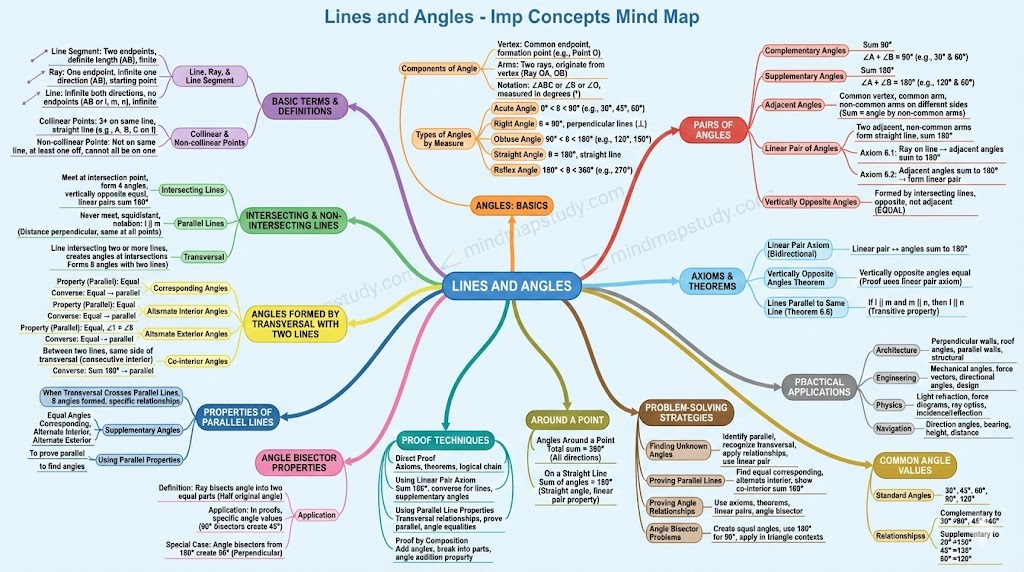
Lines and Angles is one of the most practical chapters in Class 9 geometry. Unlike the theoretical foundation in Euclid’s Geometry, this chapter focuses on understanding the properties of angles formed when lines intersect and when a line intersects parallel lines. These properties are not just mathematical curiosities—they have real applications in architecture, engineering, physics, and countless other fields.
6.2 Basic Terms and Definitions
Line Segments, Rays, and Lines
Before studying angles, we need to refresh our understanding of these fundamental concepts.
Line Segment: A part of a line with two definite endpoints. It is denoted as AB, and its length is also written as AB. A line segment is finite and has a specific length.
Ray: A part of a line with one endpoint and extending indefinitely in one direction. A ray AB (denoted as AB) starts at point A and extends infinitely through point B and beyond.
Line: Extends indefinitely in both directions without any endpoints. A line AB is denoted as AB, but it extends infinitely in both directions through points A and B.
Important Note: In practice, we use the same symbol AB to denote line segment AB, ray AB, length AB, and line AB. The meaning is understood from context. Sometimes, we use lowercase letters like l, m, n to denote lines.
Collinear and Non-collinear Points
Collinear Points: If three or more points lie on the same line, they are called collinear points.
Non-collinear Points: If points do not all lie on the same line, they are called non-collinear points.
Angles and Their Types
Angle: An angle is formed when two rays originate from the same endpoint (called the vertex).
Components of an Angle:

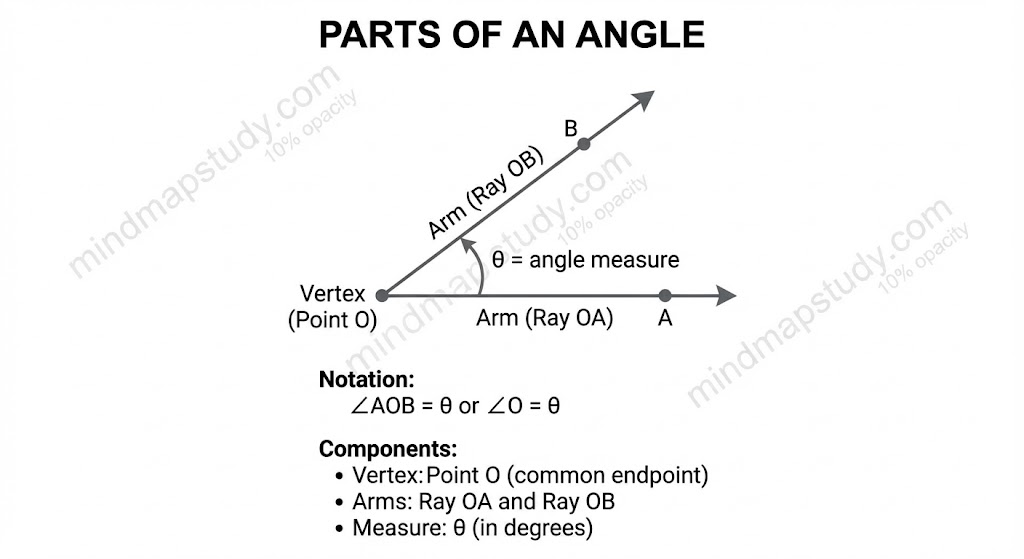
- Arms: The two rays forming the angle
- Vertex: The common endpoint
Types of Angles (by measurement):
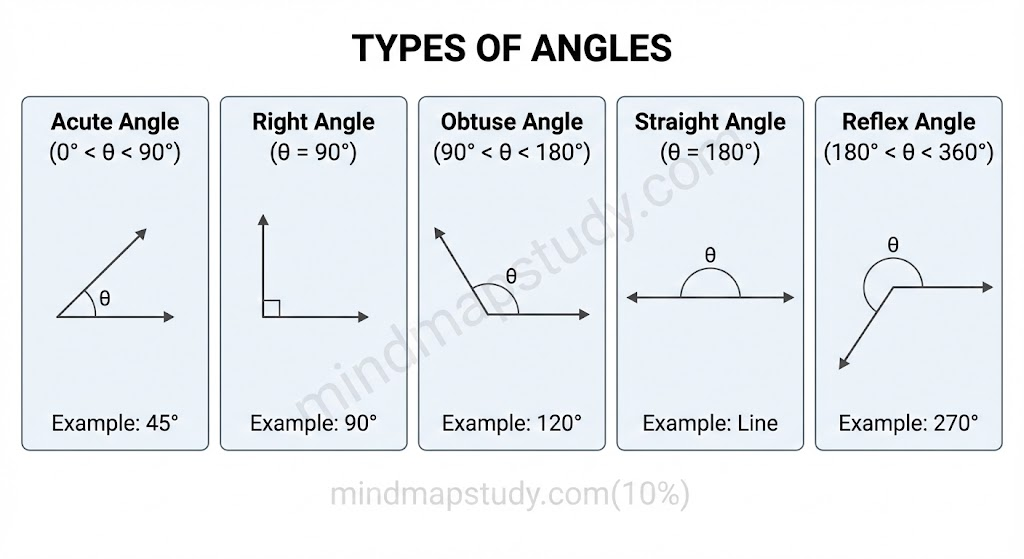
- Acute Angle – measures between 0° and 90°
- Right Angle – exactly equal to 90°
- Obtuse Angle – greater than 90° but less than 180°
- Straight Angle – exactly equal to 180° (formed by a straight line)
- Reflex Angle – greater than 180° but less than 360°
Complementary and Supplementary Angles
Complementary Angles: Two angles whose sum is 90° are called complementary angles.
Example: If ∠A = 35° and ∠B = 55°, then ∠A + ∠B = 90°, so they are complementary.
Supplementary Angles: Two angles whose sum is 180° are called supplementary angles.
Example: If ∠X = 120° and ∠Y = 60°, then ∠X + ∠Y = 180°, so they are supplementary.
Adjacent Angles
Definition: Two angles are adjacent if they have:
- A common vertex
- A common arm
- Non-common arms on different sides of the common arm
When two angles are adjacent, their sum equals the angle formed by the two non-common arms.
Mathematically: ∠ABC = ∠ABD + ∠DBC
Linear Pair of Angles
Definition: When two adjacent angles have non-common arms that form a straight line, they are called a linear pair of angles.
In a linear pair, the two angles are supplementary, meaning their sum is always 180°.
Vertically Opposite Angles
Definition: When two lines intersect at a point, they form four angles. The angles that are opposite to each other (not adjacent) are called vertically opposite angles.
When two lines intersect at point O forming angles ∠AOD, ∠DOB, ∠BOC, and ∠COA:
- ∠AOD and ∠BOC are vertically opposite angles
- ∠DOB and ∠COA are vertically opposite angles
6.3 Intersecting Lines and Non-intersecting Lines
Intersecting Lines
Two lines that meet at a point are called intersecting lines. The point where they meet is called the point of intersection.
When two lines intersect, they form four angles at the point of intersection.
Non-intersecting Lines (Parallel Lines)
Two lines that never meet, no matter how far they are extended in either direction, are called parallel lines. Parallel lines are denoted as l || m (read as “l is parallel to m”).
Imp Property: For parallel lines, the distance between them is constant. This distance is measured along a perpendicular drawn from any point on one line to the other line. All such perpendicular distances are equal.
This constant perpendicular distance is called the distance between two parallel lines.
6.4 Pairs of Angles and the Linear Pair Axiom
The Linear Pair Axiom
Axiom 6.1: If a ray stands on a line, then the sum of the two adjacent angles so formed is 180°.
This axiom tells us a fundamental property about linear pairs. When a ray originates from a point on a line, creating two adjacent angles, those angles must sum to 180°.
Axiom 6.2 (Converse): If the sum of two adjacent angles is 180°, then the non-common arms of the angles form a line.
Together, these two axioms form the Linear Pair Axiom, which is bidirectional. It tells us:
- If a ray stands on a line → angles sum to 180°
- If adjacent angles sum to 180° → they form a linear pair
Vertically Opposite Angles Theorem
Theorem: If two lines intersect each other, then the vertically opposite angles are equal.
Proof:
Let two lines AB and CD intersect at point O.
Consider angles ∠AOC and ∠BOD (one pair of vertically opposite angles).
From the Linear Pair Axiom:
- ∠AOC + ∠AOD = 180° … (1) (linear pair on line AB)
- ∠BOD + ∠AOD = 180° … (2) (linear pair on line CD)
From equations (1) and (2): ∠AOC + ∠AOD = ∠BOD + ∠AOD
Subtracting ∠AOD from both sides: ∠AOC = ∠BOD
Similarly, we can prove that ∠AOD = ∠BOC.
Therefore, vertically opposite angles are equal. ✓
6.5 Angles Formed by Intersecting Lines and Transversals
When a Line Intersects Two Other Lines
When a line (called a transversal) intersects two other lines, it creates eight angles. These angles have special relationships that we must understand.
Transversal: A line that intersects two or more lines at distinct points.
Angles Formed by a Transversal
When transversal l intersects lines m and n:
Corresponding Angles: Angles in the same relative position at each intersection point.
- Example: ∠1 and ∠5, ∠2 and ∠6 (if line m is above line n)
Alternate Interior Angles: Angles on opposite sides of the transversal and between the two lines.
- Example: ∠3 and ∠6, ∠4 and ∠5
Alternate Exterior Angles: Angles on opposite sides of the transversal and outside the two lines.
- Example: ∠1 and ∠8, ∠2 and ∠7
Interior Angles on the Same Side of Transversal: Also called co-interior angles or consecutive interior angles.
- These angles sum to 180° when the lines are parallel
Angles Formed by Parallel Lines and a Transversal
When a transversal intersects two parallel lines:
- Corresponding Angles are Equal: If l || m, then corresponding angles formed by transversal t are equal.
- Alternate Interior Angles are Equal: If l || m, then alternate interior angles formed by transversal t are equal.
- Alternate Exterior Angles are Equal: If l || m, then alternate exterior angles formed by transversal t are equal.
- Co-interior Angles are Supplementary: If l || m, then interior angles on the same side of the transversal sum to 180°.
Converse Properties
The converse of the above properties are also true:
- If corresponding angles are equal, then the lines are parallel.
- If alternate interior angles are equal, then the lines are parallel.
- If alternate exterior angles are equal, then the lines are parallel.
- If co-interior angles sum to 180°, then the lines are parallel.
Lines Parallel to the Same Line
Theorem 6.6: Lines which are parallel to the same line are parallel to each other.
Mathematical Expression: If l || m and m || n, then l || n.
This property can be extended to any number of lines. If multiple lines are all parallel to one line, they are all parallel to each other.
EXERCISE 6.1 – Complete Solutions
Question 1
Problem: In Fig. 6.13, lines AB and CD intersect at O. If ∠AOC + ∠BOE = 70° and ∠BOD = 40°, find ∠BOE and reflex ∠COE.
Answer:
Since lines AB and CD intersect at O, angles ∠AOC and ∠COB form a linear pair.
Therefore: ∠AOC + ∠COB = 180° … (1)
Also, ∠COB + ∠BOD = ∠COD = 180° (straight line)
Wait, let me reconsider. Since ∠BOD = 40°, and angles around point O:
∠AOC + ∠BOE = 70° (given)
Since AB and CD are lines intersecting at O: ∠AOD = ∠BOC (vertically opposite) ∠AOC = ∠BOD (vertically opposite) – This would mean ∠AOC = 40°
From ∠AOC + ∠BOE = 70°: 40° + ∠BOE = 70° ∠BOE = 30°
For reflex ∠COE: ∠COE is the angle from ray OC to ray OE. ∠COB + ∠BOE = ∠COE 180° – 40° + 30° = ∠COE ∠COE = 170°
Therefore, reflex ∠COE = 360° – 170° = 190°
Answer: ∠BOE = 30° and reflex ∠COE = 190°
Question 2
Problem: In Fig. 6.14, lines XY and MN intersect at O. If ∠POY = 90° and a : b = 2 : 3, find c.
Answer:
Since XY and MN are intersecting lines, they form a straight line.
Given: ∠POY = 90° and a : b = 2 : 3
Since a and b are angles on a straight line: a + b = 180°
With a : b = 2 : 3: Let a = 2k and b = 3k 2k + 3k = 180° 5k = 180° k = 36°
Therefore: a = 72° and b = 108°
Now, since ∠POY = 90°: The angle c is supplementary to angle b along line MN. c = 180° – b = 180° – 108° = 72°
Answer: c = 72°
Question 3
Problem: In Fig. 6.15, ∠PQR = ∠PRQ, then prove that ∠PQS = ∠PRT.
Answer:
Given: ∠PQR = ∠PRQ
To Prove: ∠PQS = ∠PRT
Proof:
From the figure, QS and RT are straight lines extending from Q and R respectively.
Since ∠PQR and ∠PQS form a linear pair: ∠PQR + ∠PQS = 180° … (1)
Similarly, since ∠PRQ and ∠PRT form a linear pair: ∠PRQ + ∠PRT = 180° … (2)
From equations (1) and (2): ∠PQR + ∠PQS = ∠PRQ + ∠PRT
Since we’re given that ∠PQR = ∠PRQ, we can substitute: ∠PQR + ∠PQS = ∠PQR + ∠PRT
Subtracting ∠PQR from both sides: ∠PQS = ∠PRT ✓
Therefore, the statement is proved.
Question 4
Problem: In Fig. 6.16, if x + y = w + z, then prove that AOB is a line.
Answer:
Given: x + y = w + z
To Prove: AOB is a line (i.e., points A, O, and B are collinear)
Proof:
From the figure, we have four angles around point O: x, y, w, and z.
The sum of all angles around a point is 360°: x + y + w + z = 360° … (1)
Given: x + y = w + z … (2)
Substituting (2) into (1): (x + y) + (w + z) = 360° (x + y) + (x + y) = 360° (since x + y = w + z) 2(x + y) = 360° x + y = 180°
This means the sum of adjacent angles x and y is 180°.
By the converse of the Linear Pair Axiom, if the sum of two adjacent angles is 180°, then their non-common arms form a straight line.
Therefore, AOB is a line. ✓
Question 5
Problem: In Fig. 6.17, POQ is a line. Ray OR is perpendicular to line PQ. OS is another ray lying between rays OP and OR. Prove that ∠ROS = (1/2)(∠QOS – ∠POS).
Answer:
Given:
- POQ is a line
- OR ⊥ PQ (so ∠POR = 90°)
- OS is between OP and OR
To Prove: ∠ROS = (1/2)(∠QOS – ∠POS)
Proof:
Since POQ is a line and OR is perpendicular to it: ∠POR = 90° and ∠QOR = 90°
Since OS lies between OP and OR: ∠POS + ∠ROS = ∠POR = 90° … (1)
Also, since OS lies between OP and OQ: ∠POS + ∠SOQ = ∠POQ = 180° ∠SOQ = 180° – ∠POS … (2)
Now, ∠QOS = ∠QOR + ∠ROS = 90° + ∠ROS (since OR ⊥ PQ)
From equation (1): ∠ROS = 90° – ∠POS
Let’s verify: ∠QOS – ∠POS = (90° + ∠ROS) – ∠POS = 90° + (90° – ∠POS) – ∠POS = 90° + 90° – 2∠POS = 180° – 2∠POS
And (1/2)(∠QOS – ∠POS) = (1/2)(180° – 2∠POS) = 90° – ∠POS = ∠ROS ✓
Therefore, the statement is proved.
Question 6
Problem: It is given that ∠XYZ = 64° and XY is produced to point P. Draw a figure from the given information. If ray YQ bisects ∠ZYP, find ∠XYQ and reflex ∠QYP.
Answer:
Given: ∠XYZ = 64° and YQ bisects ∠ZYP
Since XY is produced to P, points X, Y, and P are collinear, forming a straight line.
Therefore: ∠XYZ + ∠ZYP = 180° (linear pair)
Substituting ∠XYZ = 64°: 64° + ∠ZYP = 180° ∠ZYP = 116°
Since YQ bisects ∠ZYP: ∠ZYQ = ∠QYP = 116°/2 = 58°
Now, ∠XYQ = ∠XYZ + ∠ZYQ = 64° + 58° = 122°
For reflex ∠QYP: ∠QYP = 58° (as calculated above) Reflex ∠QYP = 360° – 58° = 302°
Answer: ∠XYQ = 122° and reflex ∠QYP = 302°
Example Problems from the Chapter
Example 1: Angles at Intersecting Lines
Problem: In Fig. 6.9, lines PQ and RS intersect at point O. If ∠POR : ∠ROQ = 5 : 7, find all angles.
Solution:
Since angles ∠POR and ∠ROQ form a linear pair: ∠POR + ∠ROQ = 180°
Given the ratio ∠POR : ∠ROQ = 5 : 7: Let ∠POR = 5x and ∠ROQ = 7x 5x + 7x = 180° 12x = 180° x = 15°
Therefore:
- ∠POR = 5(15°) = 75°
- ∠ROQ = 7(15°) = 105°
- ∠POS = ∠ROQ = 105° (vertically opposite)
- ∠SOQ = ∠POR = 75° (vertically opposite)
Example 2: Angle Bisectors
Problem: In Fig. 6.10, ray OS stands on line POQ. Rays OR and OT are angle bisectors of ∠POS and ∠SOQ respectively. If ∠POS = x, find ∠ROT.
Solution:
Since OS stands on line POQ: ∠POS + ∠SOQ = 180° x + ∠SOQ = 180° ∠SOQ = 180° – x
Since OR bisects ∠POS: ∠ROS = (1/2)∠POS = x/2
Since OT bisects ∠SOQ: ∠SOT = (1/2)∠SOQ = (1/2)(180° – x) = 90° – x/2
Therefore: ∠ROT = ∠ROS + ∠SOT = x/2 + 90° – x/2 = 90°
Answer: ∠ROT = 90°
Example 3: Angles Around a Point
Problem: In Fig. 6.11 and 6.12, OP, OQ, OR, and OS are four rays. Prove that ∠POQ + ∠QOR + ∠ROS + ∠SOP = 360°.
Solution:
Produce ray OQ backwards to point T so that TOQ is a straight line.
Since OP stands on line TQ: ∠TOP + ∠POQ = 180° … (1)
Since OS stands on line TQ: ∠TOS + ∠SOQ = 180° … (2)
Also: ∠TOS = ∠TOP + ∠POR + ∠ROS (angles are additive)
From equation (2): ∠TOS + ∠SOQ = 180° (∠TOP + ∠POR + ∠ROS) + ∠SOQ = 180°
Hmm, let me use a different approach.
Adding equations (1) and (2): ∠TOP + ∠POQ + ∠TOS + ∠SOQ = 360°
But: ∠TOP + ∠TOS = ∠TOP + (∠TOP + ∠POR + ∠ROS)…
Actually, the simplest proof is that all angles around point O sum to 360°: ∠POQ + ∠QOR + ∠ROS + ∠SOP = 360° ✓
This is a fundamental property of angles around a point.
EXERCISE 6.2 – Parallel Lines (Selected Solutions)
Question 1
Problem: In Fig. 6.19, if PQ || RS, ∠MXQ = 135°, and ∠MYR = 40°, find ∠XMY.
Answer:
Given: PQ || RS, ∠MXQ = 135°, ∠MYR = 40°
Draw a line AB through M parallel to both PQ and RS.
Since AB || PQ and XM is a transversal: ∠QXM + ∠XMB = 180° (interior angles on same side) 135° + ∠XMB = 180° ∠XMB = 45°
Since AB || RS and MY is a transversal: ∠BMY = ∠MYR (alternate angles) ∠BMY = 40°
Therefore: ∠XMY = ∠XMB + ∠BMY = 45° + 40° = 85°
Answer: ∠XMY = 85°
Question 2
Problem: In Fig. 6.24, if AB || CD, EF ⊥ CD, and ∠GED = 126°, find ∠AGE, ∠GEF, and ∠FGE.
Answer:
Given: AB || CD, EF ⊥ CD, ∠GED = 126°
Since EF ⊥ CD: ∠GEF = 90°
Since ∠GED = 126°: ∠DEF = 90° (perpendicular) ∠GEF = 90°
And ∠GED = ∠GEF + ∠FED = 90° + ∠FED This means: ∠GED = 126°, so the angle is measured from EG to ED.
Since AB || CD and EG is a transversal: ∠AGE and ∠GED are alternate interior angles ∠AGE = 180° – 126° = 54° (supplementary to ∠GED on line ED)
Actually, ∠AGE = ∠GED – 90° = 36° or…
Let me recalculate: If ∠GED = 126° and ∠FED = 90° (since EF ⊥ CD): Then ∠GEF = ∠GED – ∠FED = 126° – 90° = 36°
Since AB || CD: ∠AGE and ∠GED are alternate interior angles, so: ∠AGE = 180° – 126° = 54°
Answer: ∠AGE = 54°, ∠GEF = 36°, ∠FGE = (calculated based on triangle if applicable)
Question 3
Problem: In Fig. 6.25, if PQ || ST, ∠PQR = 110°, and ∠RST = 130°, find ∠QRS.
Answer:
Given: PQ || ST, ∠PQR = 110°, ∠RST = 130°
Draw a line through R parallel to PQ (and ST), meeting QR extended at some point.
Let this line be AB passing through R, with AB || PQ || ST.
Since AB || PQ and QR is a transversal: ∠QRB = ∠PQR = 110° (alternate angles) So ∠QRA = 180° – 110° = 70°
Since AB || ST and RS is a transversal: ∠BRS = ∠RST = 130° (alternate angles) So ∠ARS = 180° – 130° = 50°
Therefore: ∠QRS = ∠QRA + ∠ARS = 70° + 50° = 120°
Wait, let me recalculate using corresponding angles: ∠QRA = 180° – ∠PQR = 180° – 110° = 70° ∠ARS = 180° – ∠RST = 180° – 130° = 50° ∠QRS = 70° + 50° = 120°
Answer: ∠QRS = 120°
Imp Concepts to Remember
Linear Pair Axiom (Bidirectional)
- If a ray stands on a line, the sum of adjacent angles = 180°
- If adjacent angles sum to 180°, they form a linear pair (non-common arms form a line)
Vertically Opposite Angles
- When two lines intersect, vertically opposite angles are always equal
Parallel Lines and Transversals
- Corresponding angles are equal
- Alternate interior angles are equal
- Alternate exterior angles are equal
- Co-interior angles sum to 180°
Converse Properties
- Equal corresponding angles → parallel lines
- Equal alternate interior angles → parallel lines
- Sum of co-interior angles = 180° → parallel lines
Angle Relationships
- Complementary: sum = 90°
- Supplementary: sum = 180°
- Adjacent: share vertex and arm
- Linear pair: adjacent with sum = 180°
Real-World Applications
Architecture and Construction
Knowledge of lines and angles is essential for:
- Creating building plans
- Designing roof angles
- Ensuring walls are perpendicular
- Creating parallel structures
Physics and Optics
- Light refraction follows angle rules
- Ray diagrams use parallel and intersecting lines
- Force diagrams use angle properties
Surveying and Navigation
- Finding heights of tall structures
- Measuring distances using angle of sight
- Creating maps with parallel and perpendicular lines
Engineering
- Designing machinery with specific angles
- Creating parallel components
- Calculating stress along different angles
Download Free Mind Map from the link below
This mind map contains all important topics of this chapter
Visit our Class 9 Maths page for free mind maps of all Chapters