
1. Introduction
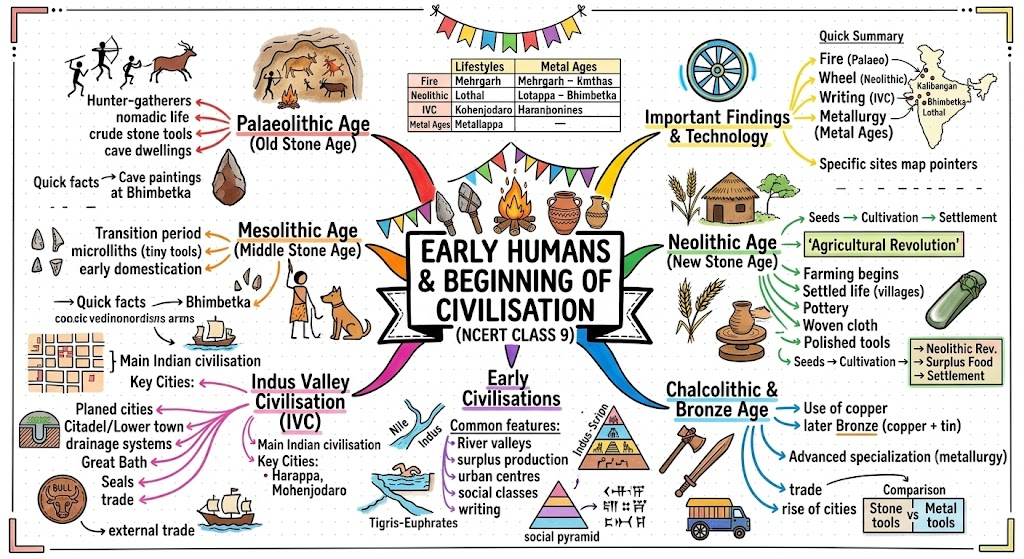
Human history stretches back millions of years before kingdoms and empires ever existed. This chapter takes you all the way back to explore who our earliest ancestors were, where they evolved, what they ate, how they lived, and how they gradually became what we are today.
The period before writing was invented is understood mostly through archaeological evidence, because written languages appeared at different times in different parts of the world.
2. The Invention of Writing — Before and After
Understanding what changed with the invention of writing helps us appreciate why it matters so much in the study of history.
| Aspect | Before Writing | After Writing |
|---|---|---|
| Human History | More than 99% of human history (from about 3 million years ago to 5000 years ago) | Less than 1% of human history, the last 5000 years including the present |
| Main Source for Reconstruction | Tools, implements, and other material objects (artefacts) | Both material remains and written documents |
| Lives of the People | Difficult to understand thoughts and ideas of people | Literature provides information about names, events, social, political, and cultural life |
| Measurement of Time | Approximate only | Relatively accurate, as written documents mention specific dates |
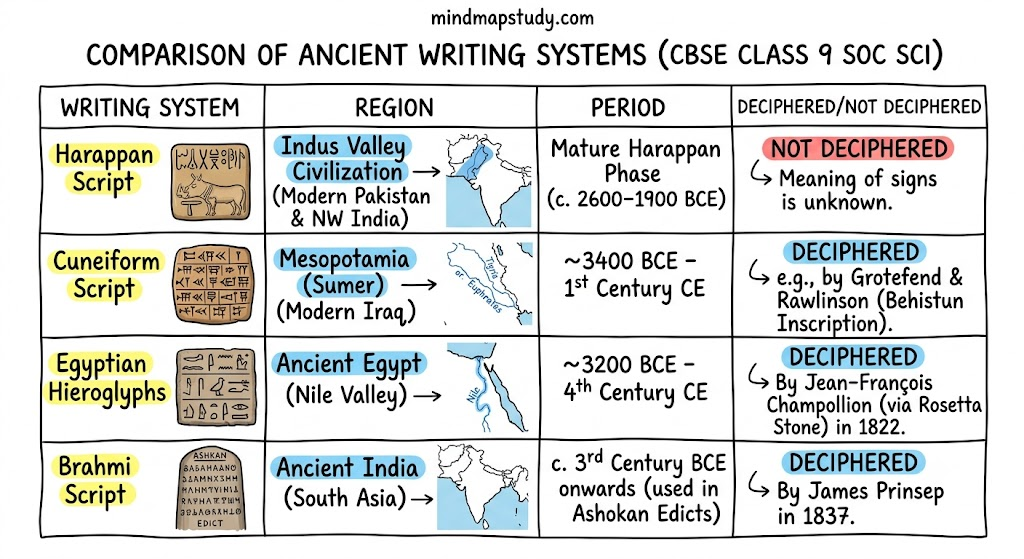
3. Early Writing Systems
Several writing systems developed independently across the world.
- Harappan Script (Sindhu Lipi): Found on seals and pottery of the Sindhu–Sarasvatī (Indus Valley / Harappan) Civilisation. It is a pictographic script that has not yet been deciphered.
- Cuneiform Script: Developed by the Sumerians of Mesopotamia. It has been deciphered and marks the beginning of the historical period, about 5000 years ago.
- Hieroglyphic Script: Developed in ancient Egypt, also deciphered, contemporary with the Harappan Civilisation.
- Brahmi Script: Used from about 400 BCE in parts of southern India and the Ganga Valley. It was later formalised by Emperor Ashoka in the 3rd century BCE.
4. Why Should We Study Early Human History?
Studying early human history helps us understand two important processes:
Biological Evolution refers to the gradual physical and genetic changes through which our early ancestors, known as australopithecines (australis = southern; pithecus = primates), evolved into modern human beings called Homo sapiens.
Cultural Evolution explains how humans adapted to their surroundings during the Quaternary Period (the last 26 lakh years, including the present). To survive changing climatic and environmental conditions, humans developed tools, techniques, and technology to use natural resources.
Over time, human ways of life changed from hunting and gathering to agriculture and food production. The ability to produce surplus food and material goods laid the foundation for the emergence of civilisation.
5. Who Were Our Human Ancestors?
The earliest human settlements were found in Africa, Asia, and Europe — together known as the ‘Old World’.
Around 3.3 million years ago, one of the early ancestors made the earliest stone tools. This marked the beginning of what we call ‘human behaviour’, distinguishing humans from animals who cannot make such tools. Human beings came to be known as hominins, or tool makers.
Tools are sometimes called extra-corporal limbs because they work as extensions of the human body. These discarded tools got buried in the earth and turned into fossils over thousands or millions of years.
Imp Terms:
- Fossil: Preserved remains, traces, or impressions of plants, animals, or humans from the distant past, formed when remains get buried under layers of earth and slowly turn to stone.
- Hominin: A group that includes modern humans and our early human-like ancestors.
- Homo erectus: An upright or bipedal human ancestor.
- Old World: Geographical area of the oldest human settlements of the earliest palaeolithic period.
The Evolutionary Sequence
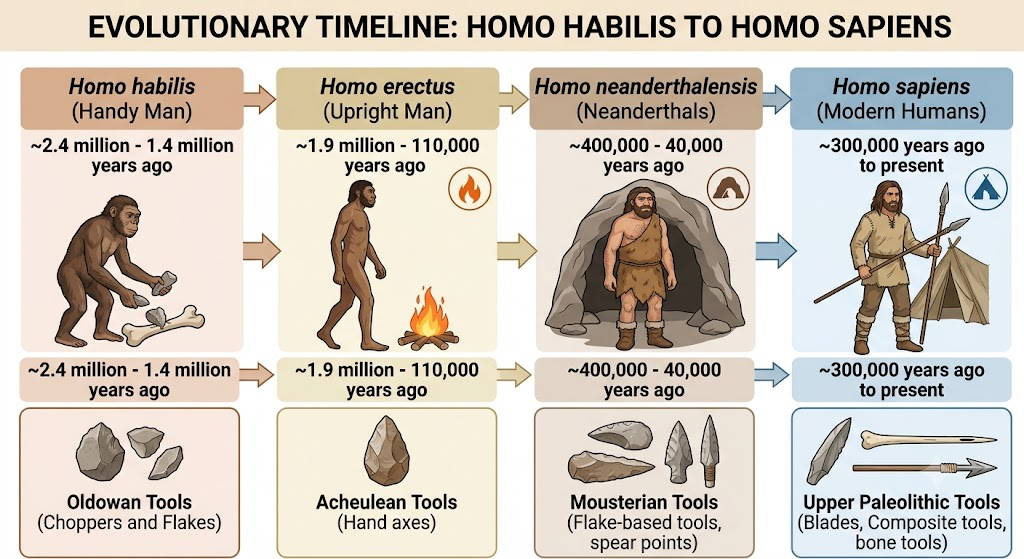
| Species | Where They Lived | Time Period | Tools Made |
|---|---|---|---|
| Homo habilis | Olduvai Gorge, Tanzania and Kenya | 2–6 million years ago | Chopper stone tools |
| Homo erectus | Eastern African Rift Valley | 2 million years ago | Handaxes and cleavers |
| Homo neanderthalensis | Europe and Southwest Asia | Till about 40,000 years ago | Middle Palaeolithic flake tools |
| Homo sapiens | Spread all over the world | 300,000 years ago to present | Complex technologies |
Imp facts about migration out of Africa:
- Homo erectus was the first hominin to exit Africa, around 2 million years ago. Their tools have been found in Asia and Europe.
- Another major wave of migration happened around 125,000 years ago, associated with early Homo sapiens.
- Homo sapiens evolved in Africa around 300,000 years ago and are now spread all over the earth.
6. How Do We Know About Our Ancestors?
Archaeologists explore early human sites to uncover clues such as tools, bones, and other objects left behind by our early ancestors. Each clue helps build a picture of how people lived long ago. To better understand these clues, archaeologists also experiment by making and using similar tools.
7. Periods in Early Human History
Early human history is divided into distinct periods based on technological progress, development and use of tools, the beginning of agriculture, and changes in human lifestyle and settlement patterns.
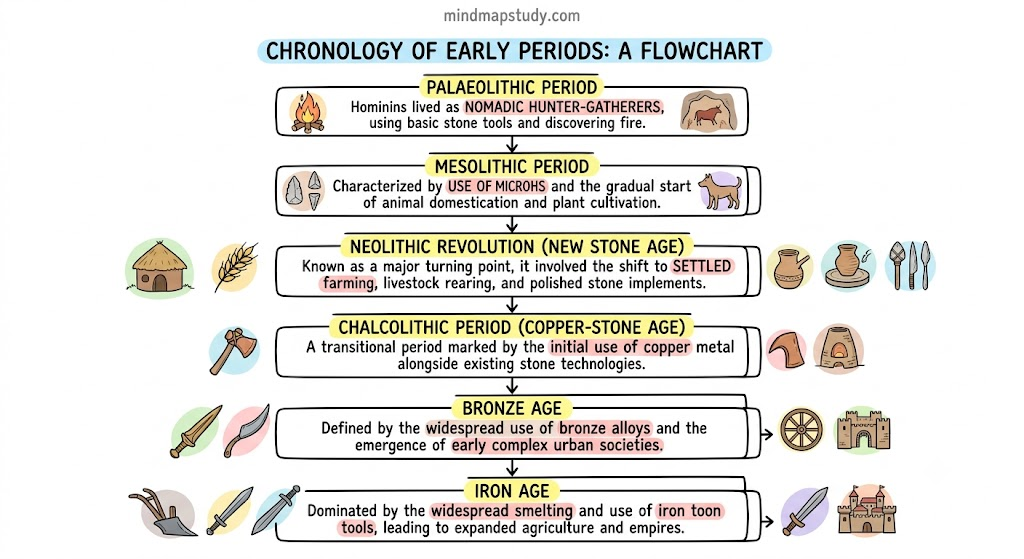
| Period | Also Known As | Imp Features |
|---|---|---|
| Palaeolithic | Old Stone Age | Hunting-gathering lifestyle; simple stone tools |
| Mesolithic | Middle Stone Age | Microlithic (tiny stone) tools; transitional phase between hunting-gathering and agriculture |
| Neolithic | New Stone Age | Shift to agriculture; domestication of animals; polished stone tools |
| Chalcolithic | Copper and Stone Age | Use of copper along with stone tools; early metallurgy |
| Bronze Age | — | Development of bronze metallurgy; expansion of trade, towns, and early civilisations |
| Iron Age | — | Widespread use of iron; stronger tools and weapons; more advanced societies |
8. Palaeolithic Hunter-Gatherers
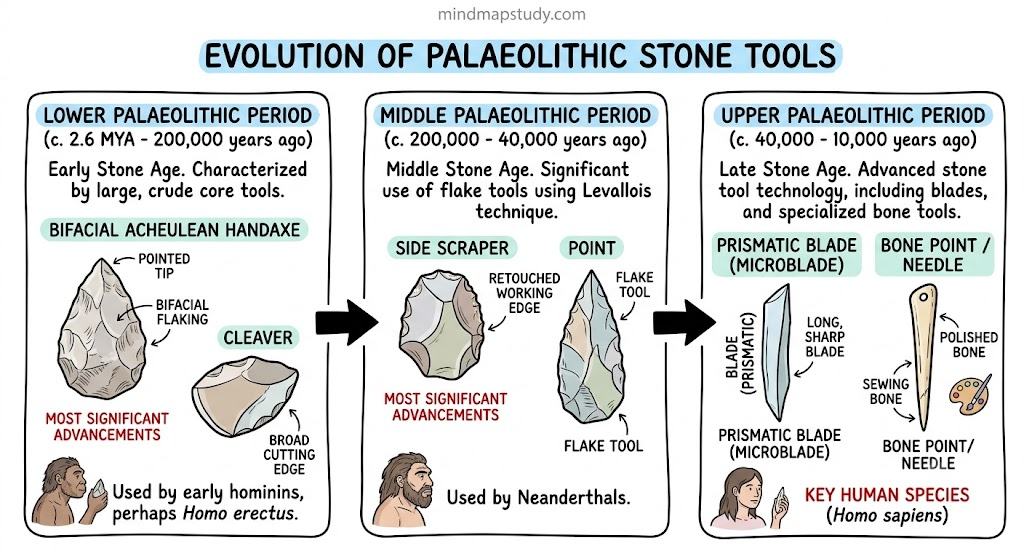
The Stone Age is broadly divided into three stages — Palaeolithic, Mesolithic, and Neolithic. Palaeo means ‘old’ and lithic means ‘stone’, so the Palaeolithic period is also the Old Stone Age.
In the Indian Subcontinent:
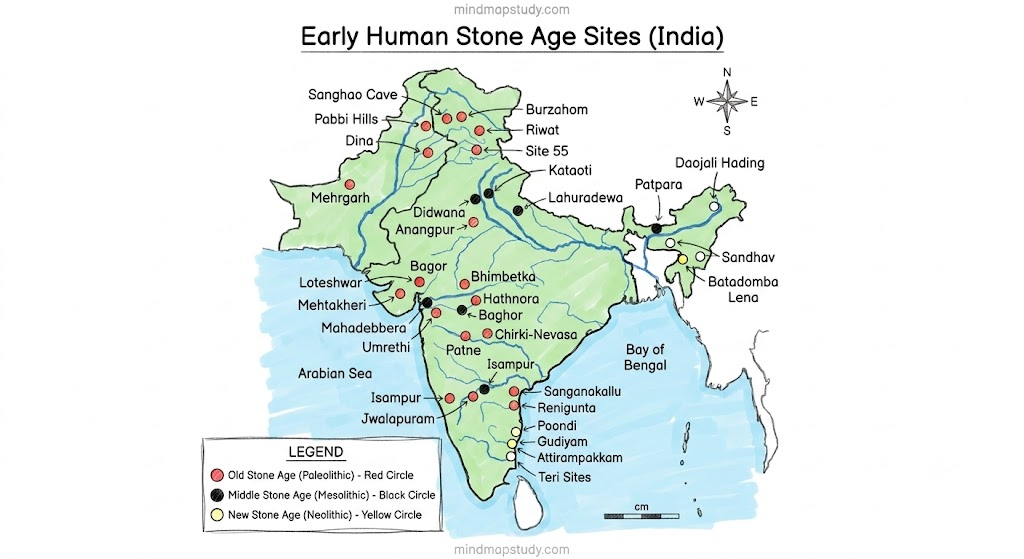
- The oldest human settlement in India dates to about 2 million years ago.
- Attirampakkam in Tamil Nadu is dated to about 1.5–1.7 million years ago.
- Isampur in Karnataka is dated to 1.2 million years ago.
- At these sites, animal fossils and large cutting tools including handaxes, cleavers, scrapers, and choppers made of quartzite and limestone have been found.
- These tools were used to chop animal meat, dig tubers, scrape animal skin, and cleave bones to extract protein-rich marrow.
Progress in Tool Making:
- Later tools included scrapers, borers, and points — indicating improved efficiency in hunting.
- Humans eventually invented the bow and arrow and microblade tools made from glassy rocks.
- They also developed symbolic communication, decorated cave walls and rock shelters with paintings, used pigments on their bodies, and produced beads of stone, bone, and shell.
- A tool called a burin or engraver was used to engrave symbolic features on bones and shells.
9. Mesolithic Hunter-Gatherers
Around 12,000 years ago, Earth’s climate became warmer, leading to significant environmental changes. Forests and grasslands expanded into areas previously covered by ice sheets.
Imp changes during Mesolithic period:
- New landscapes offered a wider variety of resources — small game animals, fish, and edible wild grains.
- The world saw the first-ever population explosion in human history.
- Microlithic tools enabled people to gather aquatic food — both marine and freshwater.
- Fishing became the main source of livelihood.
- Art activity flourished and caves and rock shelters were frequently occupied.
- The World Heritage Site of Bhimbetka in Madhya Pradesh contains hundreds of painted rock shelters with Mesolithic and earlier human occupation.
10. The Neolithic Revolution
As hunter-gatherers gained familiarity with seasons and food resources, there was a gradual shift to a food-producing way of life, also called the Neolithic Revolution.
Imp features of the Neolithic Revolution:
- Hallmark: Domestication of select animals and plants, bringing them under human control.
- Development of new breeds through cultivation and husbandry.
- Neolithic farmers made tools for food production and processing (not just procuring food).
- They developed earthenware pottery in various shapes and sizes.
- They utilised raw materials and resources, and established the first village settlements, laying the foundations for the urban revolution.
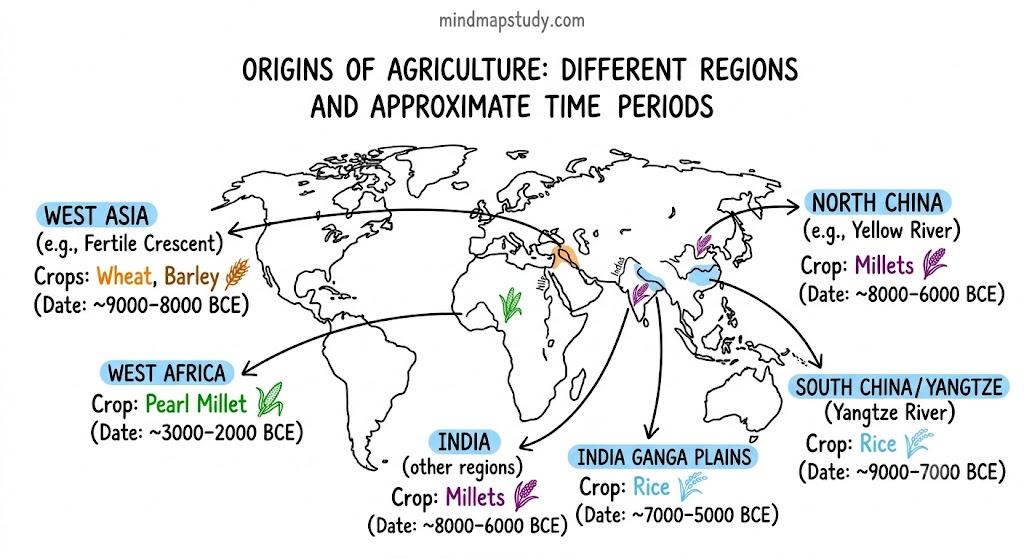
This transition did not happen at the same time everywhere. Different regions shifted to farming at different periods.
10.1 Neolithic Period in the Indian Subcontinent
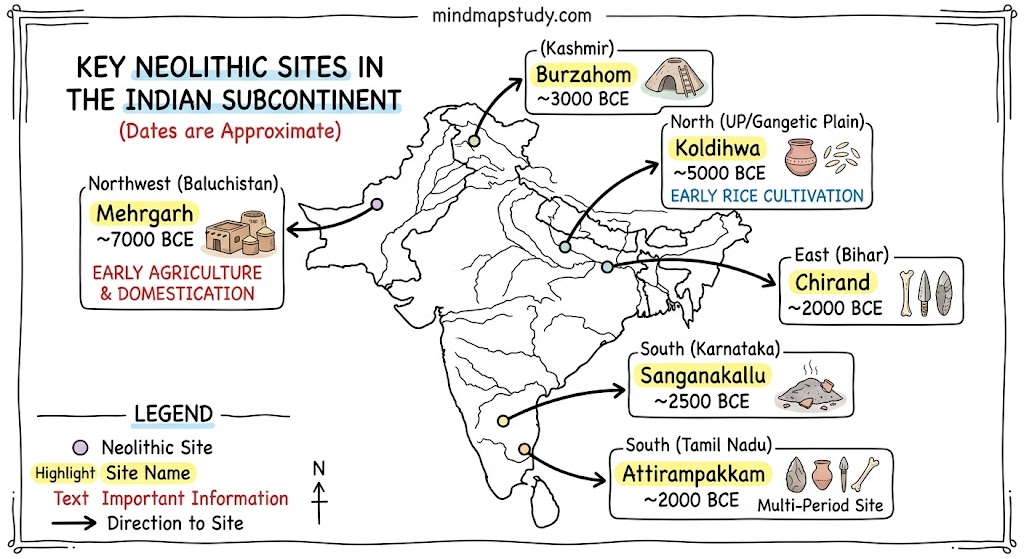
- The site of Mehrgarh on the Bolan River (present-day Pakistan) is the oldest Neolithic site in the Indian subcontinent and the earliest agricultural village, dating to about 7000 BCE.
- Its people built handmade sun-dried brick houses and granaries, buried their dead in graves, and made ornaments from semi-precious stones such as lapis lazuli, carnelian, and shells.
- They cultivated wheat and barley, and raised sheep, goats, and the zebu humped bull.
- They were the first to make copper objects, becoming known as the Chalcolithic people by about 4000 BCE.
- This laid the basis for the Bronze Age Sindhu–Sarasvatī civilisation around 3500 BCE.
- By 2500 BCE, most of the Indian subcontinent was occupied by Neolithic agricultural communities.
11. Sindhu-Sarasvatī Civilisation
The Neolithic way of life that emerged around 7000 BCE at Mehrgarh spread through the middle and upper Indus Valley and further east. Some settlements mastered copper extraction around 4000 BCE, becoming the earliest Chalcolithic sites in the subcontinent.
Imp features:
- Copper tools introduced in the Indus and Ghaggar-Sarasvatī plains enhanced agricultural productivity and prosperity.
- Large-scale pottery production with diverse regional styles developed.
- Some radio-carbon dates suggest that at sites like Bhirrana and Kunal, the Pre-Harappan phase began between 7000 and 5500 BCE.
- By about 2500 BCE, regional styles became standard features of the Sindhu–Sarasvatī civilisation — this stage is called Early Harappan.
- Continuity in pottery traditions, stone beads, shell bangles, terracotta objects, and copper working is seen.
- Developments such as perimeter walls, use of seals, and the Harappan script probably began in the Early Harappan stage.
Harappan Arts and Crafts:
- The Harappans practised arts and crafts extensively — pottery was a major craft product.
- Other crafts: copper work, shell work, and semi-precious stone beads.
- The Harappans had their own standard system of weights and measurement — a binary multiple system (1, 2, 4, 8, 16, etc.) for smaller units and multiples of ten for larger denominations.
- Cubical stone weights have been found at several sites.
- Early Harappans at Kalibangan ploughed fields with horizontal and vertical furrows, indicating double crop cultivation — similar to today’s seasonal Rabi and Kharif cultivation.
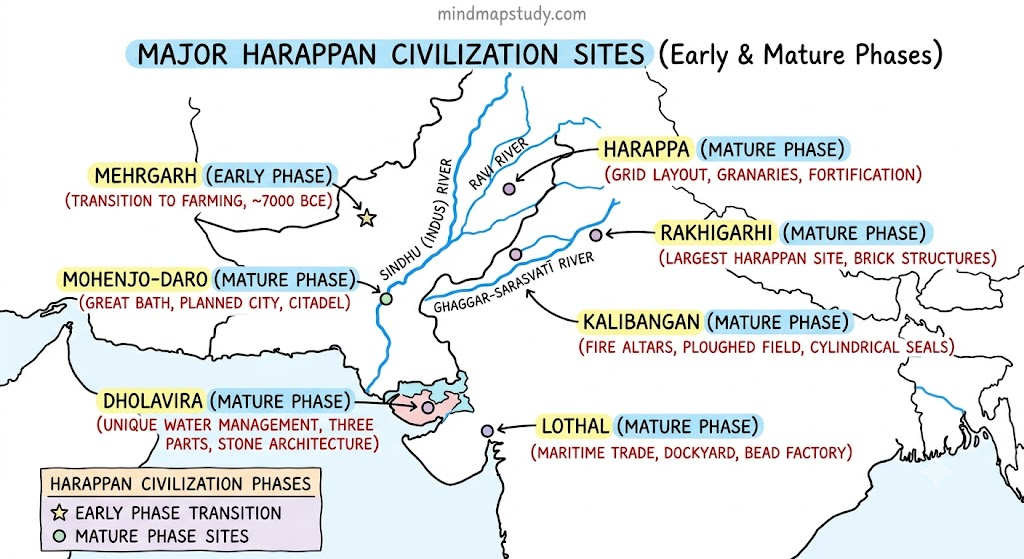
Timeline of the Harappan Civilisation:
| Phase | Period |
|---|---|
| Neolithic | 7000 BCE |
| Chalcolithic | 4500 BCE |
| Bronze Age | 3300 BCE |
| Early Harappan | From 3300 BCE |
| Mature Harappan | 2600 BCE – 1900 BCE |
| Late Harappan | Up to 1300 BCE |
12. Bronze Age Civilisations Outside India
Four early world civilisations emerged in river plains:
| Civilisation | River(s) | Region |
|---|---|---|
| Harappan (Sindhu-Sarasvatī) | Sindhu and Sarasvatī | Indian Subcontinent |
| Mesopotamian | Euphrates and Tigris | West Asia |
| Egyptian | Nile | Africa |
| Chinese | Huang He (Yellow River) and Yangtze | East Asia |
Geographically, Mesopotamia and the Indus and Ghaggar-Sarasvatī valleys are closer to each other, which facilitated strong contacts and trade between them. The Egyptian and Chinese civilisations had little tangible evidence of direct contact with the Sindhu–Sarasvatī civilisation.
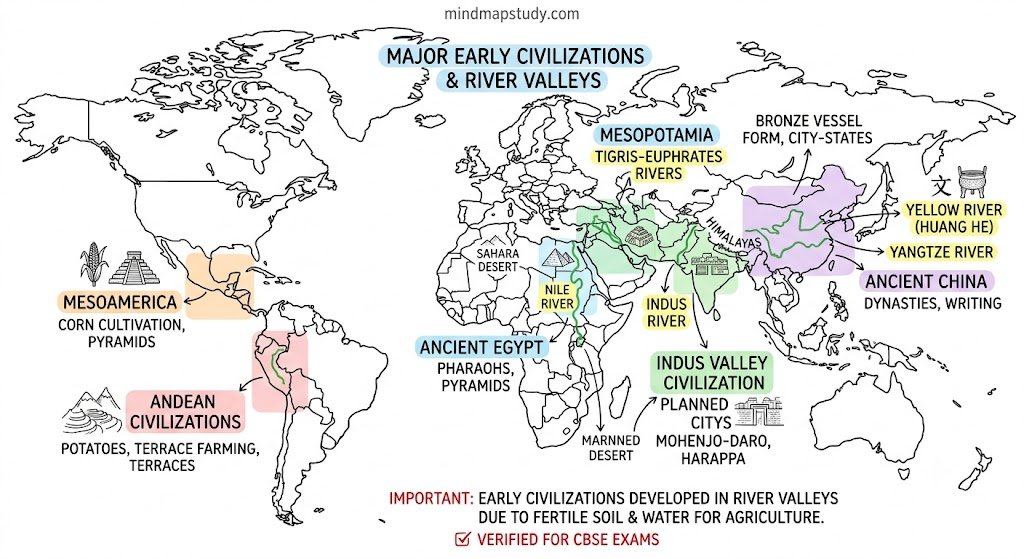
13. Mesopotamian Civilisation
Mesopotamia means “the land in between” in Greek — the land drained by the Euphrates and Tigris rivers in West Asia. In modern times, this region includes mainly Iraq and Kuwait, with parts of Turkey and southwestern Iran.
The crescent-shaped foothills of the Zagros and Taurus mountains, stretching from the Mediterranean to the Persian Gulf, are known as the ‘Fertile Crescent’ due to high agricultural potential.
- Farming began here 12,000 years before the present.
- Copper tools arrived around 4500 BCE, improving agriculture and trade.
- Over the next 2000 years, large cities became city-states by developing governing systems.
City-State: A sovereign state centred around a city that rules the surrounding territories.
Four major city-based civilisations from 3500 BCE onwards in Mesopotamia:
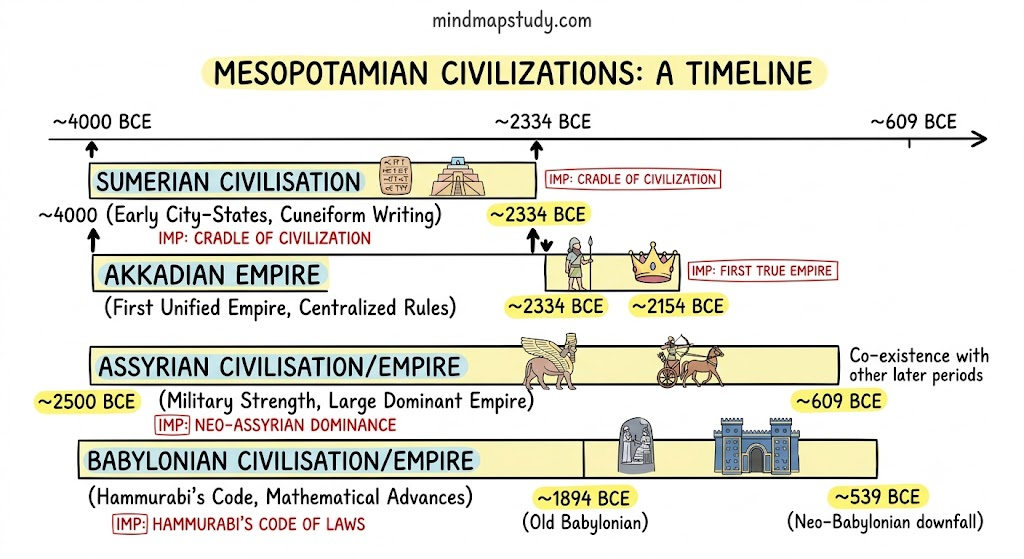
13.1 The Sumerians
- The Sumerian civilisation was the earliest city-based civilisation at Ur and other cities in Sumer (present-day southern Iraq).
- First to build a system of dams and canals for irrigation.
- First to use mud bricks and burnt bricks in construction of houses, defensive walls, and other structures.
- Worshipped multiple gods, believed to have power over natural forces such as floods and winds.
- Each city built a grand temple called a ziggurat for its chief god, and the city grew around it.
Ziggurat: A tower-like stepped pyramid-shaped temple with several floors. The top was a holy place. The surrounding area contained palaces and royal storehouses. It also served as the city’s treasury.
- All economic activities — agriculture, trade, transport of goods — were tied to the temple authority.
- Entry to the sacred temple was restricted to high priests and priestesses, reflecting a clear division of social hierarchy.
- Cities were large settlements where kings lived in grand palaces and people lived in small brick houses.
- Crafts like metalworking, pottery, and textiles were practised alongside farming.
Other Sumerian achievements:
- Invented the wheeled cart and sailboat.
- Used calculations for building structures and measuring agricultural fields.
- Their number system was based on 60 — the concepts of the 60-minute hour, 60-second minute, and the 360-degree circle were invented by the Sumerians.
The Beginning of Writing:
- The Sumerians were the first to start writing around 3300 BCE.
- Their writing system is called cuneiform, from the Latin word cuneus meaning ‘wedge’, because it was written by pressing a wedge-shaped stylus into soft clay tablets.
- Cuneiform consists of hundreds of marks pressed onto damp clay using sharp wedge-shaped reeds.
- Scribes enjoyed high social status.
- By 3000 BCE, cuneiform was widely used all over Mesopotamia by different city-states.
- Cuneiform tablets reveal myths, epics, hymns, law codes, educational treatises, and records of farming and craft activities.
13.2 The Akkadians
- In 2334 BCE, the power of the Sumerians was overshadowed by the emergence of the city of Akkad in central Mesopotamia.
- People spoke Akkadian, a different language from Sumerian, but both used the same cuneiform script.
- Akkadian records document the establishment of the world’s first dynastic empire.
- Akkadian king Sargon’s cuneiform tablets mention trade with Dilmun, Magan, and Meluhha.
- Meluhha is generally identified with the Sindhu–Sarasvatī civilisation.
- Dilmun and Magan are today’s Bahrain and Oman.
- Trade goods included semiprecious stone beads, ivory, timber, gold dust, and probably copper.
13.3 The Assyrians
- The Akkadian empire lost supremacy around 2154 BCE to a new city-state, Assur, in northern Mesopotamia.
- The Assyrian civilisation lasted till early 1700 BCE.
- Assyrian dominance spread across Mesopotamia and over neighbouring regions in the west and south.
13.4 The Babylonians
- Babylonia gained dominance in central Mesopotamia from 1900 BCE onwards.
- Babylonia’s most significant ruler was Hammurabi (from 1792 BCE), who compiled rules and regulations for civil and social conduct known as the Code of Hammurabi — a foundational model for many future legal systems.
- By the end of 1400 BCE, the Babylonians had lost prominence due to attacks by the Hittites and other rising powers.
Hittites: Indo-European people who established a powerful empire in Anatolia (modern-day Turkey) around the second millennium BCE.
14. Egyptian Civilisation
Egyptian civilisation is one of the earliest civilisations of the world, known for its rich historical records and lasting influence on other civilisations. Egyptian history is reconstructed from papyrus records.
Papyrus: Made by cutting the inner trunk of the papyrus plant into strips, criss-crossing, pressing, drying, and polishing them into sheets.
Timeline of Egyptian Civilisation:
| Phase | Period |
|---|---|
| Neolithic | 5500 BCE |
| Chalcolithic | 4000 BCE |
| Bronze Age | 3100 BCE |
| Old Kingdom | 2686 BCE – 2181 BCE |
| Middle Kingdom | 2030 BCE – 1650 BCE |
| New Kingdom | 1570 BCE – 1069 BCE |
Imp features of Egyptian Civilisation:
- Egypt saw the emergence of city-states around 3000 BCE.
- The River Nile watered the land along its banks and flooded every summer, leaving rich mud called kemet (meaning ‘the black’), excellent for growing crops.
- About 5000 years ago, farmers dug ditches to divert Nile water into their fields. By counting days between floods, the Egyptians developed a calendar.
- The Egyptian calendar has three seasons — Inundation (autumn), Peret/growing (winter), and Shemu/harvest (summer). It is based on the rising of Sirius (the Dog Star) and has 365 days.
- Collective efforts to dig ditches and construct dams led to the growth of local government.
Libraries and Literature:
- Libraries dating back to 2000 BCE stored papyrus scrolls in labelled jars.
- One jar contained the oldest version of the story of ‘Sindbad the Sailor’.
- Short stories included animal fables (linked to ‘Aesop’s Fables’), tales of ghosts, miracles, romances, and even the oldest known form of ‘Cinderella’.
How was the Egyptian script deciphered?
- In 1799, French army engineer Pierre Bouchard found a giant black stone covered in mysterious writing while repairing a fort in Egypt — this was the Rosetta Stone, which had three types of writing including Greek.
- Since people could still read Greek, it was a breakthrough. In 1822, French linguist Jean-François Champollion finally deciphered the Egyptian script.
Pharaohs and Pyramids:
- Powerful individuals called Pharaohs emerged as rulers of Egypt.
- After death, pharaohs were buried underground and a rectangular structure called a mastaba was placed over the burial chamber.
- These mastabas were stacked to form pyramids. A prominent example is the step pyramid at Saqqara.
- Pyramids were built because Egyptians believed each person had a ka (a spiritual double) that lived on after death if the body was preserved through mummification.
Mummification: The process involved removing internal organs (except the heart) and drying the body with natron. The body was then oiled, wrapped in linen strips, placed in a coffin, and buried with rituals.
Social Hierarchy of Egypt:
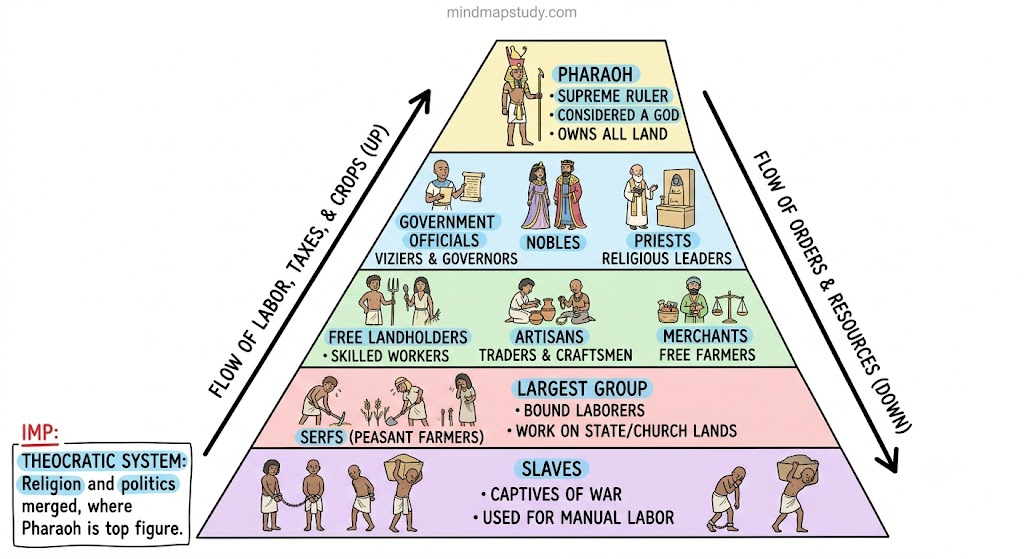
Women in Egypt:
- Egyptian women enjoyed more rights than their Greek or Roman counterparts — they could own property and run businesses.
- Cleopatra (69–30 BCE) was trained from childhood to rule and became queen at the age of eighteen.
Leisure and Culture:
- Early Egyptians swam, canoed, played board games, and enjoyed music and dancing.
- Festivals were central to Egyptian culture, dedicated to gods and the pharaoh’s rule. Each god had a festival in which their statue was paraded with music played on instruments such as the ‘sistrum’.
- The Sed festival was held to mark a king’s 30th year on the throne.
15. The Chinese Civilisation
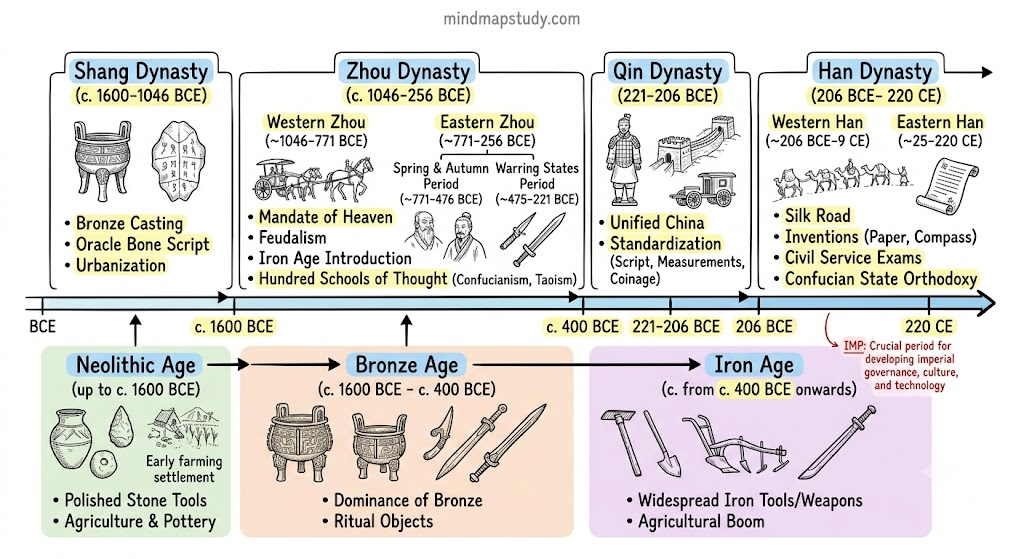
The Chinese civilisation flourished along two rivers — the Huang He (Yellow River) and the Yangtze. These river valleys were centres of early Chinese Neolithic cultures dating to around 7000 BCE.
Imp milestones:
- Around 2000 BCE, copper/bronze metallurgy brought many Neolithic settlements to the threshold of the Bronze Age.
- Urban centres began to emerge around 1600 BCE with advances in agricultural productivity, metallurgy, and craft production.
- This led to the rise of the first Chinese Bronze Age territorial empire.
Chinese Dynasties:
| Dynasty | Period | Age |
|---|---|---|
| Shang dynasty | 1600–1046 BCE | Bronze Age |
| Zhou dynasty | 1046–256 BCE | Bronze Age |
| Qin (Ch’in) dynasty | 221–206 BCE | Iron Age |
| Han dynasty | 206 BCE–220 CE | Iron Age |
- By 600 BCE, use of iron became popular throughout China — the Chinese Iron Age dates from this period.
- The name ‘China’ probably comes from the Iron Age Qin (Ch’in) dynasty, the first imperial dynasty, credited for unifying the country.
How do we know about China?
- China has an abundance of historical records from official historiographers.
- The earliest source of information are the ‘oracles’ — symbols made on pieces of animal bones and tortoise shells. These bones were heated until they cracked, and interpretations were made based on the crack patterns. They were used to foretell the future.
Chinese Writing System:
- The Chinese script is logographic — characters represent entire words or morphemes (smallest meaningful units of language), rather than sounds.
Chinese Crafts and Culture:
- Jade objects and figurines were unique to Chinese civilisation — they were ritual or prestige objects obtained from outside China.
- Marble was carved into ornaments in the form of birds and animals.
- The Chinese mastered bronze metallurgy to produce weapons, tools, and elaborate ritual vessels.
- Chinese artisans carved jade into fish shapes — when struck, they produced a clear musical sound, reflecting the importance of music in Chinese culture.
Silk and Trade:
- Silk was known to the Chinese from the Neolithic period (4000–3000 BCE) and became an important craft during the Bronze Age.
- During the Han dynasty (2nd century BCE), silk became a major item of external trade, and the entire trade route came to be known as the ‘Silk Route’.
The Great Wall of China:
- Built over a period of two thousand years. Initially, several walls were built from 680 BCE onwards by the Zhou and other dynasties to protect against raids of nomadic tribes.
- They were later joined together to form an effective defence mechanism.
- Expansion and repair of the wall continued till the 17th century CE.
Social Structure:
- By 1500 BCE, Chinese Bronze Age society was highly stratified — ruling class, nobles, and aristocrats at the top, followed by farmers and labourers.
- A metal-based medium of exchange appeared during the Zhou dynasty and a money economy developed by the 5th century BCE.
- China was the first country to introduce paper currency to the world and the first to develop civil services through public examination.
- The Zhou rulers were both kings and priests, believed to be appointees of heaven, but could be dismissed when their people did not prosper.
- Public officials were chosen carefully after being examined in archery, horsemanship, calculations, writing, and music.
16. Exercise Questions and Answers
Q1. Do you think life became easier or more challenging after humans started farming? Give two reasons for your answer.
Life became both easier and more challenging after humans started farming.
Easier because:
- Farming allowed humans to produce a regular and reliable food supply rather than depending on the uncertain availability of wild animals and plants. This reduced the risk of starvation.
- The ability to produce surplus food meant some people could take up other roles such as craftspeople, traders, and administrators, leading to more organised and comfortable societies.
More challenging because:
- Farmers were tied to fixed land and permanent settlements, unlike hunter-gatherers who could move when resources ran out. If crops failed due to drought or floods, entire communities faced famine.
- Farming required continuous hard labour — ploughing, planting, irrigating, weeding, and harvesting — throughout the year, which was physically demanding and left little time for rest.
Q2. The environment offers human societies both opportunities as well as challenges. Explain with reference to early farming communities and river-valley civilisations.
Opportunities provided by the environment:
- Rivers like the Nile, Indus, Euphrates, Tigris, and Huang He provided fertile soil through annual flooding, making agriculture highly productive.
- River water enabled irrigation, allowing farming in areas that would otherwise be dry and barren.
- Forests and grasslands in the Mesolithic period offered diverse food resources — small game animals, fish, and edible wild grains — supporting the first population explosion in human history.
- The ‘Fertile Crescent’ in Mesopotamia had high agricultural potential due to its favourable geography, encouraging the growth of city-states.
Challenges posed by the environment:
- Unpredictable floods could destroy crops and settlements. Farmers had to construct dams and canals to control water — this required collective effort and organisation.
- Changing climatic conditions forced early humans to adapt constantly — developing new tools, techniques, and ways of living.
- Communities dependent on river agriculture were vulnerable to environmental degradation, as seen in the eventual decline of Babylonian control partly due to pressure on agricultural lands.
- The need to manage water collectively led to complex social and administrative systems, which, while beneficial, also brought new social pressures and hierarchies.
Q3. Why do historians divide early human history into different ages such as Stone Age, Bronze Age, and Iron Age? What does this classification tell us about human progress?
Historians divide early human history into different ages because technological progress — particularly the development and use of tools and materials — is one of the clearest markers of change in human ways of life and social organisation. Since written records do not exist for most of early human history, tools and material remains become the primary evidence.
What the classification tells us about human progress:
- The Stone Age (divided into Palaeolithic, Mesolithic, and Neolithic) shows the gradual shift from simple stone tools used for hunting, to microlithic tools, to polished tools used for agriculture. This reflects the development of human cognitive ability, problem-solving, and adaptation to the environment.
- The Neolithic period marks a revolution — the shift from depending on nature for food to actively producing food through farming and animal domestication. This was a fundamental change in human society.
- The Chalcolithic and Bronze Age show that humans learned to extract metals and combine them (copper and tin to make bronze), leading to stronger tools, expansion of trade, growth of towns, and the emergence of early civilisations.
- The Iron Age indicates even more advanced metallurgy — smelting and working iron — which produced stronger tools and weapons and led to more powerful and organised societies.
Overall, this classification shows that human progress has been gradual, cumulative, and marked by increasingly sophisticated control over materials and the environment.
Q4. Imagine you are a Neolithic farmer. Describe one day of your life. What challenges would you face that a hunter-gatherer would not?
[Note: This is a creative/imaginative answer. A model response is given below.]
I wake up before sunrise. Today, I must check the fields where we planted wheat last season. Walking out of our small mud-brick house in the village, I see the granary nearby — a reminder that we must work hard now to store enough grain for the dry months ahead.
My first task is to water the crops using the canal that our community dug together. Then I use a polished stone hoe to break up the soil around the plants. By midday, I am helping to build a fence around the cattle enclosure to keep the goats from wandering off.
In the afternoon, a neighbour and I fire clay pots that we shaped yesterday. These pots will store grain, oil, and water.
Challenges I face that a hunter-gatherer would not:
- I am tied to my land. I cannot simply move to another area if the rains fail. A hunter-gatherer could follow animals or move to where wild plants grew.
- I have to plan months ahead — thinking about seeds, irrigation, storage, and harvests. A hunter-gatherer lived more in the present, responding to what was available each day.
- I must cooperate with many people — managing the canal, the granary, the animals — which means social rules and obligations that a small hunting band would not have needed.
- If a flood or drought destroys my crops, my entire community suffers. A hunter-gatherer could switch to a different food source more easily.
Q5. Imagine that the Harappan script gets deciphered tomorrow. What new types of information do you think historians might learn?
If the Harappan script (Sindhu lipi) were to be deciphered, historians could potentially learn a great deal that is currently unknown:
- Names of rulers, priests, or important figures — just as deciphering cuneiform revealed names of Akkadian kings like Sargon, deciphering the Harappan script could tell us who led or administered Harappan cities.
- Religious beliefs and rituals — the script could reveal the gods worshipped, the nature of religious ceremonies, and beliefs about life and death.
- Economic records — like the cuneiform tablets that recorded farming, craft activities, and trade, the Harappan script on seals may carry information about trade goods, quantities, and trading partners.
- Social organisation — whether Harappan society had a strict hierarchy, what roles different people played, and how decisions were made for the community.
- Language family — knowing what language the Harappans spoke would help trace connections to other civilisations and peoples of the ancient world.
- Specific dates and events — written records with dates would allow historians to construct a much more accurate timeline of the Harappan Civilisation than is currently possible through archaeological dating alone.
Q6. Prepare a table with three columns — Palaeolithic, Mesolithic, and Neolithic — and fill in their distinctive features: tools, settlements, art, and subsistence.
| Feature | Palaeolithic (Old Stone Age) | Mesolithic (Middle Stone Age) | Neolithic (New Stone Age) |
|---|---|---|---|
| Tools | Large stone tools — handaxes, cleavers, scrapers, borers, points; later microblades and bone points | Microlithic (tiny stone) tools; bow and arrow; blades | Polished stone tools; tools for food production and processing |
| Settlements | No permanent settlements; lived in caves or open camps; moved with food sources | Temporary settlements near rivers and lakes; frequent use of caves and rock shelters | Permanent village settlements; mud-brick houses and granaries |
| Art | Cave paintings and rock art; use of pigments; beads of stone, bone, and shell; engravings on bones and shells | Cave and rock shelter paintings flourished (e.g. Bhimbetka) | Pottery in various shapes and sizes; earthenware decorated with painted designs |
| Subsistence | Hunting wild animals and gathering wild plants; fishing | Fishing (mainstay), hunting small game; gathering aquatic food — both marine and freshwater | Food production through farming; cultivation of crops; animal domestication; husbandry |
Q7. “Bronze Age civilisations developed independently but shared common features.” Examine this statement with reference to the civilisations given in the chapter.
Independent Development: The four major Bronze Age civilisations — Sindhu-Sarasvatī, Mesopotamian, Egyptian, and Chinese — emerged independently in their respective river plains. Each developed its own writing system, religious practices, art styles, and administrative systems without directly copying from the others. For example, the Harappans used a pictographic script, the Sumerians used cuneiform, the Egyptians used hieroglyphics, and the Chinese used a logographic script. Each system was unique to its civilisation.
Common Features:
- River-based origins: All four civilisations emerged in fertile river plains — rivers provided water for irrigation, fertile soil, and routes for trade.
- Urban centres: All civilisations developed towns and cities with organised planning, as seen in the well-planned Harappan cities, Sumerian city-states, Egyptian cities around the Nile, and Chinese urban centres.
- Writing systems: Each civilisation independently developed its own system of writing to record economic transactions, social activities, religious beliefs, and literary texts.
- Social hierarchy: All civilisations had clear social hierarchies — rulers, priests/nobles, craftspeople, farmers, and labourers — with power concentrated at the top.
- Trade: All engaged in both local and long-distance trade. The Harappans traded with Mesopotamia; the Chinese developed the Silk Route.
- Metallurgy: All used bronze (an alloy of copper and tin) for tools, weapons, and ritual objects.
- Agriculture and surplus: All civilisations were based on agricultural productivity, and the production of surplus food and goods supported the growth of urban life and specialised occupations.
- Religious institutions: Temples and religious centres played important roles in social and economic organisation in all four civilisations.
Thus, while each civilisation was unique in many ways, their common geographical, economic, and social conditions led to strikingly similar features.
Q8. Although rivers provided many benefits, they also created challenges for early societies. Discuss both the advantages and disadvantages of settling near rivers.
Advantages:
- Rivers provided fertile soil through seasonal flooding — the Nile’s annual floods left behind rich black mud called kemet, excellent for growing crops.
- River water could be diverted for irrigation, allowing farming even in dry periods and supporting large populations.
- Rivers served as trade routes, connecting communities and allowing the exchange of goods. The proximity of Mesopotamia to the Indus valley, for instance, facilitated strong Harappan-Mesopotamian trade.
- Rivers provided fish and aquatic food, supplementing agricultural produce and supporting communities during crop failures.
- The need to collectively manage rivers led to organised governance and administration — for example, the earliest forms of local government in Egypt emerged from cooperative dam and ditch building.
Disadvantages:
- Unpredictable floods could destroy crops, homes, and entire settlements. Communities had to invest enormous effort in building dams and canals to manage flood waters.
- Settlements near rivers were vulnerable to environmental degradation — overuse of agricultural land and changes in river courses could reduce fertility over time, as seen in the eventual decline of some Mesopotamian settlements.
- Managing river resources required large-scale cooperation, which could also lead to conflict between communities or city-states competing for water and land.
- Over-reliance on rivers meant that changes in climate or river courses could be devastating — if a river shifted or dried up, entire civilisations could decline, as may have been the case with the Sarasvatī river and the late Harappan phase.
Q9. With the help of your teacher, find out more about the Code of Hammurabi. Why was it important? Do you think it was fair to all sections of society? Give reasons for your answer.
About the Code of Hammurabi: The Code of Hammurabi is a collection of 282 laws compiled by the Babylonian king Hammurabi (1792 BCE) and inscribed on a large stone stele. It covered rules for civil and social conduct — including trade, property, family matters, wages, and punishments for crimes. It served as a foundational model for many future legal systems.
Why it was important:
- It was one of the earliest written legal codes in the world, establishing the principle that laws should be written down and publicly known.
- It brought uniformity in governance — people across the empire were subject to the same set of rules.
- It demonstrated that rulers had a responsibility to provide justice to their people — Hammurabi presented himself as a king chosen by the gods to bring justice to the land.
- It covered a wide range of situations — from theft and property disputes to wages for workers, fees for doctors, and rules about marriage and inheritance.
Was it fair to all sections of society? The Code was not entirely fair to all sections of society. The punishments varied depending on the social class of the person involved. For example, punishments were harsher for lower-class people than for nobles committing the same offence. Women had fewer rights than men under the code. Slaves had very limited protections. However, for its time, it was a significant step forward in that it attempted to establish consistent rules and offered some protections even to people of lower status — such as setting minimum wages for labourers and regulating the behaviour of merchants.
Q10. If you had to choose one major innovation from early civilisations that changed the world permanently, what would it be and why?
The invention of writing is arguably the most important innovation from early civilisations that permanently changed the world.
Reasons:
- Preservation of knowledge: Before writing, all knowledge was passed orally and could be lost. Writing allowed civilisations to record and preserve information across generations — laws, scientific knowledge, literary texts, religious beliefs, and historical events.
- Administration and governance: Writing made it possible to manage large empires by keeping records of trade, taxation, agricultural output, and census. Without writing, complex governance would have been impossible.
- Foundation for all learning: Every form of modern education, science, medicine, philosophy, and literature traces its origins to the invention of writing. The cuneiform tablets recorded early mathematical calculations; Egyptian papyrus recorded medical treatments; the Code of Hammurabi recorded law.
- Communication across distance and time: Writing allows a message to travel across space and survive across thousands of years — the cuneiform tablets of Mesopotamia still tell us about trade agreements made 4000 years ago.
- Cultural identity: Writing allowed civilisations to define and preserve their own histories, stories, and cultural practices, forming the foundation of cultural identity that continues to this day.
Q11. Compare the social hierarchy and daily life of people in the Egyptian civilisation with those in Mesopotamia or China. What similarities and differences do you notice?
Similarities between Egypt and Mesopotamia:
- Both societies had a clear social hierarchy with rulers and priests at the top, followed by officials, craftspeople, merchants, farmers, and slaves at the bottom.
- In both civilisations, temples and religious institutions were central to social and economic life — in Mesopotamia, all economic activities were tied to the temple authority; in Egypt, festivals dedicated to gods were central to culture.
- Both had professional groups such as scribes, merchants, craftspeople, and farmers.
- Both civilisations practised large-scale agriculture supported by river irrigation.
Similarities between Egypt and China:
- Both had stratified societies with a ruling class (Pharaoh / emperor-kings) at the top and farmers and labourers at the base.
- Both developed public examination or selection systems to choose officials — China famously developed civil services through public examination; Egyptian administrators were also carefully selected.
Differences:
| Aspect | Egypt | Mesopotamia | China |
|---|---|---|---|
| Ruler | Pharaoh, considered divine | Kings of city-states | Emperor-kings, considered appointees of heaven |
| Role of women | Women could own property and run businesses | Less documented women’s rights | Less documented |
| Governance | Centralised under the Pharaoh | City-states with individual rulers | Dynastic rule; Zhou rulers could be dismissed if people did not prosper |
| Daily life | Farming, crafts, festivals, leisure activities like swimming and board games | Farming, crafts, trade; economic life tied to temples | Farming, crafts; silk production; jade carving |
| Record keeping | Papyrus scrolls stored in libraries | Cuneiform clay tablets | Oracle bones; later official historiographers |
Q12. Activity — Using maps, locate the major rivers and civilisations of Mesopotamia, Egypt, China, and the Sindhu–Sarasvatī Valley. Mark the trade links between them.
Diagram prompt: A large world map showing:
- Mesopotamia: Euphrates and Tigris rivers, with cities Ur, Uruk, Babylon, and Akkad marked.
- Egypt: River Nile, with Upper Egypt and Lower Egypt, Giza, Memphis, and Saqqara marked.
- China: Huang He (Yellow River) and Yangtze River, with Shang dynasty sites marked.
- Indian Subcontinent: Sindhu and Sarasvatī/Ghaggar rivers, with Harappa, Mohenjo-Daro, Dholavira, Lothal, and Rakhigarhi marked.
- Trade links shown as arrows: A strong arrow between Mesopotamia and Indus Valley (through Dilmun/Bahrain and Magan/Oman); dotted arrows indicating limited or no confirmed direct contact between Egypt and Harappan civilisation; a later arrow showing the Silk Route connecting China to India and West Asia.
Q13. Activity — Choose one early civilisation (Mesopotamia, Egypt, or China) and prepare a mini-scrapbook or a presentation showing their innovations in tools, writing, art, and architecture. Include pictures, brief descriptions, and explain their significance.
[Note: This is a project activity. A model outline for Mesopotamia is given below.]
Mini-Scrapbook Outline: The Mesopotamian Civilisation
Page 1 — Tools and Technology
- Dams and canals for irrigation — significance: enabled large-scale agriculture in a dry region.
- Wheeled cart — significance: revolutionised transport of goods, making trade faster and more efficient.
- Sailboat — significance: enabled travel and trade along rivers and coastlines.
Page 2 — Writing
- Cuneiform script on clay tablets — significance: one of the world’s first writing systems; used for recording laws, trade, myths, and education.
- The Rosetta Stone parallel — unlike Harappan script, cuneiform has been fully deciphered, giving historians access to Mesopotamian literature, law codes, and records.
Page 3 — Art
- Decorated boxes showing scenes from Sumerian daily life (wheeled carts, elaborate clothing, ornaments).
- Stone stele of King Hammurabi — showing the king receiving laws from the god Shamash.
Page 4 — Architecture
- The Ziggurat — a stepped pyramid-shaped temple that was the centre of the city’s religious, economic, and political life. Significance: it represented the power of religion in Mesopotamian society and served as a treasury, palace, and storehouse.
- Mud brick and burnt brick construction — the first civilisation to use these standardised building materials.