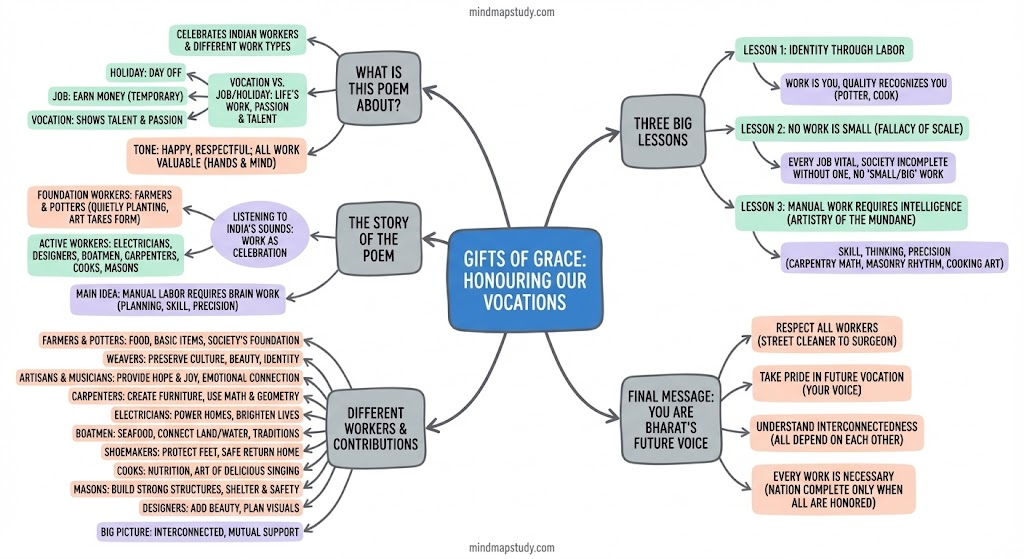
Every time the lights come on after a power cut, or a meal arrives hot on the table, or a building stands tall against the sky — a worker made it happen. Gifts of Grace: Honouring Our Vocations is a poem that pauses to celebrate these very people — the farmer, the carpenter, the boatman, the cook, and many more — with honest, joyful words. This guide covers every part of the poem with clear explanations and full answers to all textbook questions.
This poem is composed by an Anonymous (unknown) poet and stands as a warm, joyful tribute to India's everyday workers — craftspersons, musicians, carpenters, electricians, boatmen, shoemakers, cooks, designers, and masons. Each worker is celebrated not for fame or wealth, but for the skill, pride, and purpose they bring to their work every single day.
💡 Central Idea:
The poet walks through Bharat (India) and simply listens. What meets their ear is not the roar of crowds cheering a leader — it is the hum of an electrician, the song of a boatman, the steady tap of a mason at work. The poem makes one powerful argument: every job, no matter how simple it appears, is a gift that deserves to be honoured.
Title Explained — "Gifts of Grace: Honouring Our Vocations"
Gifts — A worker's skill is not accidental. It is a gift built through years of effort, practice, and patience
Grace — Grace means beauty, dignity, and elegance. Every worker, from the potter shaping clay to the boatman sailing the sea, performs their work with a quiet grace worth noticing
Honouring Our Vocations — The poem bows its head in respect to all forms of honest work, reminding us that a vocation is not just a job — it is a calling
2 Vocations in the Poem
Worker
What They Do in the Poem
Why They Matter
🎨 Craftsperson
Creates work woven with colours and myriad hues
Keeps traditional arts and crafts alive; their work is both functional and beautiful
🎵 Artisan / Musician
Plays lutes, hails varied emotions, celebrates dreams — music echoes in the streets
Expresses human emotion through music; brings joy and culture to communities
🪚 Carpenter
Creates anything out of wood with mathematical precision
Builds the furniture, doors, and structures that make every home and building functional
⚡ Electrician
Hums while working; handles cables and wires to brighten lives
Provides electricity and light — without them, modern life would come to a standstill
⛵ Boatman
Gathers nets from shore, sails, sings at work, returns with tales of the sea
Feeds communities through fishing; carries goods and people across waters
👟 Shoemaker
Affirms the quality of their work for feet that walk, dance, run, jump, return home
Serves every human being — their craft supports every step of a person's daily life
🍳 Cook
Sings deliciously while working — their rhythm fills the kitchen
Nourishes families and communities; preserves food traditions and cultural flavours
✏️ Designer
Works with their own rhythm — celebrating what belongs to them and none else
Shapes the look and feel of objects, spaces, and experiences in daily life
🧱 Mason
Works with steady rhythm — celebrating their unique craft
Builds the walls, foundations, and structures that shelter every family
3 Poem Explanation — Stanza by Stanza
IMP
The poem is by an Anonymous poet and written in free verse — no fixed rhyme scheme, no fixed line length. Each group of lines is followed by a plain English explanation.
Opening Line
"I hear Bharat celebrating, the varied vocations I hear;"
The poet stands somewhere in India and simply listens. What reaches their ears is not applause for a celebrity — it is the sound of people working. The word "celebrating" is carefully chosen: the poet wants us to understand that working with skill and dedication is itself a kind of celebration. By using "hear" twice — at the start and end of the same line — the poet makes listening feel like an active, important act. The sounds of work are all around us every day; we just need to pay attention.
Stanza 1 — Craftspersons
"Those of craftsperson, each one celebrating their craft,woven with colours and myriad hues."
Craftspersons are people who make things by hand — weavers, potters, painters, embroiderers, and more. Their work is described as being "woven with colours and myriad hues" — a beautiful image comparing their craft to a rich, multi-coloured cloth. The word myriad means countless. Just as a handwoven cloth holds thousands of threads, a craftsperson's work holds years of tradition, skill, and creativity passed down through generations. Their work is not just functional — it is art.
Stanza 2 — Artisans and Musicians
"The artisans with lutes, each hailing varied emotionsand celebrating dreams, echoing in the streets."
Here the poet celebrates musician-artisans — performers who play traditional string instruments like the lute. Their music carries a wide range of emotions — happiness, sadness, hope, longing — and speaks to something deep inside every listener. The phrase "echoing in the streets" paints a lively picture: this music does not stay locked inside a hall. It spills out into lanes and neighbourhoods, reaching everyone, belonging to everyone. Music is their vocation — and through it, they keep dreams alive.
Stanza 3 — Carpenters
"The carpenters celebrating; they create anythingout of wood with mathematical precision,"
Carpenters shape wood into furniture, doors, windows, and structures. What the poet admires most is their mathematical precision — every angle must be exact, every measurement spot-on. There is no room for guesswork in carpentry. The poet wants us to recognise that a skilled carpenter thinks like both an artist and a scientist. Their work demands patience, accuracy, and deep knowledge of materials — qualities just as impressive as anything found in a classroom or office.
Stanza 4 — Electricians
"The electricians humming; they get ready for work,work with cables and wires to brighten our lives,"
The single word humming says more than a paragraph could. A person who hums while working is content, at ease, and happy in what they do. The electrician hums while preparing for a job that carries real risk — handling live cables and wires. Yet their attitude is cheerful and calm, a sign of true mastery. The phrase "brighten our lives" works on two levels: electricians literally bring light into homes, and they also lift the quality of everyday life. Imagine a world without electricity — no lights, no fans, no devices. The electrician makes all of it possible.
Stanza 5 — Boatmen
"The boatmen gathering their nets from the shore,sailing, and singing while at work, return to tellthe tales of life at sea,"
This stanza is alive with movement and energy. We see boatmen collecting their heavy nets from the shore, then setting off to sea — and they sing as they go. For them, work and song are not separate things; they flow together naturally. When they return to land, they carry back not just fish but tales of life at sea — stories of vast open waters, of storms and calm, of the world far beyond the shore. They are workers, yes — but also brave adventurers and living storytellers.
Stanza 6 — Shoemakers
"The shoemakers affirming the quality of their work,for the feet that walk, dance, run, jump, return home."
Shoemakers affirm — they declare with full confidence — that what they make is of the highest quality. And look at what their work supports: feet that walk, dance, run, jump, return home. These five verbs capture the entire range of human movement — from a child skipping to school, to a dancer on stage, to a farmer trudging through fields, to a traveller finally returning home. The shoemaker's craft silently holds all of human life together, one step at a time.
Stanza 7 — Cook, Designer, Mason
"The delicious singing of the cook, or the rhythm ofdesigner, mason, each celebrating what belongs to themand to none else,"
Three more workers come together here. The cook's singing is called "delicious" — a clever metaphor, since delicious usually describes food, not sound. But the poet means that the cook's joy at their work is so warm and satisfying that it can almost be tasted. The designer and mason work with their own rhythm — a steady, skilled flow of action built through years of practice. The phrase "what belongs to them and to none else" is the heart of this stanza: every worker's craft is entirely their own. No one else can replicate your skill exactly the way you do it. That uniqueness is what makes it precious.
Closing Lines
"The voice of their vocation is the voice of their identity.I hear Bharat celebrating, the varied voices I hear!"
These two lines are the most important in the entire poem. "The voice of their vocation is the voice of their identity" — this means that a person's work and their sense of self are completely bound together. A potter is not simply someone who makes pots — they are a keeper of tradition and an artist. A boatman is not simply a sailor — they are a storyteller who has faced the open sea. Remove their work, and you remove their voice in the world. The poem closes exactly as it opens — with the poet hearing Bharat celebrate. This circular structure quietly tells us: this celebration never stops.
4 Check Your Understanding
IMP
True or False — with Corrections
1. The poem highlights the skilled work of craftspersons.
✅ Answer
True. The poem celebrates craftspersons who weave their work with "colours and myriad hues," showing that their craft is rich in skill, tradition, and artistic value.
2. The poet shares that musicians express emotions through their instruments.
✅ Answer
True. The artisans with lutes are described as "hailing varied emotions and celebrating dreams" — their instruments become the medium through which they communicate feeling and keep dreams alive.
3. The carpenters in the poem are admired for their logical work.
✅ Answer
False.Correction: The carpenters are admired for their work done with mathematical precision — not "logical work." This refers to the exactness of their measurements and the accuracy needed to craft anything from wood.
4. The electricians in the poem are recognised for their crucial role in lighting up lives.
✅ Answer
True. The poem says electricians "work with cables and wires to brighten our lives" — both literally by bringing electricity and light into homes, and figuratively by improving the quality of daily living for all.
5. The poem pays homage to shoemakers who manufacture quality footwear.
✅ Answer
True. The shoemakers are shown "affirming the quality of their work" for all the feet that walk, dance, run, and jump — they take pride in what they make and the poem honours that pride wholeheartedly.
6. The poem celebrates the patriotism of the people of Bharat.
✅ Answer
False.Correction: The poem celebrates the vocations and skilled work of the people of Bharat — not their patriotism. The focus is entirely on the dignity and unique identity that every form of honest work gives to the worker.
7. The poet feels that each vocation deserves to be respected.
✅ Answer
True. The whole poem is a tribute to workers of every kind. The closing line — "The voice of their vocation is the voice of their identity" — makes it unmistakably clear that every job gives a person their dignity, and every worker deserves equal and genuine respect.
5 Poem Appreciation
IMP
1. Rhyme Scheme and Lineation
(i) Does the poem strictly follow a rhyme scheme, or is it in free verse?
✅ Answer
The poem is written in free verse — it does not follow any fixed rhyme scheme. Lines do not end in rhyming words. This makes the poem sound natural and honest, like someone genuinely moved by what they observe around them — not performing, but truly celebrating.
(ii) What is the impact of the varying length of lines?
✅ Answer
The varying line lengths reflect the variety of the vocations being described. No two jobs are the same, and no two lines are the same length. Some tasks are quick, others take longer — and the poem's rhythm reflects that natural, uneven flow of real work and real life.
(iii) What is the structural pattern of most lines?
✅ Answer
Most lines follow a clear pattern: "The [worker] + what they do + how or why it matters." This list-like, inclusive structure works like a roll call of honour — every worker gets a turn to be seen and appreciated, and no vocation is ranked above another.
2. Speaker
(i) Who appears to be the speaker and what is their role?
✅ Answer
The speaker is a thoughtful observer and listener — someone who moves through India paying close attention to the sounds and sights of people at work. Their role is that of a witness and celebrator: they shine a light on workers who are often overlooked, giving them the recognition they have always deserved.
3. Tone and Mood
(i) Fill in the blanks — Tone and Mood.
✅ Answer
A. The tone is reverential and celebratory, depicting a deep sense of admiration and respect for the artisans and craftspersons of India.
B. There is a joyful mood throughout the poem, capturing the energy, vibrancy, and richness of India's cultural traditions and working skills.
4. Imagery
(i) Select two descriptions that evoke visual images.
✅ Answer
"craftsperson, each one celebrating their craft, woven with colours and myriad hues" — we picture a vivid, multi-coloured piece of handwoven craft, like a rich tapestry or painted pottery bursting with colour
"boatmen gathering their nets from the shore, sailing, and singing while at work" — we see fishermen on a beach pulling in heavy nets, then heading out onto open water, their voices carrying across the waves
(ii) Fill in the blanks — Auditory Imagery.
✅ Answer
The poem includes auditory (sound-based) imagery through mentions of artisans with lutes, the electricians humming, and the boatmen singing while at work, emphasising the rich, varied sounds that accompany each vocation throughout the working day.
5. Metaphor
(i) True or False: "The delicious singing of the cook" is a metaphor.
✅ Answer
True. "Delicious" is a word we normally use for food, but here the poet applies it to singing. This metaphor tells us that the cook's singing — born out of genuine happiness at their work — is so warm, rich, and satisfying that it can almost be experienced like tasting something truly delicious. The two worlds of the cook — food and song — blend beautifully into one image.
6. Personification
(i) Select the line where the poet personifies vocations.
✅ Answer
"The voice of their vocation is the voice of their identity." A vocation — a job — is given a voice, which is a human quality. In reality, a job cannot speak. But the poet treats each person's work as if it were alive, capable of expressing who that person truly is and what place they hold in the world. The vocation speaks on behalf of the worker.
7. Repetition
(i) Why does the poet begin and end with the same line?
✅ Answer
The line "I hear Bharat celebrating, the varied vocations I hear!" is used as a refrain — a repeated line that frames the entire poem. Starting and ending with the same words creates a circular structure, suggesting that the celebration of India's workers is continuous — it has no true beginning or end. It also gives the poem a chant-like, musical quality, as if the whole nation is singing together.
8. Alliteration
(i) Identify two examples of alliteration from the poem.
✅ Answer
"celebrating... colours" — repetition of the 'c' sound at the start of nearby words
"sailing... singing... shore" — repetition of the 's' sound in the boatmen's stanza
(Alliteration = the same consonant sound repeating at the beginning of words placed close together.)
9. Symbolism
(i) What does each vocation symbolise beyond just a job?
✅ Answer
Each vocation in the poem stands for something far greater than a mere occupation. Together, all the vocations symbolise human dignity, cultural identity, and the living spirit of India. The craftsperson's colours symbolise creativity and tradition; the boatman's net symbolises courage in the face of uncertainty; the shoemaker's craft symbolises quiet, selfless service. The poem's deeper message is this: every form of honest, skilled work is a gift — not just to the worker, but to every person who benefits from it.
6 Critical Reflection — Extract Questions
IMP
Extract: "The shoemakers affirming the quality of their work, for the feet that walk, dance, run, jump, return home.
The delicious singing of the cook, or the rhythm of designer, mason, each celebrating what belongs to them and to none else,"
1. What does 'affirm' refer to here?
✅ Answer
(ii) To declare with confidence. The shoemakers are not quietly going about their task — they are standing fully behind what they make, declaring to the world with complete confidence that their work meets the highest standard. There is pride and certainty in every stitch.
2. What do quality shoes help with, according to the poet?
✅ Answer
Quality shoes support every type of human movement — walking, dancing, running, jumping, and finally returning home safely. The poet points out that good footwear is not a luxury — it is woven into the fabric of daily human life, from the first steps of the morning to the last ones at night.
3. What does 'return home' symbolise besides the literal act?
✅ Answer
'Return home' symbolises safety, completion, and the comfort of belonging. Beyond the simple act of going back to one's house, it suggests that every effort a person makes in life — every dance, every run, every stride — eventually leads back to a place of warmth and rest. It also implies that the shoemaker's work silently accompanies every person through the entire journey of their life.
4. Identify the phrase that tells us every worker's contribution is distinct.
✅ Answer
"…each celebrating what belongs to them and to none else." This phrase tells us clearly that every worker's skill is entirely their own. Nobody else can do it the same way. A mason's rhythm is personal. A cook's touch is irreplaceable. These are personal signatures on the work of their hands.
5. Complete: "…for the feet that walk, dance, run, jump, return home refers to ___."
✅ Answer
…refers to all human beings — people of every age and background whose feet carry them through every experience life offers. It is the poet's way of saying that the shoemaker's work serves everyone, without exception, through every stage of their lives.
7 Long Answer Questions
IMP
Q1. Why does the poet say, 'I hear Bharat celebrating, the varied vocations I hear'?
✅ Answer
The poet uses the sense of hearing because the sounds of work are all around us — the hum of the electrician, the song of the boatman, the steady tap of the mason's tools. By saying "I hear," the poet steps into the role of an attentive witness — someone who chooses to notice what most people walk past without a second thought. The word "celebrating" tells us that working is not drudgery — it is a joyful, even festive act. The poem pays tribute to India (Bharat) as a nation whose true greatness lies in the hands of its everyday workers.
Q2. What does the electrician 'humming' while getting ready for work suggest?
✅ Answer
Humming is something a person does when they feel genuinely at ease with what they are doing. The fact that the electrician hums while preparing for a job that involves real danger — working with live cables and wires — shows that they are skilled, calm, and confident. There is no fear, only contentment. The humming also adds a musical quality to their work, turning a technical task into something almost artistic. It reinforces the poem's message that every worker, in their own way, brings joy and music to what they do.
Q3. Explain the significance of 'The voice of their vocation is the voice of their identity.'
✅ Answer
This is the poem's most powerful line. It means that a person's work and their sense of self are completely bound together — you cannot separate one from the other. A carpenter is not just someone who cuts wood — they are a craftsperson, a problem-solver, a creator. A boatman is not just a person who sails — they are an explorer who has faced the open sea and returned with stories. The poet urges us: never look down on any worker, because their vocation is not simply what they do — it is who they are. Take it away, and you silence their voice in the world.
Q4. Do you think all vocations are important in our daily lives? Give a reason.
✅ Answer
Yes, without question. Each vocation plays an essential and often invisible role in keeping life running smoothly. Without farmers, there would be no food on anyone's plate. Without electricians, homes and schools would sit in darkness. Without masons, there would be no buildings to live or learn in. Without cooks, there would be no nourishment for families. No vocation can honestly be called less important than another — they are all deeply interconnected, and the loss of any one would create a gap the entire community would feel immediately.
Q5. Why is the poet celebrating all the vocations in the poem?
✅ Answer
The poet celebrates all vocations because in everyday life, most of these workers go unnoticed, undervalued, or taken entirely for granted. Society tends to admire doctors, engineers, and executives — but rarely pauses to thank the carpenter who built the desk, the shoemaker who made the shoes, or the boatman who risked the sea. The poem seeks to correct this imbalance. A power cut instantly reminds us of the electrician's value; a flood makes the boatman a life-saver. Every vocation earns its place in the poem — and earns a place in our daily gratitude.
Q6. How does the poet use sensory imagery to bring out the beauty of everyday work?
✅ Answer
The poet engages multiple senses to make ordinary work feel vivid and beautiful:
👁 Sight: "woven with colours and myriad hues" — we see the craftsperson's rich, multi-coloured handiwork
👂 Sound: "electricians humming," "boatmen singing," "artisans with lutes echoing in the streets" — we hear the layered music of labour
👅 Taste (Metaphor): "delicious singing of the cook" — we almost taste the warmth and richness of the cook's joyful world
🖐 Movement: "feet that walk, dance, run, jump" — we feel the unstoppable energy of human life in all its forms
Together, these layered images make everyday work feel not dull or routine, but genuinely beautiful — worthy of a poem and worthy of celebration.
8 Vocabulary in Context — Match the Vocations
🌿 Horticulturist
A person who studies or grows garden plants
🏥 ASHA Worker
A trained female community health worker
🐛 Sericulturist
A producer of raw silk (from silkworms)
🍬 Confectioner
A person who makes or sells sweets and chocolates
💍 Goldsmith
A metalworker who specialises in precious metals
🔥 Welder
A person who fuses materials together using heat
Did You Know? ASHA stands for Accredited Social Health Activist. These are trained community health workers appointed by India's Ministry of Health and Family Welfare under the National Rural Health Mission (NRHM). In villages across India, they are often the very first point of healthcare contact — making them one of the most vital vocations of all.
9 Identify the Word That Is NOT a Synonym
IMP
#
Word
Options Given
❌ Not a Synonym
Why?
1
myriad
countable, innumerable, numerous, abundant
countable
Myriad means too many to count. "Countable" is its exact opposite — it means you can put a number to it.
2
hues
shades, tints, drawing, colour
drawing
Hues refers to shades and tones of colour. "Drawing" is a sketch — an art form, not a shade of colour.
3
precision
exactness, accuracy, correctness, calculation
calculation
Precision means being exact in execution. "Calculation" means working out a sum — the process, not the quality of being precise.
4
varied
assorted, diverse, uniform, different
uniform
Varied means different and diverse. "Uniform" means all the same — a direct contradiction.
5
delicious
mouth-watering, inedible, tasty, flavourful
inedible
Delicious means something that tastes wonderful. "Inedible" means not fit to be eaten — the complete opposite.
10 Listen & Respond — Answers
I. What does the boy use to understand the details of the tools?
✅ Answer
A magnifying glass — the boy uses a magnifying glass to examine the fine details of the tools his father works with, showing genuine curiosity about skilled work.
II. Multiple Choice Answers
#
Question
✅ Correct Answer
1
The girl is __________ about taking food for her mother at the factory.
(i) happy
2
The boy thinks that the job of the girl's mother carries a lot of __________.
(iii) responsibility
3
The girl __________ why the boy is good at science exhibitions.
(iii) realises
4
The girl shares her __________ about joining the weekend discussion on tools.
(ii) wish
11 Bonus Poem: The Lamplighter — Explanation
by R.L. Stevenson
Background — Who is Leerie?
Before electric street lights existed, towns used gas lamps on poles to light the streets after dark. Every evening, a person called the lamplighter walked from lamp to lamp carrying a tall ladder and a lantern, climbing up to light each one by hand. In this poem, a young child watches this person — called Leerie — every single evening with complete fascination.
Stanza 1 — Waiting at the Window
"My tea is nearly ready and the sun has left the sky;It's time to take the window to see Leerie going by;For every night at tea-time and before you take your seat;With lantern and with ladder he comes posting up the street."
Evening has arrived. The sun has gone down and tea is almost ready — but before sitting down, the child rushes to the window specifically to watch Leerie the lamplighter making his way up the street. The child does this every single evening. Leerie is so reliable and regular in his work that the child can almost time his appearance to the minute. He walks with his lantern and his ladder — the tools of his trade — and the child watches with quiet wonder. This opening stanza immediately tells us something important: a working person, doing a simple and essential job, has captured this child's complete and devoted attention.
Stanza 2 — A Surprising Dream
"Now Tom would be a driver and Maria go to sea,And my papa's a banker and as rich as he can be;But I, when I am stronger and can choose what I'm to do,O Leerie, I'll go round at night and light the lamps with you!"
This is the heart of the poem. The child looks at the ambitions of others — Tom dreams of being a driver, Maria of going to sea, and their own father is already a banker, a man of wealth and status. And yet, the child makes a bold, unexpected choice: when I grow up, I want to be a lamplighter — just like Leerie. The phrase "when I am stronger" tells us the child is still young, but the dream is sincere and firm. This stanza powerfully challenges the common belief that only well-paying or high-status jobs are worth admiring. The child finds something far more meaningful in Leerie's humble, faithful, essential work.
Stanza 3 — A Child's Gentle Request
"For we are very lucky, with a lamp before the door,And Leerie stops to light it as he lights so many more;And O! before you hurry by with ladder and with light,O Leerie, see a little child and nod to him to-night!"
The child feels deep gratitude — their home has a lamp at the door, and Leerie faithfully lights it every night along with all the others on the street. But the final two lines are the most touching moment in the poem. The child calls out to Leerie directly: before you hurry off to the next lamp, just look back for one moment and give me a nod. Not a gift, not money, not even a conversation — just a simple nod of acknowledgment. This tiny wish shows how deeply a single moment of recognition from someone we admire can mean to us. It is also a reminder that workers like Leerie — reliable, quiet, and essential — often pass through life without anyone stopping to say: I see you. You matter.
Connection to "Gifts of Grace":
Both poems look at workers the world tends to overlook — a lamplighter, a shoemaker, a cook, a boatman. Both carry the same message: doing your work faithfully, with skill and joy, is its own form of greatness. Leerie's nod to the child costs nothing and means everything — much like the quiet daily work of every person the poem celebrates.
12 Haiku — Structure & Examples
IMP
Example Haiku from the Textbook
Make up your mind, Snail! (5 syllables)
You are half inside your house, (7 syllables)
And halfway out! (5 syllables)
Sample Haiku — Vocations Theme
Hands shape the wet clay, (5)
The wheel spins a bowl of dreams, (7)
Fired into being. (5)
Tips for Writing Your Own Haiku:
Count syllables carefully — clap once per syllable to keep track
Focus on a single moment, object, or feeling from nature or everyday life
Use simple, vivid words — Haiku does not require rhyme
Aim for a quiet surprise or a fresh thought in your final line
Gifts of Grace · Class 8 Kaveri · Study Guide
Download Free Mind Map from the link below
This mind map contains all important topics of this chapter