The Paralympic Games are a global sports competition for athletes who have locomotor (related to bones, joints, or muscles), sensory, or intellectual disabilities. They are held shortly after the Olympic Games in the same host city.
The Paralympics are not just about winning medals — they challenge stereotypes and show the world that physical limitations do not define a person's potential.
Imp Points — Paralympics
Origin: 1948 — Sir Ludwig Guttmann organised games for war veterans with spinal cord injuries in England.
First Olympic-style Paralympic Games: Rome, 1960 (called the Stoke Mandeville Games).
India's debut in Paralympics: 1968.
India's first Paralympic medal: 1972 (in swimming).
Winter and Summer Games alternate every two years.
Reflect & Respond — Sheetal Devi
Sheetal Devi is a para-archer who was honoured with the Arjuna Award in January 2024. She is a powerful example of an athlete who overcame physical challenges to represent India at the highest level.
1. Look at the picture of Sheetal Devi carefully. What are your observations?
Answer (Sample): Sheetal Devi is a young para-archer. She uses her feet to hold and shoot the bow because she has no arms. Her posture shows great concentration, balance, and determination. She proves that the human spirit can adapt to any challenge.
2. Does this personality inspire you? Explain how.
Answer (Sample): Yes, Sheetal Devi is deeply inspiring. Despite being born without arms, she mastered archery at a world-class level. Her story teaches us that we should never make excuses or give up because of our difficulties. She motivates us to find creative ways to achieve our goals.
3. Give a caption for this picture.
Sample Caption:"Where there's a will, there's always a way — Sheetal Devi, India's armless para-archer, proving that limits are only in the mind."
KWL Table — Paralympics
What I Know
What I Want to Know
Paralympics is for athletes with disabilities. India has won medals in Paralympics. It is held after the Olympics.
How many events are in Paralympics? Who is India's best-ever Paralympian? How do para-athletes train?
About Dr. Deepa Malik
Dr. Deepa Malik is one of India's most celebrated para-athletes. She received the prestigious Rajiv Gandhi Khel Ratna Award (now called Major Dhyan Chand Khel Ratna), the Arjuna Award, and the Padma Shri. She was also named among the 10 most inspirational women para-athletes globally by the International Paralympic Committee.
Her Journey — A Timeline
The Interview — Reading for Meaning
Interviewer
Namaste, ma'am! It is my privilege to have this opportunity to meet a famous personality in the world of Paralympics, such as you.
Dr. Malik
Namaste! Believe me, I'm truly honoured.
Interviewer
You've been listed as one of the 10 most inspirational women para-athletes globally by the International Paralympic Committee. How did you brave the odds to be who you are today?
Dr. Malik
I was 29 when an awful tragedy struck me — I was diagnosed with a spine tumour. After surgery, doctors declared I would be paralysed waist down and bound to a wheelchair for life. I had two choices — squander my life in remorse, or transform it into a world of limitless possibilities. I chose to transform. Since I loved sports and had been a swimmer, I decided to switch to para-athletics. My breakthrough moment came at the 2016 Rio Paralympic Games when I secured the silver medal in the shot-put event.
Interviewer
You're a trailblazer — the first ever Indian female para-athlete to win an Asian Games medal in athletics and India's first female Paralympics medallist. What do these accomplishments mean to you?
Dr. Malik
These achievements are a testimony to my belief that physical limitations don't define one's potential. I am a proponent of 'ability beyond disability'.
Interviewer
Could you share something about the challenges you faced and how you overcame them?
Dr. Malik
The biggest challenge was societal perceptions — people underestimated my abilities. I embraced challenges as opportunities. The support of my family and my fortitude allowed me to turn obstacles into stepping stones.
Interviewer
How do you believe sports and Paralympics can challenge societal stereotypes?
Dr. Malik
Sports, especially Paralympics, have the extraordinary ability to challenge stereotypes and change attitudes. When people witness the strength, skill, and competitive spirit of para-athletes, it breaks down preconceived notions. Paralympics gave me a new lease of life.
Interviewer
How do you see your role in advocating for disability rights and inclusivity?
Dr. Malik
Advocacy is integral to my mission. I work to strengthen the emotional health of persons with challenges and empower women through outdoor sports. I also support persons from lower socio-economic backgrounds and provide equipment to para sportspersons. I organise disability sports awareness sessions at schools and colleges. My goal is a society where everyone is treated with dignity and given a fair chance.
Interviewer
What advice do you have for individuals facing challenges or setbacks?
Dr. Malik
"Every setback is an opportunity to prove your strength." Surround yourself with a support system, believe in yourself, and let your journey inspire others. Remember, disability is not a limitation — it's a unique strength waiting to be unleashed.
Vocabulary — Word Meanings
Resilience
Ability to recover quickly from difficult circumstances
Quell
To overcome or suppress something
Locomotor
Related to bones, joints, or muscles
Indelible
Permanent; impossible to remove or forget
Squander
To waste something carelessly
Remorse
Deep regret for something done wrong
Trailblazer
A pioneer or leader who is first to do something
Accolades
Praise and honours given for achievement
Coveted
Strongly desired by many people
Proponent
A person who actively supports an idea
Fortitude
Strength and courage to face difficulty
Testament
Clear proof or evidence of something
Preconceived notions
Opinions formed before knowing the full truth
Inclusivity
Including everyone and treating them equally
Advocating
Publicly supporting or suggesting an idea
Unleashed
Released something powerful that cannot be controlled
Check Your Understanding — Answers
I. Fact Table — Dr. Deepa Malik
#
Question
Answer
1
Diagnosed with spinal tumour at the age of
29
2
Result of the surgery
Paralysed waist down; bound to a wheelchair for life
3
Named as one of the 10 most effective para-athletes by
The International Paralympic Committee
4
First successful Paralympic event
2016 Rio Paralympics — Silver medal in shot-put
5
List of 'firsts' (i) (ii)
(i) First Indian female para-athlete to win an Asian Games medal in athletics (ii) India's first female Paralympics medallist across any sport
6
Awards won (i) (ii) (iii)
(i) Rajiv Gandhi Khel Ratna Award (ii) Arjuna Award (iii) Padma Shri
7
Two things supported by her (i) (ii)
(i) Strengthening emotional health of persons with disabilities (ii) Empowering women through outdoor sports and adventure activities
II. Fact-Opinion or Cause-Effect?
Set (1): (i) "In the 2016 Rio Paralympic Games, I secured the silver medal in the shot-put event." (ii) "I feel it was a moment of personal victory and a step forward in changing perceptions."
Answer: This is a Fact-Opinion pair. Statement (i) is a fact — it can be verified. Statement (ii) is an opinion — it expresses the speaker's personal feeling.
Set (2): (i) "I was diagnosed with a tumour in my spine." (ii) "I had a surgery and was told I would be bound to a wheelchair for the rest of my life."
Answer: This is a Cause-Effect pair. The cause is the spine tumour (i); the effect is being paralysed and wheelchair-bound (ii).
III. Pair Identification — 1 (Cause-Effect) or 2 (Fact-Opinion)
(i) Dr. Deepa Malik was a member of the Working Group for the Formulation of the Twelfth Five Year Plan. / It is believed she contributed greatly to create better sports policies for persons with disabilities.
Answer: 2 — Fact-Opinion. The first statement is a verifiable fact. The second is a belief/opinion about her contribution.
(ii) Paralympics showcases incredible talent and determination of para-athletes. / The global perception on disabilities shifts, inspiring para-athletes to pursue their dreams.
Answer: 1 — Cause-Effect. The first is the cause (showcasing talent); the second is the effect (perception shifts, athletes get inspired).
Critical Reflection — Answers
Extract 1 Questions
(i) Give a reason: "The speaker's decision to transform her life can be likened to a caterpillar transforming into a butterfly."
Just as a caterpillar undergoes a complete change to become a beautiful butterfly, Dr. Malik chose to completely transform her life after her disability. Instead of giving up, she channelled her energy into para-athletics and emerged as a stronger, more inspiring person — just like a butterfly emerging from its cocoon.
(ii) Why could the speaker switch to para-athletics quite comfortably?
Dr. Malik could switch comfortably because she already had a strong sports background — she had been a swimmer before her surgery. Her love for sports and her existing fitness mindset made it easier for her to adapt to para-athletics.
(iii) Complete: "The speaker calls 2016 Rio Paralympic Games as a 'breakthrough moment' because ________."
…she won the silver medal in the shot-put event, making her India's first female Paralympic medallist. It was a turning point that proved her abilities to the world and helped change perceptions about disability.
(iv) The phrase 'in hindsight' indicates the speaker is __________.
Answer: (B) Reflective. "In hindsight" means looking back at a past event with new understanding — this shows the speaker is thoughtfully reflecting on her own experience.
(v) List one likely perception the speaker might have changed.
The perception that people with disabilities cannot compete at an elite sports level. Her silver medal showed that para-athletes can perform with the same skill and competitive spirit as able-bodied athletes.
Extract 2 Questions
(i) Choose the option that lists the words describing the tone of the speaker.
Answer: (a) A and D — Appreciative and Optimistic. Dr. Malik appreciates the role of Paralympics in her life (appreciative) and believes in a positive future where disabilities are not barriers (optimistic).
(ii) Complete the analogy: ability : potential :: preconceived notions : __________
Answer: stereotypes. Just as "ability" relates to "potential" (what one can do), "preconceived notions" relate to "stereotypes" (fixed, incorrect ideas formed before knowing the truth).
(iii) True or False: "Paralympics is a platform that not only showcases remarkable abilities of para-athletes but also questions stereotypes."
Answer: TRUE. Dr. Malik clearly states that Paralympics breaks down preconceived notions and changes societal attitudes towards disability.
(iv) What does 'helped me push boundaries' tell us about the speaker?
It tells us that Dr. Malik is a determined and ambitious person who refuses to accept limitations. She continuously challenged herself to go beyond what society — and even doctors — thought was possible for her.
(v) Which phrase from the extract suggests the speaker was able to transform her life?
"A new lease of life." This phrase directly shows that Paralympics gave Dr. Malik a fresh start and a renewed sense of purpose after her disability.
Section II — Long Answer Questions
1. Explain how Dr. Malik's achievements challenge societal perceptions.
Society often assumes that people with physical disabilities cannot compete at the highest levels. Dr. Malik directly challenged this by winning medals at the Asian Games and the Rio Paralympics. Her 'firsts' — as India's first female para-athlete to win an Asian Games medal and the first female Paralympic medallist — forced people to rethink their assumptions. She proved that disability is about finding different ways to achieve, not giving up on achieving.
2. What can be the long-term impact of involving youth in disability advocacy sessions?
When young people attend disability sports awareness sessions at schools and colleges, they grow up with a more inclusive mindset. They are less likely to discriminate or underestimate persons with disabilities. Over time, this creates a society where equal opportunities are not just demanded but naturally given. Youth today become the policy-makers, employers, and leaders of tomorrow — so changing their thinking early creates lasting social change.
3. Rationalise the appropriateness of the title "The World of Limitless Possibilities".
The title perfectly captures Dr. Malik's life philosophy. When faced with permanent paralysis, she chose to see a world of limitless possibilities rather than a world of limitations. Her journey from a wheelchair-bound patient to a globally celebrated para-athlete proves that human potential truly has no fixed boundary. The title is not just about sports — it is a message for everyone that one's attitude and choices define their world, not their physical condition.
4. "Every setback is an opportunity to prove your strength." How is this a life lesson for everyone?
This quote applies to everyone — students, professionals, and ordinary people alike. A student who fails an exam can use that setback to study harder and come back stronger. An employee who loses a job can use the experience to learn new skills. Every difficulty carries a hidden chance to discover our inner strength and capabilities. Dr. Malik's life is the best proof: her paralysis, which looked like the end of everything, became the beginning of her greatest achievements.
5. How does Dr. Malik's global recognition contribute to the larger discourse on gender equality in sports?
Dr. Malik broke two barriers at once — disability and gender. Being recognised as one of the 10 most inspirational women para-athletes globally shows that women with disabilities can reach the pinnacle of sports. This recognition challenges the double discrimination that women with disabilities often face — being underestimated both as women and as persons with disabilities. Her story encourages more girls and women to enter para-sports, pushing institutions to provide them equal training, funding, and visibility.
6. How might 'ability beyond disability' serve as a guideline for future para-athletes?
"Ability beyond disability" means that a person's true capabilities go far beyond what their physical condition suggests. For future para-athletes, this serves as a mental framework — instead of focusing on what they cannot do, they should focus on what they can. It encourages them to adapt, train differently, and measure success by their own standards rather than comparing themselves to able-bodied athletes. This mindset makes them resilient competitors and role models for society.
7. What have you learnt from this interview, and how can you implement these learnings in your life?
Sample Answer: I have learnt that our attitude towards challenges is more important than the challenges themselves. Dr. Malik had every reason to give up, but she chose to transform her tragedy into triumph. In my own life, when I face difficulties — like a tough exam, a disappointment, or self-doubt — I can choose to see them as stepping stones rather than roadblocks. I can also practise empathy towards classmates who face challenges, and speak up against discrimination in my school and community.
Vocabulary Exercises — Answers
I. Match the Phrases
Phrase
Meaning
Example Sentence
Defy the odds
Succeed when most people think it would result in failure
She defied the odds and won the gold medal despite her injury.
A new lease of life
An occasion when you become more energetic and active than before
Moving to a new city gave him a new lease of life.
In hindsight
Ability to understand something after it has happened
In hindsight, choosing science was the best decision I ever made.
Breakthrough moment
A time of significant development or discovery
Inventing the light bulb was Edison's breakthrough moment.
Turn obstacles into stepping stones
Overcome challenges and achieve goals
She turned every failure into a stepping stone towards success.
II. Word Cline — Movement Words (Slowest → Fastest)
III. Modal Auxiliaries — Match the Functions
Sentence
Modal
Function
"I could hear the audience clapping."
could
Past ability
"It couldn't be helped."
couldn't
Impossibility
"I should give it my best shot."
should
Obligation
"I knew if I tried, I would win."
would
Prediction
Grammar — Modal Auxiliaries
Modal auxiliaries are helping verbs that add meaning to the main verb. The same modal can have different functions depending on the context.
Modal
Function
Example Sentence
could
Possibility
It could rain tomorrow.
Unreal ability
If I were a bird, I could fly.
Request
Could you pass the book, please?
Suggestion
You could try a different approach.
couldn't
Inability
She couldn't walk after the surgery.
should
Probability
She should arrive by 5 p.m.
Advice
You should practise every day.
would
Request
Would you help me with this?
Past habit
She would train for hours every day.
Grammar — Direct & Reported Speech
The sentences from the interview are in Direct Speech and they are declarative (statement) sentences.
Steps to Remember for Reported Speech:
Use reporting verbs: said, told, says
Remove quotation marks
Add linking word 'that' after the reporting verb
Change pronouns: I → she/he, you → she/he
Backshift tense: have been → had been; love → loved; decided → had decided; is → was
Exercise V — Changes Observed
Direct Speech
Reported Speech
Changes
Dr. Malik: "I love sports and had been a swimmer too, and so I decided to switch to para-athletics."
Dr. Malik said that she loved sports and had been a swimmer too, and so she had decided to switch to para-athletics.
1. 'said that' added 2. I → she 3. love → loved 4. decided → had decided
Interviewer: "Your story is indeed a testament to the power of determination."
The interviewer said that her story was indeed a testament to the power of determination.
1. 'said that' added 2. Your → her 3. is → was
Dr. Malik: "I believe youth is the voice of tomorrow."
Dr. Malik says that she believes youth is the voice of tomorrow.
1. 'says that' added (present reporting verb — no tense change) 2. I → she
Exercise VI — Siya & Tarun Conversation → Reported Speech
Fill in the blanks to convert the conversation to reported speech.
Siya said that1. she had watched a documentary on the para equestrian event on television the previous night.
Tarun replied that he hadn't known that Paralympics had equestrian events.
Siya added that2. it did and that it had been so interesting to watch.
Tarun remarked that it was wonderful and that para equestrians must be training for months for that.
Siya replied that3. they also had to find and develop their own style of communication with their horse.
Tarun said that4. he would watch that documentary the following weekend.
Note: Exact answers depend on the audio transcript provided to the teacher (page 268 of the textbook). Sample answers above are indicative.
Writing Task — Notice Writing
A notice is a formal written message that conveys important information to a specific group of people. It is used to announce events, competitions, or urgent information.
Format of a Notice
Sunrise Public School
NOTICE
Date: 12 April 2026
Inter-School Athletic Meet — Student Registration Open
The Sports Club is organising an Inter-School Athletic Meet on 25 April 2026 at the school ground. Students interested in participating in events such as sprinting, shot-put, long jump, and relay races must register with the Sports Captain by 18 April 2026. Selection trials will be held on 20 April 2026. All are welcome.
Aryan Sharma Sports Captain, Class X
Learning Beyond the Text
📖 Did You Know? — Origin of Paralympics
The origin of the Paralympics goes back to 1948, when Sir Ludwig Guttmann organised a sports competition for war veterans with spinal cord injuries in England. This grew into the Stoke Mandeville Games — the first Olympic-style event for differently-abled athletes. The first official Paralympics were held in Rome in 1960. Since the late twentieth century, the Paralympics are always held in the same city as the corresponding Olympic Games.
Group Presentation — Guidelines
Suggested Topics:
Two lesser-known Paralympic sports (e.g., para equestrian, para rowing)
Two Paralympians from India
Slide Structure:
Slide 1: Introduction — topic chosen
Slides 2–3: Origin and brief history of Paralympics
Slides 4–8: Details about chosen topic (sports or athletes)
Final Slide: Concluding thoughts
Tips:
Use a good balance of text and images
Each group member should present at least one slide
Choose clear colour schemes and readable fonts
Speaking Activity — Interview Phrases
Informal Interview (Sports Captain)
Formal Interview (Sports Coach)
Hello! I'm so glad you agreed to meet me.
Good morning, it is my privilege to have this interaction with you.
Tell me about yourself and your love for sports.
Could you tell me how your journey in sports began?
Did you face any challenges? How did you deal with them?
Could you share something about the challenges you faced and how you overcame them?
What are some impressive achievements you've had?
You've received many accolades. What do these accomplishments mean to you?
What would you like to say to your peers or juniors interested in sports?
What advice do you have for aspiring athletes?
— Dr. Deepa Malik
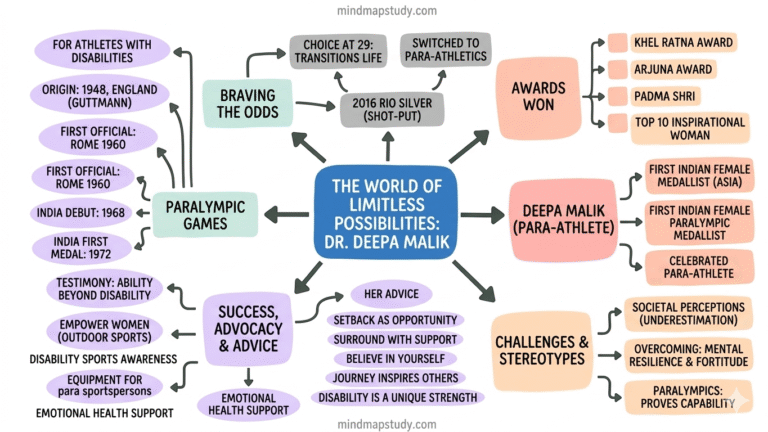
Download Free Mind Map from the link below
This mind map contains all important topics of this chapter