
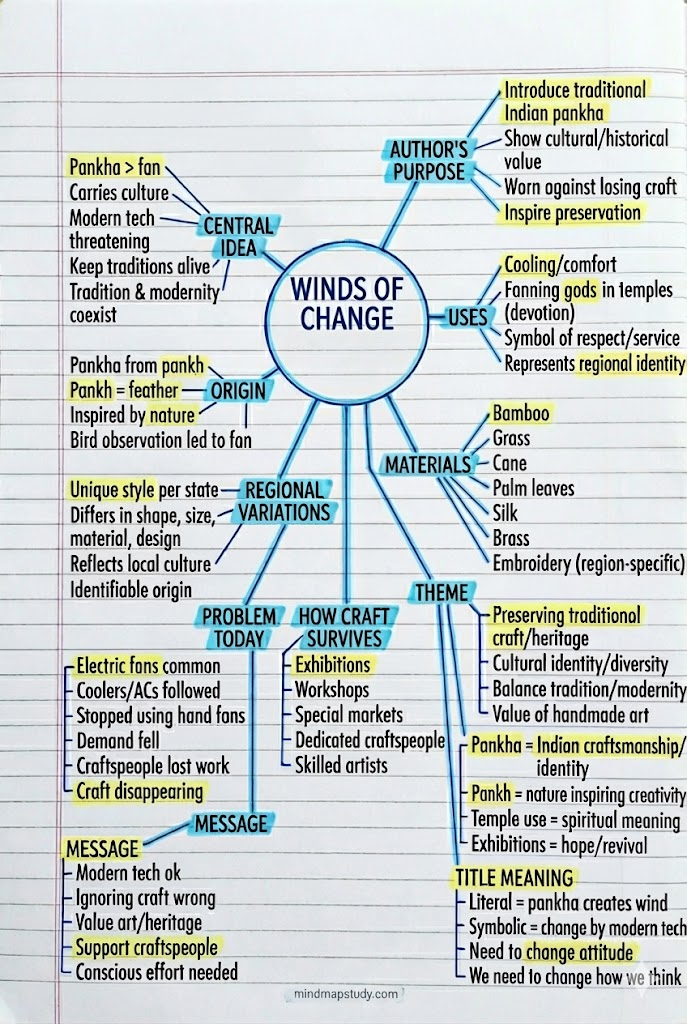
Winds of Change is a chapter from the Class 9 English Kaveri textbook. It is about the traditional Indian hand fan called the pankha. The writer describes where this fan came from, how different states of India made their own version of it, what materials were used, and why this craft is slowly disappearing in today’s world.
The chapter carries an important lesson — using modern technology is perfectly fine, but forgetting the art and craft that our ancestors created with great skill and love is something we must consciously avoid.
Central Idea
The pankha is not just a fan. It is a piece of art that holds within it the culture, identity, and traditions of the region where it was made. Today, because of electric fans, coolers, and air conditioners, people have stopped using hand fans. The pankha craft is slowly dying out. The writer wants readers to notice this, understand the value of what is being lost, and take small steps to keep this heritage alive.
Section-wise Explanation
Where Does the Word Pankha Come From?
The word pankha comes from the word pankh, which means the feather of a bird. Long ago, people observed birds and their feathers moving in the air and developed the idea of creating something that could move air in the same way. That is how the hand fan came into existence.
This connection between nature and human creativity is one of the most thoughtful ideas in the chapter. It tells us that the simplest objects we use today were once born from careful observation of the natural world.
Was the Pankha Only for Cooling?
No. The pankha was not just a tool for relief from heat. In temples all across India, the pankha was used to fan the deity as a mark of devotion and respect. It was treated as a sacred object.
This makes the pankha special. It was both a practical everyday item and a spiritually meaningful object. It served people in their homes and served God in temples.
How Was It Different in Different States?
Every state in India developed its own unique style of pankha. The shape, size, material, and decoration were all different depending on the region.
Some regions used:
- Bamboo sticks and grass
- Cane and palm leaves
- Silk and brass
- Embroidery with designs specific to that area
The writer says that the structure of each fan reflects the cultural core of the region that crafts it. In simple words, by looking at a pankha, you can understand the people who made it — their resources, their skills, and their way of life.
What Problem Does the Pankha Face Today?
When electric fans became common, people slowly stopped using hand fans. When coolers and air conditioners followed, the situation worsened. The demand for traditional pankhas fell sharply. Fewer people bought them and fewer craftspeople made them.
The writer points out that the beautiful culture of pankhas runs the risk of slowly losing its presence among Indians. This means that if no effort is made, the craft could one day disappear entirely.
Is There Any Hope?
Yes. Even today, some dedicated craftspeople continue to make traditional pankhas. They showcase their work at exhibitions, sell at special markets, and pass on their skills through workshops. These platforms help the craft reach new people and find a new generation of admirers.
The message is clear — we do not need to give up modern comforts. We only need to create space in our lives to also value and support the crafts that carry our cultural identity.
Theme
The theme of the chapter is the importance of preserving traditional crafts in the face of modernisation. The pankha is used as a symbol to show how culture, art, devotion, and regional identity can be contained within a single everyday object. The chapter encourages readers to look at familiar things with awareness and respect.
Word Meanings
| Word | Simple Meaning |
|---|---|
| Pankha | Traditional Indian hand fan |
| Pankh | Feather of a bird |
| Craftsmanship | The skill of making something beautifully by hand |
| Regional variation | Different styles found in different parts of the country |
| Devotion | Deep love, respect, and dedication |
| Heritage | Old traditions, art, and culture passed down from ancestors |
| Ornate | Very decorative and beautifully designed |
| Embroidery | Decorating cloth with colourful needle and thread work |
| Cane | A type of plant stem used for weaving and making objects |
| Brass | A yellowish metal used in decorative work |
| Contemporary | Related to the present time; modern |
| Sacred | Holy or deeply respected |
Important Questions and Answers
1. What is the chapter Winds of Change about?
The chapter is about the traditional Indian hand fan called the pankha. It covers the history of the pankha, how it was used across different regions of India, the materials involved in making it, and the threat it faces from modern technology.
2. Where does the word pankha come from?
The word pankha comes from the word pankh, which means a feather of a bird. The idea of the fan was inspired by observing birds and their feathers moving in the air.
3. Was the pankha only used for cooling?
No. The pankha was also used in temples to fan the deity as a sign of devotion and respect. This made it both a practical and a spiritually meaningful object.
4. How was the pankha different in different regions of India?
Every region of India made its own style of pankha using local materials like bamboo, grass, cane, palm leaves, silk, and brass. The designs, patterns, and embroidery on each pankha were also unique to that region. Looking at a pankha, one could tell where it came from.
5. What materials are used to make a traditional pankha?
Traditional pankhas are made using bamboo sticks, grass, cane, palm leaves, silk, and brass. Decorative embroidery with region-specific patterns is also added.
6. Why is the pankha disappearing today?
The arrival of electric fans, coolers, and air conditioners made people stop using hand fans. This reduced demand for pankhas and fewer craftspeople now produce them.
7. How is the pankha craft being kept alive today?
Some craftspeople continue to make traditional pankhas and display them at exhibitions, workshops, and special markets. These spaces help the craft survive and introduce it to newer audiences.
8. What is the main message of the chapter?
The main message is that using modern technology is not wrong, but completely turning away from traditional crafts is a mistake. We must make a conscious effort to value and support the heritage that our culture has built over generations.
9. What does the pankha represent in the chapter?
The pankha represents Indian craftsmanship, regional identity, cultural diversity, devotion, and the need to preserve traditional heritage.
10. Why is the title Winds of Change fitting for this chapter?
The title works on two levels. Literally, a pankha creates a wind or breeze. Symbolically, winds of change refers to the shift brought by modern technology that is threatening the pankha craft. Together, the title captures both the object and the bigger idea of the chapter.
Long Answer Questions
Explain how the pankha represents India’s cultural diversity.
India is a land of many states, languages, and traditions, and the pankha reflects this beautifully. Every region of India developed its own unique style of hand fan using different materials and designs. Some regions used bamboo and grass, while others worked with silk and brass. The embroidery and patterns on each pankha were specific to the artistic traditions of that place. By simply looking at a pankha, one could identify its place of origin.
The writer captures this with the line that the structure of each fan reflects the cultural core of the region. The pankha is therefore not just a tool for cooling. It is a carrier of regional art, identity, and tradition that shows how rich and varied Indian culture truly is.
What does the chapter teach us about tradition and modernity?
The chapter teaches that tradition and modernity do not have to be in conflict with each other. The writer does not suggest that we give up electric fans or air conditioners. Modern conveniences make life easier and there is nothing wrong with using them. However, the chapter points out the danger of completely forgetting traditional crafts in the process.
The pankha was created over generations with great skill and care. It carries art, spiritual meaning, and regional identity. If people stop noticing it and supporting it, the craft will disappear forever. The chapter encourages us to find a balance — enjoying the comforts of modern life while also creating room for traditional crafts through exhibitions, workshops, and markets.
Quick Revision Points
- Winds of Change is a chapter about the traditional Indian pankha from the Class 9 Kaveri textbook
- Pankha comes from pankh, meaning feather of a bird
- The pankha was used for cooling and as a devotional object in temples
- Every state of India made its own unique style of pankha
- Materials used include bamboo, grass, cane, palm leaves, silk, and brass
- The design of each pankha reflects the culture of its region
- Electric fans, coolers, and ACs have caused the pankha to slowly disappear
- Exhibitions, workshops, and markets are helping keep the craft alive
- The main message is to value traditional craft without rejecting modern life
Download Free Mind Map from the link below
This mind map contains all important topics of this chapter
Visit our Class 9 Kaveri page for free mind maps of all Chapters