
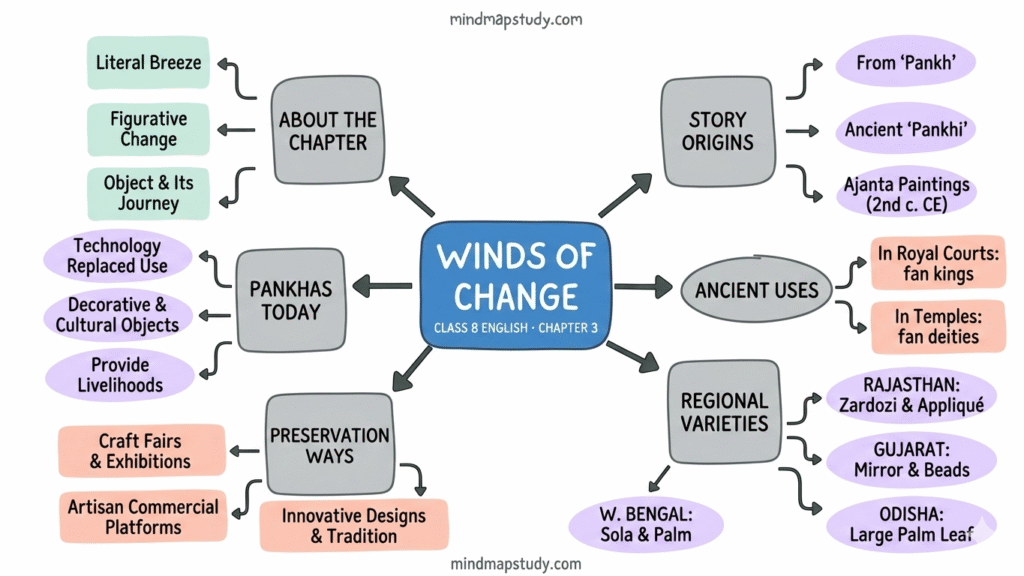
Winds of Change is a chapter from the Class 9 English Kaveri textbook. It is about the traditional Indian hand fan called the pankha. The writer describes where this fan came from, how different states of India made their own version of it, what materials were used, and why this craft is slowly disappearing in today’s world.
Table of Contents
Toggle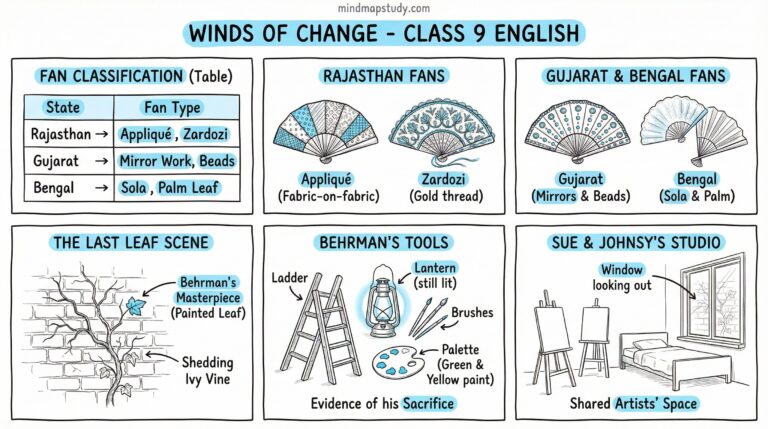
🌬️ Winds of Change
Class 8 English · Kaveri · Chapter 3
Complete Study Guide — Reading · Vocabulary · Grammar · Story
1 About the Chapter
This chapter is a factual article about the traditional Indian hand fan — the pankha. It takes us through the history of pankhas, shows us how different states in India craft their own unique versions, and explains why preserving this art matters today.
- Literal meaning — a pankha creates a wind, a breeze
- Figurative meaning — the pankha itself has changed — from a daily-use cooling tool to a decorative cultural artifact sold commercially
The title captures both the object (fan) and its journey through time.
2 Glossary — Word Meanings
IMPPankha = fan (all kinds); Pankhi = small feathered fan. Both from pankh = feather of a bird
Local — belonging to the place where it originally came from
New and original in approach
Hardworking
Elaborate and finely detailed
Brought out; stirred a feeling
Actions taken to improve a situation
Covered or decorated with something
A type of water grass used to make fans in Bengal
Constantly; all the time
The very distant past
The arrival of something new
✅ Match the Column — Answer Key
| # | Word | Correct Meaning |
|---|---|---|
| 1 | indigenous | (iv) local — from where it originated |
| 2 | innovative | (v) new and original in approach |
| 3 | industrious | (i) hardworking |
| 4 | intricate | (vi) elaborate/detailed |
| 5 | invoked | (iii) brought out |
| 6 | initiatives | (ii) actions to improve a situation |
3 The Story of Pankhas
🪶 Where Did the Pankha Come From?
The word pankha originates from pankh, meaning the feather of a bird. A pankhi was a small plumed fan used in ancient India. The oldest evidence appears in Buddhist wall paintings at Ajanta, dating back to the 2nd century CE. Representations also appear in sculptures, embroidery, and carvings.
- Used in temples to fan deities (gods)
- Used in royal courts to fan kings
- Ranged from tiny 2-inch fans to large ones needing full arm strength
🛤️ How Pankhas Spread Across India
Over time, pankhas became significant cultural goods traded across regions. They were considered exotic and stylish. Every village and town began crafting its own version using local materials — bamboo, cane, palm leaf, silk, brass, leather, silver — often decorated with beads and stones.
🔄 Pankhas Today
In modern times, pankhas have shifted from everyday use to decorative and cultural objects. Technology replaced their practical function. However, this shift created a commercial market — pankhas now provide livelihoods to India's artisans.
- Workshops, exhibitions, and craft fairs that celebrate pankhas
- Giving artisans a commercial platform to showcase and sell their work
- Balancing traditional methods with innovative designs to attract modern buyers
4 Regional Varieties of Pankha
IMP| State | Type of Fan | Material / Feature |
|---|---|---|
| Rajasthan | Appliqué hand fan | Fabric pieces in different shapes, sewn with ornamental needlework |
| Rajasthan | Zardozi hand fan | Glittering encrusted gold threadwork |
| Rajasthan | Temple hand fan | Engraved brass with a long handle; offered to gods |
| Gujarat | Mirror work hand fan | Pure cotton embellished with mirror work |
| Gujarat | Beads hand fan | Colourful beads with a silver handle; used as wall decor |
| Gujarat (Kutch) | Leather hand fan | Hand-stitched leather, decorated with thread and wool at seams |
| West Bengal | Sola fan / Tal Patar Pankha | Sola (water grass) centre or palm leaf; lightweight, kept in every Bengali home |
| Uttar Pradesh | Phadh hand fan | Pure gold, silver zari, silk and satin frills |
| Odisha | Large palm leaf fan | Known across India for its antiquity and rarity |
| Bihar | Bamboo hand fan | Colourful and sturdy bamboo fans |
| Tribal India | Tribal pankhas | Grass, metal, cane, bamboo; geometric patterns with white ink and red background |
5 Pankha Varieties Across India
6 Check Your Understanding
Fill in the table — answers provided below:
| State | Type of Fan | Material Used |
|---|---|---|
| Rajasthan | Appliqué hand fan | Fabric pieces with ornamental needlework |
| Rajasthan | Zardozi hand fan | Glittering gold thread |
| Rajasthan | Temple hand fans | Engraved brass with long handle |
| Gujarat | Mirror work hand fans | Pure cotton with mirror work |
| Gujarat | Beads hand fan | Colourful beads with silver handle |
| Gujarat (Kutch) | Leather hand fan | Leather, thread and wool |
| West Bengal | Sola / Tal Patar Pankha | Sola (water grass) or palm leaf |
| Uttar Pradesh | Phadh hand fan | Gold, silver zari, silk, satin frills |
| Bihar | Bamboo hand fan | Bamboo |
7 Critical Reflection — All Answers
IMP📌 Extract 1 — Questions & Answers
The unique local materials and intricate designs of each region made every type of pankha visually distinct and identifiable.
📌 Extract 2 — Questions & Answers
📌 Section II — Long Answer Questions
Example 2 — Gujarat's mirror work fans, made of cotton with colourful beads, reflect the state's famous bead craft and the skilled handiwork of its home-based women artisans.
8 Vocabulary — Word Pairs
Classify the Pairs (Exercise Answer)
| Appearance | Place | Material |
|---|---|---|
| exotic and stylish ornate and encrusted | within and outside villages and towns | thread and wool silk and brass |
- bamboo and cane (material)
- sculptures and carvings (art forms)
- beads and stones (decoration)
- cultures and rituals (tradition)
- temples and courts (place)
9 Fixed Expressions with "and"
IMPExample: bread and butter ✅ |
| Fixed Expression | Meaning |
|---|---|
| high and dry | In a difficult situation, without help or money |
| hard and fast | Strict; cannot be changed |
| facts and figures | Accurate and detailed information |
| all and sundry | Everyone, not just a few special people |
| wear and tear | Damage caused by normal, regular use |
| time and again | Often; on many occasions |
| through thick and thin | Even when there are problems or difficulties |
| cut and run | To make a quick or sudden escape |
- In a difficult situation → high and dry
- Damage due to normal use → wear and tear
- Accurate detailed information → facts and figures
- Even when there are problems → through thick and thin
- Everyone, not just a few → all and sundry
- Often; on many occasions → time and again
- To make a quick escape → cut and run
10 Collocations
Examples from the text: sustainable livelihood · aesthetically pleasing · appreciating the culture
Choose the Correct Word — Answers
- The students have to take the English exam tomorrow. (take an exam)
- The interviewer asked the candidate to take a seat. (take a seat)
- My scooter ran into a car. (ran into = collided with)
- I must take responsibility for my success. (take responsibility)
- I would like to improve my grammar. (improve = natural fit here)
11 Grammar — Present Perfect Tense
IMPUsed for actions that happened in the past but are still relevant now. Also used for recently completed actions.
Formula: Subject + have / has + Past Participle (V3)
Use has with he / she / it | Use have with I / we / you / they
From the Chapter — Examples
- Pankhas have become traditional craft items in India.
- Women workers have worked tirelessly in pankha-making.
- Many tribes have adopted this handicraft.
- This handicraft has transformed into a commercial business.
Fill in the Blanks — Puppetry Paragraph (Answers)
- have created intricate characters and captivating stories
- have mastered the delicate movements that bring lifeless figures to life
- puppetry has evolved, using modern technology while preserving traditional techniques
- Many puppeteers have passed down their craft through generations
- They have performed in theatres, on television, and at festivals
12 The Last Leaf
by O. Henry · Abridged
Sue and Johnsy were two young artists sharing a small flat on the third floor of an old house. In November, Johnsy fell seriously ill with pneumonia. She lay still in bed all day, staring out of the window. Sue called the doctor, but there was no improvement.
The doctor quietly told Sue: "Johnsy has made up her mind that she is not going to get well. If she doesn't want to live, medicines will not help her."
One day, Sue heard Johnsy counting backwards — twelve, eleven, ten… She was watching an old ivy creeper on the brick wall outside. Its leaves were falling in the storm. Johnsy had decided: when the last leaf falls, I will die.
Sue rushed downstairs to Behrman — a sixty-year-old painter whose lifelong dream was to paint a masterpiece. He had never achieved it. Sue told him everything. That stormy, rainy night, Behrman quietly went outside.
The next morning, Johnsy asked Sue to open the curtains. She expected the tree to be bare. But one leaf was still there — green, steady, clinging to the vine. Day after day, through every storm, it did not fall. Slowly, Johnsy began to hope again. She started eating. She began to recover.
Then Sue came in one morning and said: "Mr Behrman died of pneumonia this morning. He was found soaking wet on that stormy night. Near his room — a ladder, a still-lit lantern, and brushes with green and yellow paint."
The last leaf was not real. Behrman had painted it on the wall that stormy night. He went out in the cold and rain knowing it might cost him his life. It did. But it saved Johnsy's. That painted leaf was the masterpiece he had always dreamed of creating.
13 Story — Questions & Answers
IMP- A ladder and a still-burning lantern were found near his room
- Green and yellow paint and brushes lay on the floor
- He was found soaking wet — he had clearly been out in the storm
- The leaf never moved in the wind — because it was painted on a wall, not a real leaf
Winds of Change · Class 8 Kaveri · Study Guide
Download Free Mind Map from the link below
This mind map contains all important topics of this chapter
Visit our Class 9 Kaveri page for free mind maps of all Chapters