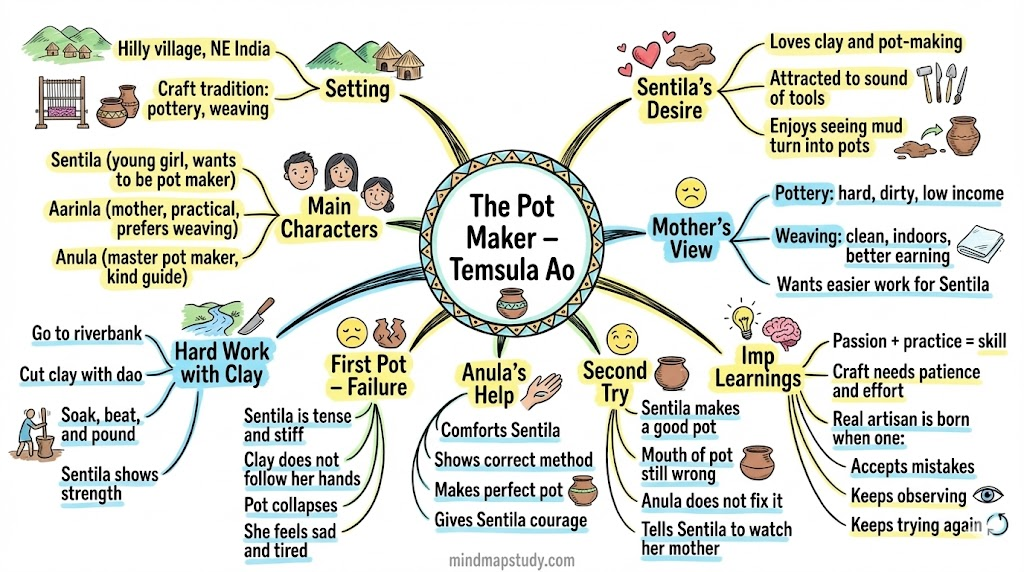
The Pot Maker Class 9 Free Notes and Mind Map (Free PDF Download)

The Pot Maker – Class 9 English Notes

The Pot Maker

by Temsula Ao  |  Class 9 English – Kaveri Book, Unit 2

CBSE • Chapter 2 • Prose + Poem • Full Notes & Solutions
Class 9 English Kaveri Chapter 2

About the Author

✦ Imp Fact
Temsula Ao is a Padma Shri and Sahitya Akademi Award winning writer from Nagaland in Northeast India. She often writes about Naga tribal life, culture, and identity.

This story is set in a Naga village and celebrates the dignity of traditional crafts. It shows how skills passed down through generations belong to the whole community — not just one family.

Story at a Glance

🔴 Central Idea

A young Naga girl named Sentila dreams of becoming a pot maker like her mother and grandmother, but her mother Arenla wants her to learn weaving because pot making gives very little money and huge hard work. The village council insists that the traditional skill must be passed on, and Sentila struggles for almost two years to learn the craft. With guidance from the dormitory caretaker Onula and a final test from her mother, Sentila finally masters pot making just as Arenla passes away — and “a new pot maker is born.”

Imp Characters

Sentila

Young Naga girl and central character. Passionate and determined, she secretly watches potters and refuses to give up even after many failures. Her hidden talent appears fully when she works alone in the shed.

Arenla

Sentila's mother and an expert pot maker. She is tired of the low income and back-breaking labour, so she wants Sentila to become a weaver instead. In the end she quietly supports Sentila by pretending to be ill and leaving the work shed to her.

Mesoba

Sentila's father. He is called by the village council and reminded that skills do not belong to individuals. He cleverly promises that Sentila will become the best pot maker in the village, standing by his daughter in front of the elders.

Onula

Widow caretaker of the girls’ dormitory. She observes Sentila's tension and clumsy attempts and realises the problem is nervousness, not lack of ability. Her patience and guidance help Sentila gain confidence and feel the “music” of pot making.

Pot Making Process

✦ Imp — Short Steps
Learn these simple points; you can easily expand them in your own words in the exam.
1
Collecting Clay

Grey and red clay is dug from the riverbank about 16 km away. Potters carry heavy baskets of clay uphill to the village.

2
Preparing the Clay

The clay is soaked in water, cleaned, and pounded in bamboo cylinders until it becomes smooth and soft like dough.

3
Shaping the Pot

A lump of clay is placed on the wheel. The left hand makes a hollow inside while the right hand and a spatula tap and shape the walls.

4
Finishing the Mouth

The potter carefully shapes the neck and mouth. Gentle, even pressure is used so that the rim is neat and does not collapse.

5
Drying and Touch-up

The pots are left to dry until semi-hard. After 2–3 days, rough edges are smoothed and the final shape is corrected.

6
Sun Drying

The pots are arranged outside in the sun and dried completely so that no extra moisture remains in the clay.

7
Loading the Kiln

Dry pots are placed on a bed of hay and dried bamboo in a uniform pattern, then covered with more hay and bamboo.

8
Firing the Pots

The kiln is fired carefully. Over-firing burns the pots and under-firing keeps them weak, so the fire is watched closely.

Story Events — Correct Sequence with Details

1
Childhood dream: From childhood, Sentila accompanies her mother to the fields and forests and quietly watches her make pots. She begins to dream of becoming a pot maker like her mother and grandmother, even though she never says it aloud.
2
Secret interest and overhearing: Sentila overhears Arenla telling Mesoba that pot making brings no joy and only a pittance in return, and that she wants Sentila to become a weaver instead. Realising her mother will oppose her dream, Sentila decides to keep her passion a secret.
3
Watching expert potters: Sentila begins visiting expert potters in the village and nearby areas. They laugh kindly at her interest, thinking she will soon outgrow it, but she keeps returning. She studies the clay preparation, the rhythmic tapping of the spatula, and the shaping of the mouth with deep fascination.
4
Village council’s concern: People start gossiping that Arenla is refusing to pass on her skill. The village council summons Mesoba and reminds him that skills handed down from generation to generation belong to the community, not to any one person. They caution him that it is Arenla’s duty to teach her daughter and all who wish to learn.
5
Formal training but failure: After this warning, Arenla agrees to teach Sentila. For almost a year, Sentila works under her mother's strict eyes, but her hands remain stiff and nervous. Although Arenla can shape perfect pots from the same lump of clay, Sentila's efforts end in clumsy shapes and failures, filling her with shame and frustration.
6
Help from Onula: At the dormitory, Onula notices Sentila's sadness and tired hands. She realises that Sentila is not lacking in talent but is too tense to let her hands move freely. Onula gently teaches her to relax, to feel the clay, and even fashions a pot herself to show the correct technique, giving Sentila new hope.
7
Arenla’s final test: One day, Arenla makes a new batch of pots and leaves some more to be completed, then suddenly tells Sentila she is feeling unwell and goes back to the house. In reality, this is a deliberate test — she wants to see if Sentila can work independently without the pressure of her mother’s direct supervision.
8
Breakthrough in the work shed: Alone in the shed, Sentila starts shaping the pots. Like a sprinter who has found sudden momentum, she makes pot after pot quickly and confidently. When she finally stops, she realises she has made just one pot less than her mother’s tally, with similar shape and quality. This is her moment of complete breakthrough.
9
Death and discovery: Sentila runs home, eager to share her success, but discovers that Arenla has died quietly. Later, when Onula goes to the work shed, she finds two neat, identical rows of pots and cannot tell which row belongs to whom. She stands there absorbing this “new phenomenon” and understands that although Arenla has died, a new pot maker has been born to carry the tradition forward.

Themes of the Story

ThemeExplanation
Passion & PerseveranceSentila never abandons her dream despite her mother’s opposition, repeated failure, and social pressure; her success comes only after long, patient effort.
Cultural HeritageThe village council insists that pot making is a community heritage, to be shared and passed on to the next generation, not locked within a single family.
Intergenerational TransmissionSkills travel from grandmothers to mothers to daughters; Sentila becomes the next link in this chain after Arenla’s death.
Dignity of LabourAlthough poorly paid and exhausting, pottery is shown as a highly skilled and honourable craft that deserves respect and fair reward.
Compassion & GuidanceOnula's gentle support, understanding of Sentila’s tension, and practical help become the turning point in Sentila’s journey.

NCERT Textbook Questions & Answers

Check Your Understanding (Pages 37 & 41)

Q1. Do you think pot making is easy? If yes, why? If no, why not?
No, pot making is not easy at all. The clay must be fetched from a riverbank about 16 km away, carried uphill, soaked, pounded, shaped in many careful steps, and then correctly dried and fired. After months of effort, the reward is just a few rupees, which makes the work physically and emotionally tiring. Even experienced potters get exhausted and must handle the clay and fire with great control, so it is a difficult and highly skilled craft.
Q2. Would Sentila be able to fulfil her dream of becoming a pot maker? Explain.
Yes, she finally fulfils her dream. After nearly two years of struggle, Sentila experiences a sudden breakthrough when she works alone in the work shed and makes an entire row of pots that almost matches her mother’s tally. The last line of the story — “a new pot maker was born” — clearly shows that she has mastered the skill and will carry the tradition forward.
Q3. Do you think Mesoba and Arenla would support Sentila?
At first, Arenla opposes Sentila’s dream because she knows the hardship and poor income involved. However, after the village council reminds them of their duty, Mesoba promises that Sentila will become the best pot maker. Arenla’s final act of pretending to be ill and leaving the pots to Sentila shows that, deep inside, she has accepted and now supports her daughter’s passion.
Q4. Do you think Onula's support helped Sentila?
Yes, Onula’s support is crucial. She recognises that Sentila’s main problem is not lack of talent but too much tension and fear of failure. By encouraging her gently, demonstrating the process herself, and making her relax, Onula helps Sentila discover her own confidence and ability, which later shows fully in the work shed.
Q5. Sentila observes her mother making pots. What does this tell us about her?
It shows that Sentila is a serious learner who believes in observing experts closely to understand every small detail. She does not rely only on formal teaching but also uses her own eyes and mind to learn, which is a sign of deep interest and maturity in any field.

Critical Reflection (Page 42)

Q1. Describe the process of pot making followed by expert pot makers, as observed by Sentila.
During her secret visits, Sentila carefully watches how expert potters work. They first mix grey and red clay with water and pound it thoroughly in bamboo cylinders until it becomes soft and malleable. Then, placing a lump of clay on the wheel, they push their left hand in and rotate it gently, while the right hand uses a spatula to tap and shape the clay with steady rhythm. After two or three days the pots receive a final touch-up to correct shape and test consistency, are dried in the sun, then loaded on a bed of hay and dried bamboo in the kiln. Finally, the kiln is fired carefully, because both over-firing and under-firing can spoil the whole batch.
Q2. What warning was given to Mesoba by the village council?
The council warned Mesoba that Arenla had no right to keep the skill only within herself. They reminded him that pot making is a traditional craft handed down from generation to generation and that it belongs to the community. They cautioned him that Arenla must teach not just her daughter but any interested learner, otherwise the tradition would slowly die.
Q3. How did Sentila feel when she failed even after a year of training?
Sentila felt deeply ashamed and discouraged. Despite practising for a year under her mother's guidance, her pots turned out clumsy while Arenla shaped perfect ones from the same clay. This made her feel that she was disappointing her parents and unworthy of her dream, so she hung her head in shame and frustration.
Q4. "Onula stood there for a long time as if trying to absorb a new phenomenon." Explain.
Onula had seen Sentila struggling with basic shapes not long before. When she entered the work shed after Arenla’s death, she found two identical rows of freshly made pots and could not distinguish between the mother’s and the daughter’s work. This sudden transformation from failure to mastery felt like a completely new and surprising event — a “new phenomenon” that she needed time to fully understand.
Q5. "The tradition and history of the people did not belong to any individual." What does this symbolize?
It symbolises that cultural skills, like pot making, are shared treasures of the entire community. No single person or family can claim ownership or refuse to pass them on. Every skilled person is only a guardian of this heritage and has a responsibility to transmit it to the next generation so that the community’s identity remains alive.
Q6. What is the significance of the concluding line "A new pot maker was born"?
Literally, it means that Sentila has finally become a true pot maker. Symbolically, it suggests a rebirth — as Arenla dies, Sentila is “born” as the next keeper of the tradition. It shows that the craft will continue beyond one person’s life, and that the community will still have a skilled potter to meet its needs.
Q7. What is the role of perseverance in pursuing one's dreams? Explain with reference to Sentila.
Perseverance is the main force behind Sentila’s success. She faces opposition from her mother, painful physical work, repeated failures, and deep self-doubt, yet she continues to practise and learn from each person around her. Only because she refuses to quit does she experience a big breakthrough in the work shed, proving that steady effort through failure is more powerful than talent alone.

Extract-Based Questions (Imp for Exams)

Extract A

"Ever since Sentila became old enough to accompany her mother to the fields and forests, she began to dream of becoming a pot maker like her mother and grandmother..."

Q1. What was Sentila's dream from childhood?
Her dream was to become a pot maker like her mother and grandmother. She wished to continue the family tradition even though she knew the work was hard and poorly paid.
Q2. How did the expert potters initially react to Sentila's visits?
They found her visits amusing and did not take her seriously. They believed that, like many children, she would soon lose interest and stop coming to the work sheds.
Q3. Why did Sentila visit the potters secretly?
She had heard her mother clearly saying that she did not want Sentila to become a pot maker. To avoid arguments at home and still follow her passion, Sentila chose to visit the potters without telling her parents.
Q4. What does "outgrow" suggest about the potters' attitude?
“Outgrow” suggests that the potters thought her fascination was only a passing phase of childhood. They expected her to become bored and forget about pot making once she grew older.
Q5. What does this extract reveal about Sentila's character?
It reveals that she is deeply passionate, patient, and quietly brave. Even when adults do not take her seriously, she continues to observe, learn, and carry her dream in her heart.

Extract B

"I shall not teach her pot making as it has brought no joy to me and only a pittance for my troubles. The riverbank... is sixteen kilometres from here."

Q1. Why did Sentila not disclose her passion for pot making at home?
She had overheard Arenla complaining bitterly about the hard work and poor earnings from pot making and firmly refusing to teach it to her daughter. Knowing this, Sentila feared that sharing her dream would hurt and anger her mother, so she kept quiet and followed her passion secretly instead.
Q2. What does the word "pittance" reveal?
“Pittance” shows that the money earned from selling pots is extremely small compared to the huge physical effort required. It reveals the unfair economic condition of traditional craft workers who get very little financial reward for their skilled labour.
Q3. (i) Choose the correct assertion reason:
A: The effort in making pots is far greater than the returns.
(A) The process is quite tiresome and long, and one hardly earns much.
(B) The process is exhausting but gives satisfaction.
Answer: (A) — The story clearly describes long walks, heavy loads, and continuous labour for only a few rupees, so the effort is far greater than the money earned.
Q4. "And the reward?" — Why does the author use a question mark here?
The question mark creates suspense and highlights Arenla’s disappointment. It makes readers pause and feel the gap between the hard work and the poor payment before she herself answers it with “a few rupees.”
Q5. Choose the sentence that uses "handsome" in the same way as in the extract:
(A) My father is a handsome man.
(B) They will make a handsome profit selling this property.
Answer: (B) — In the extract, “handsome” is used for a large amount of money, just like “handsome profit” in option (B).

Extract C — Village Council

"Mesoba was summoned by the village council and asked to explain why Arenla was refusing to pass on the skill to her daughter... Skills such as pot making did not belong to any individual."

Q1. Why was Mesoba summoned?
He was summoned because the village elders had heard that Arenla was not willing to teach pot making to Sentila. They were worried that such behaviour would stop the skill from being passed on and damage the community’s cultural future.
Q2. How did Mesoba respond to the village council?
Mesoba replied respectfully and cleverly. He said they had only been waiting for Sentila to become stronger after her illness and promised that she would soon become the best pot maker in the village, thus calming the elders.
Q3. What does "handed down from generation to generation" suggest?
It suggests that the skill has travelled through many ancestors and is part of the people’s long history. Each generation has the duty to learn it, practise it, and hand it over to the next generation so that the tradition never breaks.

Extract D — The Breakthrough

"...like a sprinter who had suddenly found momentum, she continued making pot after pot... she had made just one short of her mother's tally."

Q1. What does the sprinter metaphor suggest?
It suggests that Sentila’s progress suddenly becomes fast and smooth after a long period of struggle, just like a sprinter who finds the right speed and rhythm. Once her fear disappears, her natural talent flows freely.
Q2. What does "dexterity" mean and why is it significant here?
“Dexterity” means quick and skilful movement of the hands. It is significant because it shows that Sentila has reached the same level of fine control and fluency in her hands as her expert mother, proving her true mastery.
Q3. Sentila's clumsy efforts — Onula felt she was clumsy because ___
She was too tense and nervous whenever she worked under her mother's eyes, which made her hands stiff. This tension stopped her from using her natural sense of rhythm and touch with the clay.
Q4. "Onula fashioned a beautiful pot." What does "fashioned" mean? (created/styled)
Created — here “fashioned” means that Onula used her skill to create a beautiful pot from a lump of clay in front of Sentila.
Q5. "Don't worry, little one…" This shows Onula was:
(A) sincere and generous (B) forgiving and thoughtful (C) thoughtful and generous (D) forgiving and sincere
Answer: (C) Thoughtful and generous — she understands Sentila’s feelings and kindly offers her time and skill to help, without judging her failures.

Grammar Exercises & Solutions

1. Noun Clauses — Fill in the blanks
  • (i) The elders emphasised that pot making was a skill belonging to the entire community and must be passed on to all who wished to learn it.
  • (ii) Mesoba explained why Arenla had not yet taught Sentila the craft, saying she needed time to recover from her illness.
  • (iii) Onula's promise was that she would teach Sentila how to make a perfect pot.
  • (iv) Sentila observed her mother carefully, which helped her understand the correct technique for shaping the mouth of the pot.
  • (v) The kiln, where the pots were carefully fired on a bed of hay and dried bamboo, required careful attention.
2. Main Clause & Subordinate Clause
  • (i) Arenla took Sentila to the riverbank + (where the grey and red clay was found)
  • (ii) She started on the next one + (like a sprinter who had suddenly found momentum)
  • (iii) Skills such as pot making + (which not only catered to the needs of the people)
3. Relative Clauses — Complete the sentences
  • (i) Sentila, whose passion for pot making had been a childhood dream, practised the craft diligently.
  • (ii) The village council, where the elders gathered to discuss community matters, sought an explanation.
  • (iii) The potter's hands, which moved with incredible skill and dexterity, shaped the clay into beautiful creations.
  • (iv) Arenla wanted her to learn weaving, which was considered more profitable and less laborious.
  • (v) Mesoba discussed the matter with Arenla, who finally agreed to teach Sentila the art of pot making.
4. Determiners — Fill in the blanks
  • (A) … displayed in an elegant floral shop.
  • (B) The carpenter crafted several unique tables, and one became the centrepiece in the furniture collection.
  • (C) Each of the apprentices in the culinary class demonstrated their knife skills.
  • (D) Several of the sculptures were displayed at an art exhibition, showcasing their diverse artistic skills.
5. Listen & Respond — Answers
  • 1. three-dimensional
  • 2. statues / sculptures
  • 3. beautiful / fascinating

Six correct steps for stone statue making:

  • ✔ Choose the stone
  • ✔ Set up the different tools
  • ✔ Carve to remove large unwanted portions
  • ✔ Work to bring out the imagined shape
  • ✔ Refine the creation within the stone
  • ✔ Detach the creation from the stone as the final statue

Incorrect steps: Measure the weight & dimensions | Leave in water overnight | Begin carving from the centre

Multiple Choice Questions (MCQ)

Q1. What did Sentila dream of becoming?
(A) Weaver (B) Potter (C) Teacher (D) Farmer
✔ Ans: (B) Potter
Q2. Who wanted Sentila to become a weaver?
(A) Mesoba (B) Onula (C) Arenla (D) Villagers
✔ Ans: (C) Arenla
Q3. Why did potters laugh at Sentila initially?
(A) She was weak (B) She was poor (C) They thought her interest was childish (D) She was lazy
✔ Ans: (C) They thought her interest was childish
Q4. How far was the riverbank?
(A) 10 km (B) 12 km (C) 16 km (D) 20 km
✔ Ans: (C) 16 km
Q5. What is 'pittance'?
(A) Big amount (B) Small amount (C) Reward (D) Salary
✔ Ans: (B) Small amount
Q6. What tool is used to shape pots?
(A) Knife (B) Spatula (C) Hammer (D) Stick
✔ Ans: (B) Spatula
Q7. What happens if pots are overfired?
(A) Become strong (B) Become beautiful (C) Get ruined (D) Shine more
✔ Ans: (C) Get ruined
Q8. Who was Sentila's father?
(A) Mesoba (B) Arenla (C) Onula (D) Elder
✔ Ans: (A) Mesoba
Q9. What did the village council advise?
(A) Stop work (B) Teach the skill (C) Sell pots (D) Leave village
✔ Ans: (B) Teach the skill
Q10. What is 'malleable'?
(A) Hard (B) Soft and shapeable (C) Rough (D) Sticky
✔ Ans: (B) Soft and shapeable
Q11. Where was Sentila sent after maturity?
(A) School (B) Market (C) Dormitory (D) Forest
✔ Ans: (C) Dormitory
Q12. Who was Onula?
(A) Teacher (B) Widow caretaker (C) Farmer (D) Potter
✔ Ans: (B) Widow caretaker
Q13. Why did Sentila fail at first?
(A) No tools (B) Laziness (C) Nervousness (D) No guidance
✔ Ans: (C) Nervousness
Q14. What helped Sentila improve?
(A) Magic (B) Practice and guidance (C) Luck (D) Money
✔ Ans: (B) Practice and guidance
Q15. What happened to Arenla at the end?
(A) Fell sick (B) Left village (C) Died (D) Slept
✔ Ans: (C) Died
Q16. What did Onula see in the shed?
(A) Broken pots (B) Two rows of pots (C) Empty shed (D) Tools
✔ Ans: (B) Two rows of pots
Q17. Skill-based work is called:
(A) Business (B) Vocations (C) Jobs (D) Services
✔ Ans: (B) Vocations
Q18. What is common among all the pictures of vocations in the book?
(A) All are machines (B) All are skill-based work (C) All are office jobs (D) All are farming
✔ Ans: (B) All are skill-based work
Q19. "As a result, the clay seemed unable to yield the right shape." This is:
(A) A cause (B) An effect (C) An opinion (D) A fact
✔ Ans: (B) An effect
Q20. The word "fashioned" (in "Onula fashioned a beautiful pot") means:
(A) Styled (B) Created (C) Coloured (D) Sold
✔ Ans: (B) Created

Extra Questions & Answers

Q1. Why did Sentila keep her passion a secret from her parents?
She heard her mother saying very clearly that pot making had brought her only pain and a small income, and that she did not want her daughter to suffer the same fate. Sentila loved her parents and did not want to argue or disobey them openly, so she decided to hide her dream and visit the potters secretly instead.
Q2. What are the differences between handmade and machine-made products?
Handmade: Created mainly by hand skills; each piece is slightly different and unique; takes more time and effort; often carries cultural and emotional value.
Machine-made: Produced using machines; all pieces look almost the same; can be made quickly in large numbers; usually cheaper but with less personal touch.
Q3. What message does "The Pot Maker" convey?
The story teaches that when we truly love something and keep working at it, we can overcome great difficulties. It also reminds us that traditional skills are a shared heritage and must be preserved by teaching them to the next generation. Finally, it shows how gentle support from people like Onula can change a learner’s life.
Q4. How does the story show the theme of passion and perseverance?
Sentila keeps her dream alive from childhood to adulthood, even when her mother opposes it and her own attempts keep failing. Instead of giving up, she quietly observes, practises, and accepts help until she finally reaches mastery in a single powerful moment in the work shed. Her journey proves that passion plus perseverance is stronger than any obstacle.
Q5. What is the significance of Arenla pretending to be ill?
By pretending to be ill and leaving the unfinished pots for Sentila, Arenla creates the condition for her daughter to work freely without fear of criticism. It becomes a final act of trust and love: she silently gives Sentila a chance to prove her ability and step into her role as the next pot maker.
Q6. List five different vocations you know.
Blacksmith, Farmer, Tailor, Painter, Mason, Basket maker, Carpenter, Weaver, Potter, Cobbler.

Writing Task — Reflective Writing (My Skills & Passions)

✦ How to Write

Follow 5 steps: Introduction → Describing skills → Passion into profession → Examples & reflection → Conclusion.

Sample Answer

My Skills and Passions

I have always enjoyed writing and learning new things. From a young age, putting thoughts into words has felt natural and meaningful to me.

I practise by writing essays, short stories, and daily diary entries. I also participate in school debates and read books regularly, which improves my vocabulary and thinking.

Writing is a skill that can turn into a strong profession — as a journalist, content creator, teacher, or author. Clear communication is valuable in every field today.

Last year, I won my school's writing competition, which taught me that my words can move and inspire people. This shaped my dream of becoming a writer who informs and connects through language.

Reflecting on my journey has made me more confident and focused. Writing is not just my hobby — it is my calling, and I am committed to developing it every day.

Class 9 English • The Pot Maker • Kaveri Book Unit 2 • mindmapstudy.com

Download Free Mind Map from the link below

This mind map contains all important topics of this chapter

[Download PDF Here]

Visit our Class 9 Kaveri page for free mind maps of all Chapters