
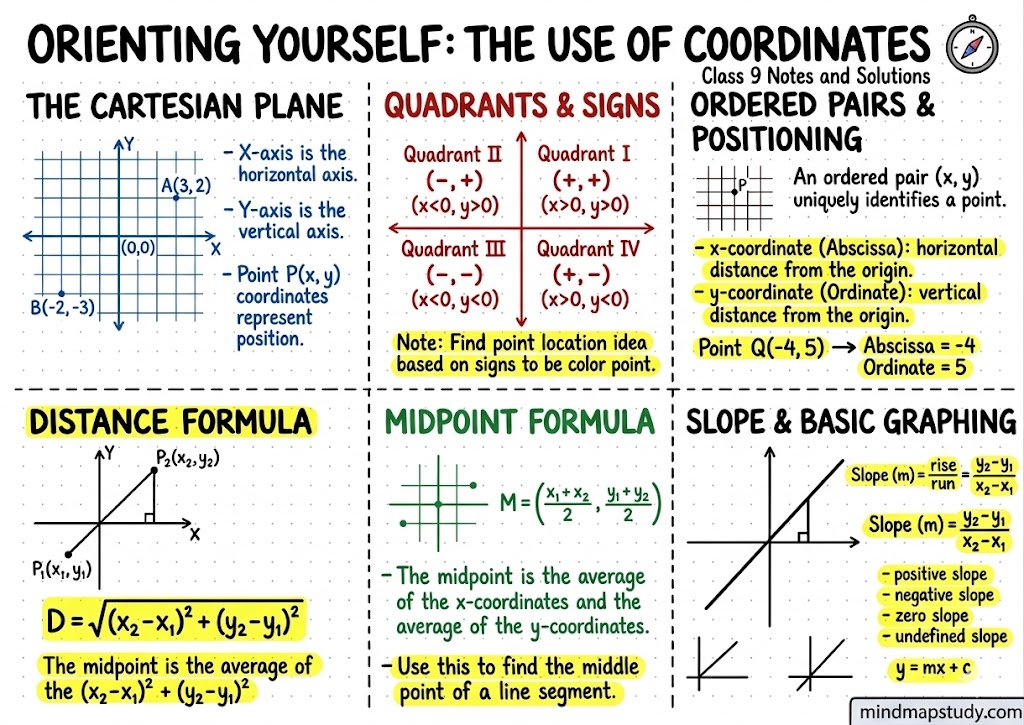
Orienting Yourself: The Use of Coordinates
1. What is a Coordinate System?
A coordinate system is like a map grid. It uses numbers to tell the exact position of a point or object. Imagine a treasure map with horizontal and vertical lines — coordinates are the instructions that say "go 3 steps right and 2 steps up."
Table of Contents
ToggleThe idea of grid-based thinking is very old. Thousands of years ago, cities of the Sindhu-Sarasvati Civilisation were built with streets in perfect North–South and East–West directions, about 10 metres apart. A merchant could find any shop by counting steps from the city centre. This was a real-life coordinate system.
Later, mathematicians like Baudhayana used East–West and North–South lines for geometry. Aryabhata mapped the sky using celestial coordinates. Brahmagupta gave us zero and negative numbers, which made the four-quadrant plane possible. Finally, Rene Descartes showed that every point on a flat surface can be described using just two numbers. This linked algebra and geometry forever.
2. The 2D Cartesian Coordinate System
In earlier grades, you used a number line, which is one-dimensional. To describe a point on a flat surface like a floor or a sheet of paper, we need two number lines that cross each other at right angles.
- The horizontal line is called the x-axis.
- The vertical line is called the y-axis.
- The point where they meet is called the origin, written as O (0, 0).
Distances to the right of the origin or upwards from it are positive. Distances to the left or downwards are negative.
Fig 1.2: Structure of the coordinate plane
Points on the Axes
- If x is positive, the point lies to the right of the origin.
- If x is negative, the point lies to the left of the origin.
- If y is positive, the point lies above the origin.
- If y is negative, the point lies below the origin.
3. Reading a Room Map with Coordinates
Reiaan and his sister Shalini use a grid to map their new room. The scale is 1 cm = 1 foot. The corner points of the room are marked so Reiaan, who cannot see, can feel where things are.
Fig 1.3: Reiaan's room on a coordinate grid
Exercise Set 1.1 — Solutions
This is not comfortable at all. A standard room door is about 2.5 to 3 feet wide. A wheelchair needs at least 2.5 feet (about 32 inches) to pass through. Therefore, a person in a wheelchair cannot enter easily.
Room door width = 0.5 feet.
The bathroom door is wider than the room door.
4. The Four Quadrants
The two axes divide the plane into four parts called quadrants. They are numbered counter-clockwise starting from the top-right.
Fig 1.4: The four quadrants of the coordinate plane
- Quadrant I (top-right): x is positive, y is positive → (+, +)
- Quadrant II (top-left): x is negative, y is positive → (−, +)
- Quadrant III (bottom-left): x is negative, y is negative → (−, −)
- Quadrant IV (bottom-right): x is positive, y is negative → (+, −)
Think and Reflect — Answers
5. Reiaan's Room — Extended Map
The bathroom is attached to the left side of the bedroom. Its corners use negative x-values because they lie to the left of the y-axis.
Fig 1.5: Bedroom and bathroom on one coordinate grid
Exercise Set 1.2 — Solutions
(i) Where will the fourth foot be?
(ii) Is this a good spot?
(iii) What is the width and length? Can you find the height?
(ii) It is an okay spot but tight. It sits in the empty corner near the bed, leaving little walking space.
(iii) Width = 11 − 8 = 3 feet. Length = 9 − 7 = 2 feet. Height cannot be found from a floor map because the map only shows length and width, not height.
If the door is made wider, it might strike the wardrobe. In that case, move the wardrobe further right or use a sliding door.
(i) What are the coordinates of the four corners O, F, R, and P?
(ii) What is the shape of the showering area SHWR? Write the coordinates of the four corners.
(iii) Mark off a 1 ft × 2 ft space for the washbasin and a 2 ft × 3 ft space for the toilet. Write the coordinates.
(ii) The showering area SHWR is a rectangle. Its corners are S (-6, 5), H (-3, 5), W (-3, 9), R (-6, 9).
(iii) One possible arrangement:
Washbasin (1 ft × 2 ft): (-5, 0), (-3, 0), (-3, 1), (-5, 1)
Toilet (2 ft × 3 ft): (-6, 0), (-4, 0), (-4, 3), (-6, 3)
(Answers may vary based on placement, but dimensions must match.)
(i) The dining room has length 18 ft and width 15 ft. Its length runs from P to A. Sketch the dining room and mark the coordinates of its corners.
(ii) Place a rectangular 5 ft × 3 ft dining table precisely in the centre. Write the coordinates of the feet.
P (-6, 0), A (12, 0), (12, -15), (-6, -15).
(ii) The centre of the room is at (3, -7.5). A 5 ft × 3 ft table placed centrally can have its feet at:
(0.5, -6), (5.5, -6), (5.5, -9), (0.5, -9) (if length 5 ft runs along x and width 3 ft along y).
6. Distance Between Any Two Points
When two points form a line segment parallel to an axis, the distance is just the difference of the matching coordinates.
- Distance between (x₁, y) and (x₂, y) = |x₂ − x₁|
- Distance between (x, y₁) and (x, y₂) = |y₂ − y₁|
But what if the segment is slanted? We use the Baudhayana–Pythagoras Theorem.
Fig 1.8: Distance formula from the Baudhayana–Pythagoras Theorem
Reflection and Distance
When a shape is reflected in the y-axis, the x-coordinate changes its sign while the y-coordinate stays the same. Reflection does not change the lengths of sides.
Fig 1.9: Reflection in the y-axis keeps side lengths the same
7. End-of-Chapter Exercises — Solutions
(i) Predict two sides of RAMP that are perpendicular.
(ii) Predict one side parallel to an axis.
(iii) Predict two points that are mirror images in one axis. Which axis?
(ii) AM is parallel to the x-axis, and MP is parallel to the y-axis.
(iii) M(-5, -2) and P(-5, 2) are mirror images in the x-axis. When reflected in the x-axis, the x-value stays the same and the y-value changes sign.
Then:
IZ = |0 − (-6)| = 6 units (vertical)
ZN = |11 − 5| = 6 units (horizontal)
IN = √[(11−5)² + (0−(−6))²] = √[36 + 36] = √72 = 6√2 units.
Note: Your triangle may be different, but the method remains the same.
Method: Find the slope between two pairs of points. If the slopes are equal, the points lie on the same straight line.
Slope of AM = (-4 − 0) / (-3 − 0) = 4/3
Slope of AG = (8 − 0) / (6 − 0) = 8/6 = 4/3
Since both slopes are equal and they share point A, all three points lie on one straight line.
Slope of BC = (-12 − (-5)) / (4 − (-2)) = -7/6
Since -4/3 ≠ -7/6, the points are not collinear.
(i) A right-angled isosceles triangle.
(ii) An isosceles triangle with one vertex in Quadrant III and the other in Quadrant IV.
OA = 4, OB = 4, and AB = √32. Since OA = OB and the angle at O is 90°, it is a right-angled isosceles triangle.
(ii) Let the vertices be O(0, 0), P(-2, -2) (Quadrant III) and Q(2, -2) (Quadrant IV).
OP = √8, OQ = √8, and PQ = 4. Since OP = OQ, it is isosceles with the base in Quadrants III and IV.
| S | M | T | Is M the midpoint? | Reason |
|---|---|---|---|---|
| (-3, 0) | (0, 0) | (3, 0) | Yes | (-3+3)/2 = 0, (0+0)/2 = 0 |
| (2, 3) | (3, 4) | (4, 5) | Yes | (2+4)/2 = 3, (3+5)/2 = 4 |
| (0, 0) | (0, 5) | (0, -10) | No | (0 + (-10))/2 = -5 ≠ 5 |
| (-8, 7) | (0, -2) | (6, -3) | No | (-8+6)/2 = -1 ≠ 0, (7+(-3))/2 = 2 ≠ -2 |
M = ( (Sx + Tx)/2 , (Sy + Ty)/2 )
-7 = (3 + x) / 2 → -14 = 3 + x → x = -17
1 = (-4 + y) / 2 → 2 = -4 + y → y = 6
So B = (-17, 6).
P = ( (2×4 + 1×16)/3 , (2×7 + 1×(-2))/3 ) = (24/3, 12/3) = (8, 4).
Q divides AB in the ratio 2 : 1.
Q = ( (1×4 + 2×16)/3 , (1×7 + 2×(-2))/3 ) = (36/3, 3/3) = (12, 1).
(ii) Check whether D(-5, 6) and E(0, 9) lie inside, on, or outside the circle.
OA = √[(1)² + (-8)²] = √65
OB = √[(-4)² + (7)²] = √65
OC = √[(-7)² + (-4)²] = √65
All three distances equal √65, so they lie on the same circle. Radius = √65 units.
(ii) OD = √[(-5)² + (6)²] = √61. Since √61 < √65, point D is inside the circle.
OE = √[(0)² + (9)²] = √81 = 9. Since 9 > √65 (≈ 8.06), point E is outside the circle.
Using the midpoint connection in reverse:
x₁ + x₂ = 2×Fx = 0, y₁ + y₂ = 2×Fy = 6
x₁ + x₃ = 2×Ex = 12, y₁ + y₃ = 2×Ey = 10
x₂ + x₃ = 2×Dx = 10, y₂ + y₃ = 2×Dy = 2
Adding all x-equations: 2(x₁+x₂+x₃) = 22 → x₁+x₂+x₃ = 11
x₃ = 11 − 0 = 11, x₂ = 11 − 12 = -1, x₁ = 11 − 10 = 1
Adding all y-equations: 2(y₁+y₂+y₃) = 18 → y₁+y₂+y₃ = 9
y₃ = 9 − 6 = 3, y₂ = 9 − 10 = -1, y₁ = 9 − 2 = 7
A (1, 7), B (-1, -1), C (11, 3).
(i) Using 1 cm = 200 m, draw a model.
(ii) Using the convention (N-S street, E-W street), find:
(a) how many intersections can be called (4, 3).
(b) how many intersections can be called (3, 4).
(ii) Under the given convention, each ordered pair names exactly one crossing.
(a) One intersection: 4th N-S street crossing 3rd E-W street.
(b) One intersection: 3rd N-S street crossing 4th E-W street.
This shows that (4, 3) and (3, 4) are different points. Order matters in coordinates.
(i) Does any part of either circle lie outside the screen?
(ii) Do the two circles intersect?
Circle B: Left = 150, Right = 350, Bottom = 130, Top = 330. All values are within limits. Fully inside.
So no part lies outside.
(ii) Distance between centres AB = √[(250−100)² + (230−150)²] = √[22500 + 6400] = 170 pixels.
Sum of radii = 80 + 100 = 180 pixels.
Since 170 < 180, the circles do intersect each other.
AB = √[(2+1)² + (1−2)²] = √10
BC = √[(-1+2)² + (2+1)²] = √10
CD = √[(-2−1)² + (-1+2)²] = √10
DA = √[(1−2)² + (-2−1)²] = √10
All four sides are equal.
Calculate diagonals:
AC = √[(2+2)² + (1+1)²] = √20
BD = √[(-1−1)² + (2+2)²] = √20
Since diagonals are also equal, ABCD is a square.
Area = (side)² = 10 square units.
(Or use diagonal formula: Area = d²/2 = 20/2 = 10.)