
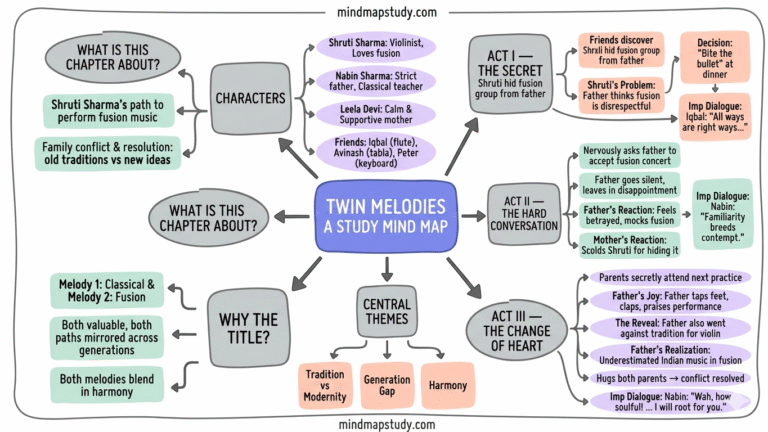
🎵 Twin Melodies 🎵
📖 Chapter Overview
This chapter presents a play about Shruti Sharma, a young violinist who wants to participate in an Indo-Western fusion concert despite her father's traditional views on classical music. The story explores the conflict between tradition and modernity, and how families can bridge generational gaps through understanding and communication.
Table of Contents
Toggle🎭 Characters in the Play
🎻 SHRUTI SHARMA - A young aspiring violinist, torn between her passion for fusion music and respect for her father's traditional views
🎼 GURU NABIN SHARMA - Shruti's father, a violinist and Principal of Sangeetika Music School; believes strictly in classical Hindustani music
👩 LEELA DEVI - Shruti's mother, supportive and understanding
🥁 AVINASH - Tabla player in the fusion group
🎺 IQBAL - Flutist of the fusion group
🎹 PETER - Keyboard player of the fusion group
📍 Setting and Opening Scene
Place: Iqbal's room
Time: After a practice session
Description: A small room with a rack and wooden table stacked with books. On the wall are posters of famous Indian flute players Pandit Hariprasad Chaurasia and Shashank Subramanyam.
📚 Important Vocabulary:
- crescendo [kri-SHEN-doe] - A piece of music that gets louder and louder
- desecration - disrespect towards something sacred
- ragas and aalaaps - elements of Hindustani classical music
- to bite the bullet - to deal with an unpleasant or difficult situation in a courageous and determined way
📝 Act I Summary
The scene opens with four children finishing their Indo-Western fusion music practice. They are:
- Iqbal - playing the flute
- Avinash - playing the tabla
- Peter - playing the keyboard
- Shruti - playing the violin
As they pack up their instruments, Shruti appears distressed. Iqbal reads from a newspaper praising Shruti's recent performance with her father, calling her a sensation. However, Shruti remains worried and distant.
The boys realize that Shruti hasn't told her father about their fusion music group or the upcoming concert. Shruti explains her dilemma:
The Conflict:
- Her father, Nabin, is very strict about music
- He believes Classical Hindustani music with its ragas and aalaaps is the only worthy form
- He would see fusion music as a "desecration of the violin"
- Shruti respects her father's opinions and doesn't want to disappoint him
- But she also has a passion for fusion music and commitment to her group
Her friends encourage her to speak to her father, assuring her that he will understand. After some hesitation, Shruti decides to "bite the bullet" and promise to bring up the topic at dinner that night.
🔑 Key Dialogues from Act I
IQBAL: (reading from newspaper) "Melody runs in the veins of Miss Shruti Sharma, daughter of the master violinist Nabin Sharma!"
AVINASH: Oh ho! Wow Shruti! You are a sensation now! The least you can do is throw a party!
SHRUTI: There is need to worry Iqbal! You don't know papa. He is very strict about these things. He will think it a desecration of the violin to be played to Western tunes. Papa firmly believes that Classical Hindustani music, with its ragas and aalaaps, is the only kind of music that an artist of any worth should play.
IQBAL: All ways are right ways, Shruti. He is your father, he will understand.
AVINASH: What's the worst that can happen? He will scold you a little, maybe. But he will eventually come round.
SHRUTI: You are right guys; I guess it is time to bite the bullet. Thanks for encouraging me again! Tonight, at dinner, I promise to bring this up.
📍 Setting
Place: Shruti's home - dining area
Time: After dinner
Mood: Tense, anxious
📚 Important Vocabulary:
- contempt - a strong feeling of dislike and disrespect
- hubbub - a loud noise
- iterated - repeated
- familiarity breeds contempt - when something becomes too common, people lose respect for it
📝 Act II Summary
Shruti's parents are cleaning up after dinner. Shruti sits at the table, lost in thought, still stuck on her last bite of dosa. Her parents notice her distraction.
The Build-up:
- Leela (mother) makes a light joke about Shruti finding words
- Shruti nervously asks her father to promise not to get too angry
- Nabin refuses to make promises but asks her to speak up
The Revelation:
- Shruti mentions there's a concert next week
- Nabin immediately says "No" - he has a rule of one performance every six months
- He believes "familiarity breeds contempt" - too many performances reduce artistic value
- When Shruti reveals it's a group performance, Nabin criticizes drowning individual style in the "hubbub of an orchestra"
- Finally, Shruti reveals it's an Indo-Western fusion concert
Nabin's Strong Reaction:
- Silence follows Shruti's revelation
- Nabin gets up, expressing deep disappointment
- He says he never thought his own child would "lose their sense of musicality"
- He has repeatedly stated his views against fusion music
- With a mocking tone, he dismisses fusion as "'phoo' music"
- He leaves abruptly without further discussion
Mother's Response:
- Leela scolds Shruti for not seeking permission first
- She also reveals she knew about the "practice classes"
- Shruti apologizes and promises not to hide things again
- Leela sends her to bed
The act ends with the conflict unresolved and Shruti's future in the fusion group uncertain.
🔑 Key Dialogues from Act II
NABIN: Shruti, staring at the dosa is not going to make it disappear. I am afraid you will have to eat it.
SHRUTI: Yes, actually I... er... was finding the right words to say something to you... to you papa. But please promise to not get too angry with me.
NABIN: (calmly but firmly) No is the answer. You know my rule—one performance in every six months. More than that, familiarity breeds contempt. Work on your art and everything will follow.
SHRUTI: (timidly) Papa, it's an... an... Indo-western fusion concert.
(silence)
NABIN: (getting up) I never thought any of my students, let alone my own child, would lose their sense of musicality to such an extent. Since my views on fusion music have been iterated in this house on several occasions, I think there remains nothing for me to say now.
NABIN: (with a slight mocking tone) Sure, there'll be a practice, for 'phoo' music when making noise starts needing practice.
SHRUTI: I know. I should have asked him. If he doesn't let me participate, our group won't be able to perform. All our practice will go down the drain.
📍 Setting
Place: Back at Iqbal's house
Time: Next practice session
Mood: Initially uncertain, then joyful
📚 Important Vocabulary:
- Aside - A theatrical technique where a character speaks directly to the audience; other characters cannot hear
- painstakingly - done with great care and effort
- worked his fingers to the bone - work very hard
- root - show support
- each bay, its own wind - everyone has their own unique path and journey
📝 Act III Summary
The Practice Begins:
- Shruti arrives at Iqbal's house for practice
- Friends ask if she told her parents
- They decide to start practice first
- Shruti thinks to herself (in an Aside) that she'll practice one last time and then tell her friends she can't join
The Unexpected Arrival:
- In the middle of their performance, Shruti's parents enter the room
- They stand in a corner, quietly observing
- Gradually, they become engrossed in the music
- Nabin starts tapping his feet - a sign he's enjoying it
- He shows evident enjoyment
The Applause:
- When the performance ends, both parents clap enthusiastically
- Nabin claps furiously with an expression of pride on his face
- Shruti is startled by the unexpected response
Nabin's Changed Perspective:
- He praises their performance as "soulful"
- Importantly, he notes that Shruti "did not lose sight of the notes of the raga" even in fusion
- This shows he recognized that classical elements were preserved in the fusion performance
- He offers them the music room for regular practice with better equipment
The Heart-to-Heart:
Shruti and her parents move aside for a private conversation while the other children practice silently (in mime).
The Revelation of Nabin's Past:
- Leela reveals that Nabin himself had rebelled against his family
- Nabin's family were all vocalists belonging to a highly traditional school
- They painstakingly nurtured their musical heritage through generations
- When Nabin wanted to play the violin (a Western instrument), his father saw it as a "betrayal of family values"
- At that time, violin hadn't been incorporated into classical Indian music yet
- Nabin "worked his fingers to the bone" to prove himself
Nabin's Realization:
- He admits he "underestimated the power of our own music"
- He was afraid Shruti would be lost to them
- He realizes his fears were baseless
- He embraces the philosophy: "Each bay, its own wind" - everyone must find their own path
- He promises to root for the group at the concert
The Resolution:
- Shruti hugs both her parents
- The family has found understanding and acceptance
- The conflict between tradition and modernity is resolved through synthesis, not sacrifice
CURTAIN DOWN
🔑 Key Dialogues from Act III
SHRUTI: (Aside) Oh, how much I enjoy performing this piece. Perhaps I can practise one last time and soon after that I will tell them that I can't join them for the performance.
(They begin practice. In the middle of the performance, Shruti's parents enter the room and stand in a corner. Slowly, her parents become engrossed and Shruti's father taps his feet and is seen evidently enjoying.)
NABIN: Wah, how soulful! You all have done a wonderful job! You too Shruti! You did not lose sight of the notes of the raga even once and performed it to excellence.
NABIN: Yes, Leela. In fact, I was planning to offer the children the music room. You'll have more equipment there and will be able to practise regularly.
NABIN: There is no need to thank me child. I must admit it was Leela who opened my eyes. I had forgotten my own past. It is your mother you should thank.
LEELA: Your own father, Shruti, had to go against his family's wishes to play the violin. His was a family of vocalists... Your grandfather saw this choice as a kind of betrayal of family values and tradition. But your father worked his fingers to the bone and see where the violin got him.
NABIN: I underestimated the power of our own music. I was afraid you would be lost to us. I realise that my fears were baseless. After all each bay, its own wind. I trust you Shruti and I will root for your group at the concert!
(Shruti hugs both of her parents)
📋 Check Your Understanding Questions & Answers
Act I - Questions
I. Complete the table based on Act I of the play.
| Category | Details |
|---|---|
| Setting - Where | Iqbal's room |
| Setting - Description | A small rack, a wooden table stacked with books |
| On the wall | Posters of famous Indian flute players Pandit Hariprasad Chaurasia and Shashank Subramanyam |
| Children & Instruments | 1. Iqbal: flute 2. Avinash: tabla 3. Peter: keyboard 4. Shruti: violin |
Speaker, Words, and Reasons:
| Speaker | Words of the Speaker | Reason |
|---|---|---|
| Avinash | "Oh ho! Wow Shruti! You are a sensation now! The least you can do is throw a party!" | To celebrate Shruti's positive newspaper review and encourage her |
| Shruti | "There is need to worry Iqbal! You don't know papa." | To express her concern about her father's strict traditional views on music |
| Peter | "That's the spirit!" | To encourage Shruti after she decides to talk to her father |
II. Do you think Shruti will gather the courage to speak to her father? Give a reason.
Answer: Yes, Shruti will likely gather the courage to speak to her father because:
- She has promised her friends that she will bring it up at dinner
- Her friends have encouraged and reassured her that her father will understand
- She realizes that hiding the truth is making matters worse
- She respects her father and wants to be honest with him
- The phrase "it is time to bite the bullet" shows her determination to face the difficult situation
- She cares about her group members and doesn't want their practice to "go down the drain"
III. What might be Shruti's father's reaction? Why?
Predicted Reaction: Shruti's father is likely to react negatively at first because:
Reasons for Negative Reaction:
- He is described as "very strict about these things"
- He firmly believes Classical Hindustani music is the only worthy form for a true artist
- He might see fusion music as a "desecration of the violin"
- He has strong traditional values that he has maintained throughout his career
- Group performances and fusion concerts go against his principle of "familiarity breeds contempt"
- He values individual style and would dislike drowning it in the "hubbub of an orchestra"
However: As Shruti's father and a musician himself, he might eventually understand her passion and come around, especially with support from Shruti's mother and if he witnesses her performance firsthand.
Act II - Questions
I. Complete the summary of Act II by choosing the correct words from the box.
Words: disapproval, plea, absent-minded, setback, surprised, scolded, courage, firm, clash, relief
Shruti seemed 1. absent-minded during dinner. She finally gathered the 2. courage to inform her father, Nabin, about her wish to participate in an upcoming Indo-Western fusion concert. Nabin reacted negatively, expressing 3. disapproval of fusion music and dismissed the idea. Despite Shruti's 4. plea to him to attend a practice before deciding, Nabin was 5. firm in his decision. Shruti's mother, Leela, 6. scolded her for not seeking permission earlier. The tension highlights the 7. clash between traditional and contemporary musical preferences within the family. Despite the 8. setback, Shruti promises not to hide again and is urged to go to bed by her mother.
Extra words not used: surprised, relief
II. Will Shruti's father go for the rehearsal? Support your answer with a reason.
Based on Act II alone: It seems unlikely that Nabin will attend the rehearsal because:
Evidence Against:
- He firmly rejected the idea immediately upon hearing it was fusion music
- He dismissed the need for practice with a mocking tone ("'phoo' music when making noise starts needing practice")
- He has repeatedly stated his views against fusion music in the household
- He got up and left without further discussion, showing his anger and disappointment
- His statement "there remains nothing for me to say now" suggests closed communication
However, there is a possibility he might reconsider if:
- Leela (his wife) convinces him to be more open-minded
- He reflects on Shruti's passion and determination
- He remembers his own struggles (as revealed later in Act III)
- His love for his daughter overcomes his rigid stance
Actual Answer (knowing Act III): Yes, Nabin does attend the rehearsal in Act III, likely convinced by Leela to give it a chance. This shows that despite his initial strong reaction, his love for Shruti and his wife's influence helped him reconsider.
III. Do you think Shruti and her parents would understand one another? If yes, why? If no, why not?
Answer: Yes, they will likely understand each other eventually because:
Positive Signs from the Play:
- Shruti deeply respects her father's opinions and doesn't want him to feel she doesn't care
- She is honest and open, finally sharing her secret despite fear
- Leela acts as a mediator and understands both perspectives
- The family has love and care for each other, which forms a foundation for reconciliation
- Shruti promises not to hide things again, showing maturity and willingness to communicate
- Nabin's own past (revealed in Act III) creates a parallel that helps him understand
Challenges to Overcome:
- Nabin's rigid views about classical music being the only worthy form
- The generational gap in understanding modern artistic expressions
- Nabin's pride in tradition and fear that his daughter might lose her way
- The initial breakdown in communication where Nabin walks away
How Understanding is Achieved:
- Nabin witnesses the fusion performance and sees classical elements preserved
- Leela helps him remember his own journey of going against tradition
- He realizes his fears of Shruti being "lost" are baseless
- Open dialogue and honesty eventually prevail
The key to understanding is dialogue, patience, experience (witnessing the performance), and perhaps most importantly, remembering one's own past struggles.
Act III - Questions
I. Work in pairs. Identify the true statements.
| Statement | True/False | Explanation |
|---|---|---|
| 1. During the rehearsal, Shruti's parents enter the room and are overjoyed at her performance. | TRUE | Nabin claps furiously with an expression of pride; both parents applaud enthusiastically |
| 2. Shruti initially considers telling her friends that she can't join them for the performance, after practising one last time. | TRUE | She says this in an Aside: "Perhaps I can practise one last time and soon after that I will tell them that I can't join them" |
| 3. Shruti's father expressed that she had sung a few notes incorrectly during her performance. | FALSE | He praised her: "You did not lose sight of the notes of the raga even once and performed it to excellence" |
| 4. Shruti's father had followed the family's tradition of being a violinist and worked very hard to achieve all that he did. | FALSE | He went AGAINST family tradition; his family were vocalists, and he chose violin (a Western instrument) against their wishes |
| 5. Shruti's mother helped her husband realise why he should support their daughter. | TRUE | Nabin says "It was Leela who opened my eyes. I had forgotten my own past" |
| 6. Shruti's father accepts that he underrated the potential of classical music. | FALSE | He underestimated the power of fusion music and Indian classical music's adaptability, not classical music itself. He says "I underestimated the power of our own music" |
🔍 Critical Reflection - Extract-Based Questions
Extract 1 Analysis
SHRUTI: There is need to worry Iqbal! You don't know papa. He is very strict about these things. He will think it a desecration of the violin to be played to Western tunes. Papa firmly believes that Classical Hindustani music, with its ragas and aalaaps, is the only kind of music that an artist of any worth should play. I don't want papa to feel that I don't care about his opinions, because I do. It's just that I want to give this a try too. I just don't know how to tell him in the right way!
IQBAL: All ways are right ways, Shruti. He is your father, he will understand.
(i) Select the option that correctly identifies Shruti's situation.
A. confident
B. indifferent
C. content
D. in a dilemma
(ii) What does Shruti mean by 'the right way', in the sentence, "I just don't know how to tell him in the right way!"?
(iii) Complete the following with a suitable reason: We can say that the extract reflects the generational gap in understanding art and tradition because ____________.
(iv) Explain how Iqbal's words were meant as an assurance to Shruti.
(v) Fill in the blank with a phrase from the extract: The critics argued that only films which provoke thoughtful discussion are _________.
(i) Answer: D. in a dilemma
Explanation: Shruti is caught between two equally important but conflicting choices:
- Respecting her father's traditional views and not wanting to disappoint him
- Pursuing her passion for fusion music and honoring her commitment to her group
She cares deeply about both, which creates an internal conflict or dilemma. She's neither confident nor indifferent, and certainly not content with her situation.
(ii) Answer: By "the right way," Shruti means:
- Finding the appropriate words and timing to approach her father
- A way that will make him understand her passion without feeling disrespected or hurt
- A method that won't make him think she doesn't value his opinions
- An approach that is respectful yet honest about her desires
- A manner of communication that will minimize conflict while expressing her true feelings
- The perfect balance between honesty and respect
(iii) Complete Answer: We can say that the extract reflects the generational gap in understanding art and tradition because Shruti's father believes only classical Hindustani music is worthy while Shruti wants to explore fusion music, showing how older generations often hold rigid traditional views while younger generations seek to blend tradition with modern expressions.
Alternative Answers:
- "the father sees fusion music as desecration while the daughter sees it as artistic exploration and innovation"
- "Nabin represents strict adherence to classical forms while Shruti represents the contemporary approach of mixing musical traditions"
- "it shows the conflict between preserving cultural purity (father's view) and embracing cultural evolution (daughter's view)"
- "the older generation views change as threatening tradition, while the younger generation sees it as honoring tradition through evolution"
(iv) Answer: Iqbal's words "All ways are right ways, Shruti. He is your father, he will understand" serve as assurance because:
- He removes Shruti's worry about finding the "perfect" way to tell her father
- He emphasizes that honesty is more important than the method of communication
- He reminds her of the father-daughter bond, suggesting love will overcome the conflict
- He provides confidence that her father's love will make him understanding
- He simplifies her complex worry by suggesting any honest approach will work
- He shifts focus from "how" to "when" - encouraging her to just do it rather than overthinking
- His calm, reassuring tone provides emotional support
(v) Answer: The critics argued that only films which provoke thoughtful discussion are of any worth.
Explanation: This phrase from Shruti's dialogue ("the only kind of music that an artist of any worth should play") means "having value" or "being worthy of consideration". It's used to indicate something that has significance or merit.
Extract 2 Analysis
NABIN: I underestimated the power of our own music. I was afraid you would be lost to us. I realise that my fears were baseless. After all each bay, its own wind. I trust you Shruti and I will root for your group at the concert!
(Shruti hugs both of her parents)
(i) Select the suitable option to complete the sentence: Nabin's breakthrough in his understanding of artistic freedom, highlights a bridge between ______.
A. personal ambition and professional success
B. traditional values and modern expressions
C. strict discipline and casual learning
D. historical techniques and futuristic innovations
(ii) Fill in the blank with a suitable phrase: The extract uses the word 'lost' both in the sense of losing _________ and physical separation.
(iii) In the line, 'Shruti hugs her parents', which word from those given below, does not show what it conveys?
reconciliation, harmony, duty, acceptance, understanding
(iv) What can be inferred about Shruti's future in music following her father's expression of trust and support?
(v) Identify the phrase that refers to the uniqueness of each artist's journey and style.
(i) Answer: B. traditional values and modern expressions
Explanation: The play's central conflict is between:
- Nabin's strict classical traditional values - belief that only pure Hindustani classical music has worth
- Shruti's desire for modern fusion music - blending Indian classical with Western elements
His acceptance and support create a bridge between these two perspectives, showing that tradition and modernity can coexist and enrich each other rather than being mutually exclusive.
(ii) Answer: The extract uses the word 'lost' both in the sense of losing cultural/traditional identity (or musical heritage/values/connection to classical music) and physical separation.
Detailed Explanation: Nabin feared Shruti would be "lost" in two ways:
- Metaphorically/Culturally lost: Losing her connection to classical traditions, musical heritage, and the values he holds dear; becoming someone he doesn't recognize musically or culturally
- Emotionally/Relationally lost: Becoming distant from the family, their values, and their shared musical legacy; a loss of connection and understanding
This dual meaning reflects the depth of his fear - it wasn't just about music, but about losing his daughter in a fundamental way.
(iii) Answer: duty
Explanation: The hug conveys:
- ✓ Reconciliation - They have resolved their conflict and come back together
- ✓ Harmony - They are now in agreement and at peace
- ✓ Acceptance - Both sides accept and understand each other's views
- ✓ Understanding - They understand each other better after the conversation
- ✗ Duty - The hug is NOT about obligation or responsibility but about genuine emotional connection, love, relief, and joy
The embrace is spontaneous and heartfelt, not a dutiful gesture.
(iv) Answer: Following her father's support, we can infer that Shruti's future in music will be:
Musical Development:
- More confident and free - She can explore fusion music without guilt or fear of disappointing her father
- Well-rounded - She will likely continue her rigorous classical training while also exploring fusion, giving her versatility
- Innovative yet rooted - She can honor classical tradition while innovating, as her father did with the violin
Practical Support:
- Better resources - Having her father's blessing and access to the music room with better equipment
- Mentorship - Her father can now guide her in maintaining classical integrity within fusion
- Family support - Both parents will attend her concert, providing emotional backing
Personal Growth:
- Authentic expression - She can follow her own path, embodying "each bay, its own wind"
- Balanced identity - She can be both a classical musician and a fusion artist
- Increased confidence - Her father's trust will strengthen her self-belief
Long-term Success:
- Strong foundation - With family support, dedication, and talent, she has all ingredients for success
- Bridge-builder - She may become someone who bridges classical and contemporary music
- Respected artist - Following both her passion and maintaining excellence will earn respect
(v) Answer: "Each bay, its own wind"
Detailed Explanation of this phrase:
Literal Meaning:
- Just as each bay (coastal inlet) has its own unique wind patterns due to geography, temperature, and other factors
- No two bays have identical winds
Metaphorical Meaning:
- Every artist must find their own unique path and style
- What works for one person may not work for another
- Each person has their individual journey, shaped by their circumstances, talents, and choices
- There's no one-size-fits-all approach to art, life, or career
- Individual expression and style should be respected and celebrated, not forced into conformity
Significance in the Play:
- Nabin's own "wind" led him to the violin despite family opposition
- Shruti's "wind" is leading her to fusion music
- Both paths are valid and worthy
- This phrase represents Nabin's acceptance that his daughter's journey will be different from his, and that's okay
💭 Long Answer Questions
Question 1: Justify the Title 'Twin Melodies'
1. Justify the title 'Twin Melodies'. How does the play explore the theme of tradition and modernity?
Justification of the Title 'Twin Melodies':
The title 'Twin Melodies' is highly appropriate and multilayered because it represents:
1. The Two Musical Traditions:
- Melody 1: Classical Hindustani music - represented by Nabin's traditional approach with ragas and aalaaps
- Melody 2: Indo-Western fusion music - represented by Shruti's contemporary, experimental approach
- Both are equally valuable "melodies" that deserve respect
2. The Two Generations:
- Father's melody: Strict adherence to classical forms, preservation of heritage, individual artistry
- Daughter's melody: Blending of traditions, innovation and exploration, collaborative group work
- Despite different approaches, both share the same love for music
3. The Parallel Journeys (Most Important):
- Both Nabin and Shruti went against family expectations to pursue their musical passion
- Nabin's journey: Chose violin (Western instrument) over vocal music (family tradition)
- Shruti's journey: Chooses fusion over pure classical (father's preference)
- Both "melodies" show courage, dedication, and the need to find one's own path
- These twin journeys mirror each other across generations
4. The Harmony at the End:
- The two melodies finally play together in harmony - father and daughter united
- Classical and fusion can coexist and complement each other
- The title suggests that both traditions are equally valid and beautiful
- Just as twin melodies in music create harmony, tradition and modernity create a richer culture together
5. The Dual Nature of Music Itself:
- Music has always been both preserved and evolved
- The violin itself was once "Western" but is now integral to Indian classical - showing the twin nature of tradition (preservation + adaptation)
Exploration of Tradition vs. Modernity Theme:
1. Through Character Conflict:
- Nabin represents Tradition:
- Rigid, preservation-focused
- Fear of dilution of classical music
- Belief in maintaining purity
- "Desecration" to mix Western with Indian
- Shruti represents Modernity:
- Experimental, fusion-oriented
- Evolution-focused
- Belief in synthesis and innovation
- Respectful of roots but looking forward
- The conflict shows how these forces clash in real families
2. Through Musical Forms:
- Classical music symbolizes:
- Cultural heritage
- Discipline and years of training
- Purity and authenticity
- Individual artistry
- Fusion music symbolizes:
- Innovation and creativity
- Global influences
- Adaptation to contemporary tastes
- Collaborative spirit
- The play asks: Can both coexist? Must we choose?
3. Through Generational Wisdom:
- Leela's revelation about Nabin's past shows that every generation faces this conflict
- What was "modern" for Nabin (violin) is now "traditional" for Shruti
- This suggests tradition and modernity are relative and evolving concepts
- Yesterday's innovation becomes today's tradition
- The cycle continues - Shruti's fusion may be the next generation's "classical"
4. Through the Resolution:
- The play doesn't ask anyone to abandon their beliefs
- Instead, it shows understanding, acceptance, and synthesis
- Nabin recognizes that:
- Classical music is powerful enough to survive in fusion
- Shruti "did not lose sight of the notes of the raga" - tradition is preserved even while innovating
- Shruti maintains:
- Respect for classical roots
- Promise to "always take my art seriously" - honoring her father's values
- The message: Tradition and modernity can complement and enrich each other
5. Through the Symbol of the Violin:
- The violin itself represents the successful integration of tradition and modernity
- Once considered a "Western" instrument unsuitable for Indian music
- Now an integral part of Indian classical music
- This historical example proves that tradition evolves by embracing new elements
6. Broader Cultural Message:
- The play argues that protecting tradition doesn't mean freezing it in time
- True preservation involves keeping tradition alive and relevant
- Modernity doesn't mean rejecting the past but building on it
- The healthiest approach is synthesis - honoring roots while growing branches
Conclusion: The title "Twin Melodies" perfectly captures the play's message that tradition and modernity are not opposing forces but complementary melodies that, when played together, create a richer, more beautiful harmony than either could achieve alone.
Question 2: Character Perspectives on Authority
2. What are the different perspectives of Peter, Iqbal, and Avinash regarding confronting figures of authority? How do their attitudes towards Shruti's dilemma with her father provide insight into their own characters and values?
Peter's Perspective:
Approach: Direct, simple, and practical
His Advice:
- "Just tell them you come for the practice from 4 to 5!"
- Believes in straightforward communication
- Doesn't see the complexity or emotional weight of the situation
- Solution-oriented but somewhat naive
Character Insights:
- Likely comes from a liberal, open family without strict traditional hierarchies
- Doesn't fully understand the weight of cultural and generational expectations
- Values honesty and simplicity above all
- Perhaps lacks personal experience with serious authority conflicts
- His Western name suggests possible different cultural background where parent-child dynamics may be less hierarchical
- Well-meaning but oversimplifies the situation
Values:
- Honesty - just tell the truth
- Directness - no need for elaborate strategies
- Practicality - focus on logistics, not emotions
Iqbal's Perspective:
Approach: Optimistic, reassuring, and emotionally supportive
His Advice:
- "All ways are right ways, Shruti. He is your father, he will understand."
- "What is a little bit of scolding? I basically have a little bit of scolding for breakfast every day!" (uses humor)
- Believes in the power of family bonds
- Uses humor to lighten serious situations
- Provides emotional reassurance rather than just practical advice
Character Insights:
- Has personal experience with parental disapproval (mentions getting scolded daily)
- Despite regular conflicts, maintains an optimistic outlook
- Has learned that parental anger is usually temporary
- More emotionally mature - understands that conflict doesn't mean the end of love
- Uses humor as a coping mechanism
- Has developed resilience through his own experiences
Values:
- Family bonds - love ultimately prevails
- Resilience - ability to bounce back from difficulties
- Positive thinking - focusing on best-case scenarios
- Emotional intelligence - understanding feelings matter more than perfect words
- Humor - using lightness to ease tension
Avinash's Perspective:
Approach: Logical, analytical, and consequential
His Advice:
- "I agree. You are making matters worse for yourself by not talking to him."
- "What's the worst that can happen? He will scold you a little, maybe. But he will eventually come round."
- Analyzes the consequences of avoiding confrontation
- Thinks through realistic outcomes
- Provides rational assessment of the situation
Character Insights:
- Most pragmatic and analytical of the three friends
- Values problem-solving over avoiding conflict
- Understands that delay makes problems worse
- Likely has experience with working through difficult conversations
- Balances optimism (like Iqbal) with realism
- Strategic thinker - weighs pros and cons
Values:
- Problem-solving - addressing issues directly
- Pragmatism - dealing with reality as it is
- Logical thinking - analyzing consequences
- Action over avoidance - facing problems head-on
Comparative Analysis:
| Aspect | Peter | Iqbal | Avinash |
|---|---|---|---|
| Approach Style | Direct, simple | Optimistic, reassuring | Logical, consequential |
| Focus | Practical logistics | Emotional support | Rational analysis |
| Personal Experience | Limited conflict experience | Regular minor conflicts | Experience with resolution |
| Strength | Clarity and simplicity | Emotional comfort | Realistic perspective |
| Weakness | Oversimplifies complexity | May underestimate difficulty | May seem too calculated |
| Cultural Background (implied) | Possibly Western/liberal | Understands traditional families | Balanced perspective |
How Their Attitudes Provide Insight:
What We Learn About Each Character:
Peter:
- His simple approach reveals privilege - he likely hasn't faced serious authority conflicts
- His directness shows confidence in parental reasonableness
- His focus on "just tell them" suggests a family where communication is easy and open
Iqbal:
- His humor about daily scolding reveals resilience and coping skills
- His optimism despite conflict shows emotional maturity
- His faith in family bonds suggests secure attachment despite disagreements
- He's learned that love and conflict can coexist
Avinash:
- His logical approach suggests experience with negotiation
- His understanding that avoidance worsens problems shows wisdom
- His balanced view (acknowledging both difficulty and hope) reveals maturity
The Value of Diverse Perspectives:
Together, these three friends provide balanced, comprehensive support to Shruti:
- Peter encourages action - don't overthink, just do it
- Iqbal provides emotional reassurance - it'll be okay, love prevails
- Avinash offers rational perspective - analyze the situation realistically
This triangle of support gives Shruti:
- The courage to act (Peter)
- The emotional comfort to face fear (Iqbal)
- The rational understanding that delay makes things worse (Avinash)
Overall Insight: Their different approaches show that there are multiple valid ways to handle authority conflicts. Having friends with diverse perspectives helps navigate difficult situations by providing practical advice, emotional support, and rational analysis - all of which are necessary for making difficult decisions and facing challenging conversations.
The fusion group itself becomes a metaphor - just as different instruments create harmony, different perspectives create balanced guidance.
🎯 Main Themes Summary
1. Tradition vs. Modernity
The play explores how classical traditions and modern innovations can coexist and enrich each other rather than being in opposition.
2. Generational Understanding
Each generation faces its own conflicts between established norms and new expressions. Understanding our elders' past struggles helps bridge gaps.
3. Communication and Honesty
Open, respectful dialogue is essential for resolving family conflicts. Hiding creates more problems than facing difficult conversations.
4. Individual Artistic Journey
"Each bay, its own wind" - every artist must find their own path while respecting their roots.
5. Evolution of Culture
Culture and tradition are living, evolving entities, not static museum pieces. What was "modern" becomes "traditional" over time.
6. Family Support
True love means supporting growth, not controlling choices. Parents' duty includes listening and understanding.
Download Free Mind Map from the link below
This mind map contains all important topics of this chapter
Visit our Class 9 Kaveri page for free mind maps of all Chapters