
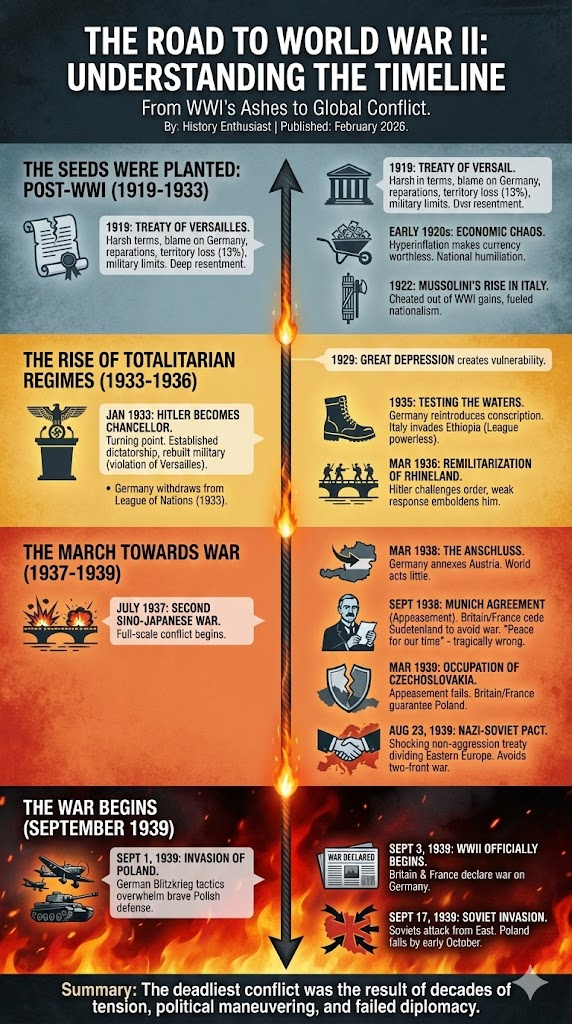
World War II didn’t just happen overnight. It was the result of decades of tension, unresolved conflicts, and political manuevering that eventually exploded into the deadliest conflict in human history. Understanding the timeline leading to this war helps us grasp how such a catastrophe could of happened and, hopefully, how to prevent similar tragedies in the future.
The Seeds Were Planted: Post-WWI (1919-1933)
The Treaty of Versailles in 1919 was suppose to bring lasting peace after World War I, but instead it planted the seeds for another global conflict. Germany was forced to accept full responsibility for the war, pay massive reparations, and give up significant territory. This created deep resentment among the German people.
Here are some imp factors from this period:
Germany lost about 13% of its territory and all overseas colonies. The military was severely restricted to just 100,000 troops. The war guilt clause humiliated the nation, and economic chaos followed with hyperinflation in the early 1920s making money practically worthless.
Meanwhile, Italy felt cheated despite being on the winning side. They didn’t recieve the territorial gains they expected, which fueled nationalist sentiments and paved the way for Mussolini’s rise to power in 1922.
The Rise of Totalitarian Regimes (1933-1936)
The Great Depression hit the world hard in 1929, and Germany was particularly vulnerable. Unemployment soared, and people desperately looked for solutions. This created the perfect storm for Adolf Hitler and the Nazi Party.
January 1933 marked a turning point when Hitler became Chancellor of Germany. Within months, he consolidated power, established a dictatorship, and began rebuilding the military in direct violation of the Versailles Treaty.
Some imp developments during this time include Germany’s withdrawal from the League of Nations in 1933, the reintroduction of conscription in 1935, and the remilitarization of the Rhineland in March 1936. Each of these actions challenged the post-war order, but Britain and France didn’t respond forcefully, emboldening Hitler further.
In Asia, Japan had already invaded Manchuria in 1931 and continued its agressive expansion into China. Italy invaded Ethiopia in 1935, demonstrating that the League of Nations was powerless to stop aggression.
The March Towards War (1937-1939)
By 1937, the world was clearly heading towards another major conflict, though many hoped it could still be avoided.
July 1937 saw the start of full-scale war between Japan and China following the Marco Polo Bridge incident. This conflict would eventually merge into the broader World War II.
In Europe, Hitler continued his expansion. March 1938 brought the Anschluss, the annexation of Austria into Germany. The world watched nervously but did little.
The Munich Agreement in September 1938 represents one of the most imp moments in pre-war history. Britain and France, desperate to avoid war, agreed to let Germany annex the Sudetenland region of Czechoslovakia. Prime Minister Neville Chamberlain famously declared it meant “peace for our time.” He was tragically wrong.
Hitler wasn’t satisfied. In March 1939, Germany occupied the rest of Czechoslovakia, making it clear that appeasement had failed. Britain and France finally realized they would have to stand firm.
When Germany demanded territory from Poland, Britain and France guaranteed Polish independence. But Hitler believed they were bluffing.
The world was shocked when Germany and the Soviet Union signed the Nazi-Soviet Pact on August 23, 1939. This non-aggression treaty included secret protocols dividing Eastern Europe between them. It removed Hitler’s fear of fighting a two-front war.
The War Begins (September 1939)
On September 1, 1939, German forces invaded Poland using Blitzkrieg tactics – lightning war. The Polish army fought bravely but was overwhelmed by Germany’s superior tactics and equipment.
Two days later, on September 3, Britain and France declared war on Germany, honoring their commitment to Poland. World War II had officially begun.
The Soviet Union invaded Poland from the east on September 17, and by early October, Poland had fallen. The Soviets also moved against the Baltic states and attacked Finland in November.
Why Understanding This Timeline Matters
Looking back at this timeline reveals several imp lessons. First, unresolved conflicts and punitive peace treaties can create conditions for future wars. The harsh treatment of Germany after WWI directly contributed to the rise of extremism.
Second, appeasement of aggressive dictators doesn’t work. Each time Hitler violated international agreements and faced no consequences, he became bolder. Earlier action might have prevented the wider war.
Third, economic instability can have dangerous political consequences. The Great Depression created desperation that authoritarian leaders exploited.
Finally, international institutions need real power to maintain peace. The League of Nations failed because it couldn’t enforce its decisions, a lesson that influenced the creation of the United Nations after WWII.
Conclusion
The path to World War II wasn’t inevitable, but it was shaped by choices made by leaders and nations over two decades. From the resentment created by Versailles to the failure of appeasement, each step brought the world closer to catastrophe.
Understanding this timeline helps us recognize warning signs in our own time. When we see rising nationalism, economic instability, or the erosion of international cooperation, we can remember where such paths have led before and work harder to choose different directions.
The sacrifices made during World War II – the millions who died, the cities destroyed, the trauma that echoed through generations – remind us why preventing such conflicts must always be a priority for humanity.