
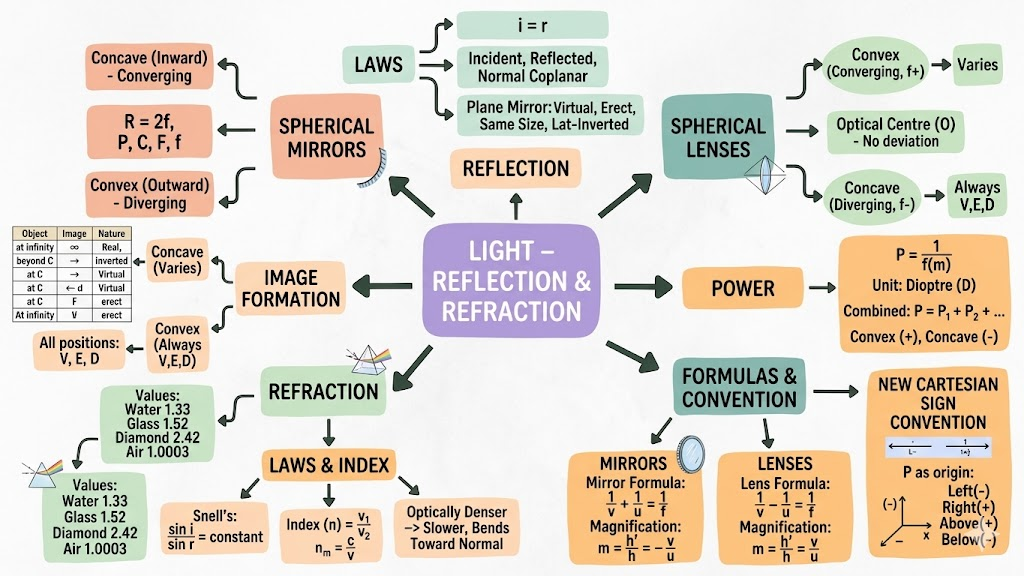
Understanding light is one of the most fascinating parts of Class 10 Science. This chapter walks you through how light bounces off mirrors, bends through lenses, and how you can calculate image positions using simple formulas. Read through each section carefully and use the solved examples to build your confidence before exams.
Reflection of Light
When light falls on a polished surface like a mirror, it bounces back. This is called reflection of light. You already know the two laws of reflection:
- The angle of incidence equals the angle of reflection.
- The incident ray, the reflected ray, and the normal at the point of incidence all lie in the same plane.
These laws apply to all reflecting surfaces, including curved ones.
A plane mirror always forms an image that is virtual, erect, same size as the object, as far behind the mirror as the object is in front, and laterally inverted.
Spherical Mirrors
A spherical mirror has a reflecting surface that forms part of a sphere. There are two types:
- Concave mirror – reflecting surface curves inward (like the inside of a bowl).
- Convex mirror – reflecting surface curves outward (like the back of a spoon).
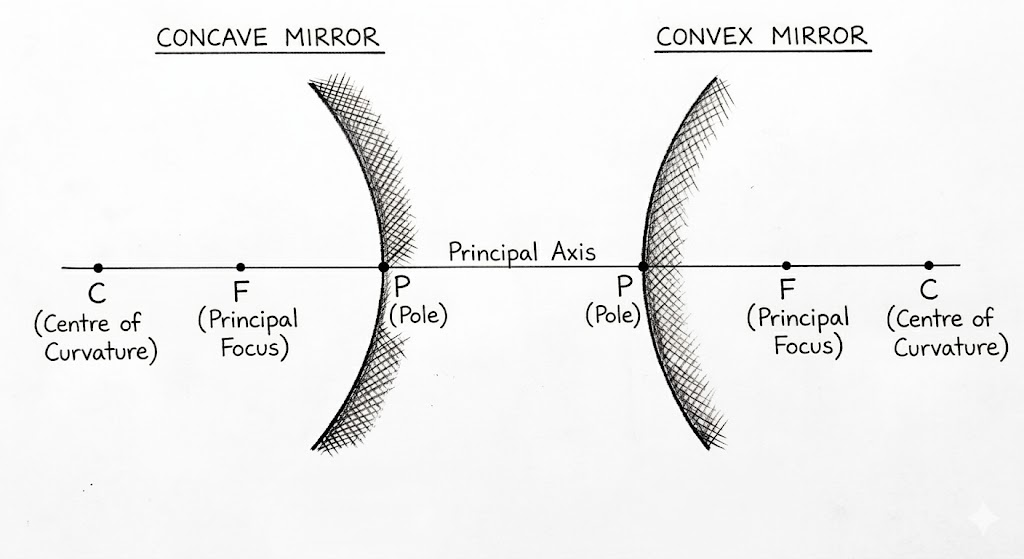
Imp Terms
| Term | Symbol | Definition |
|---|---|---|
| Pole | P | Centre point of the reflecting surface |
| Centre of Curvature | C | Centre of the sphere the mirror is part of |
| Radius of Curvature | R | Radius of that sphere; R = 2f |
| Principal Axis | — | Line through P and C |
| Principal Focus | F | Point where parallel rays meet (concave) or appear to diverge from (convex) |
| Focal Length | f | Distance from P to F; f = R/2 |
| Aperture | MN | Diameter of the reflecting surface |
The relationship between radius of curvature and focal length:
R=2fR = 2fR=2f
Image Formation by Spherical Mirrors
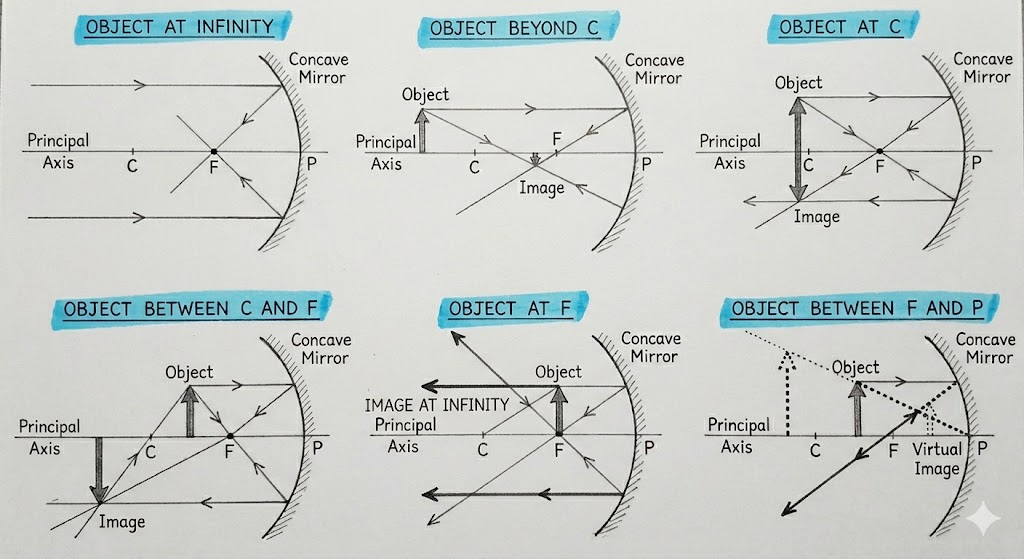
Concave Mirror – Image Table
| Position of Object | Position of Image | Size of Image | Nature of Image |
|---|---|---|---|
| At infinity | At focus F | Highly diminished, point-sized | Real and inverted |
| Beyond C | Between F and C | Diminished | Real and inverted |
| At C | At C | Same size | Real and inverted |
| Between C and F | Beyond C | Enlarged | Real and inverted |
| At F | At infinity | — | Image not formed |
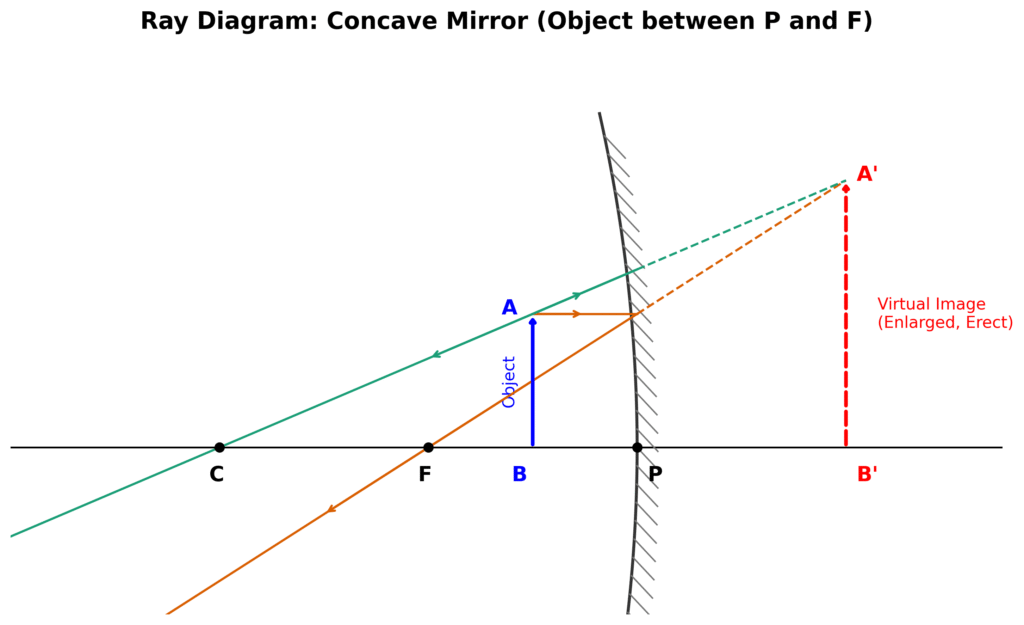
| Between P and F | Behind the mirror | Enlarged | Virtual and erect |
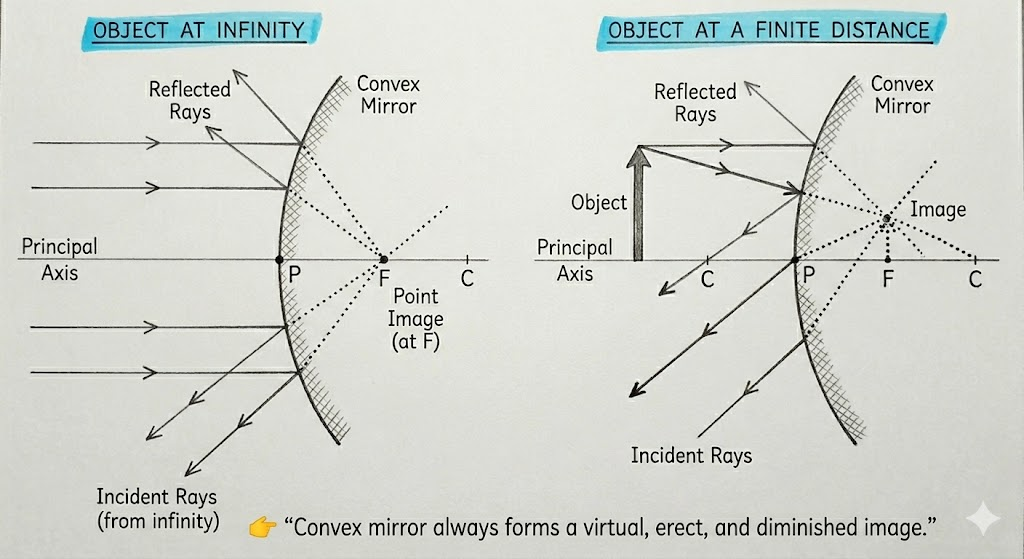
Convex Mirror – Image Table
| Position of Object | Position of Image | Size of Image | Nature of Image |
|---|---|---|---|
| At infinity | At focus F, behind mirror | Highly diminished, point-sized | Virtual and erect |
| Between infinity and P | Between P and F, behind mirror | Diminished | Virtual and erect |
Rules for Drawing Ray Diagrams
Use any two of these four standard rays:
- A ray parallel to the principal axis reflects through F (concave) or appears to diverge from F (convex).
- A ray through F reflects parallel to the principal axis (concave); a ray directed toward F reflects parallel to the axis (convex).
- A ray through C reflects back along the same path.
- A ray incident at pole P reflects at an equal angle to the principal axis.
Uses of Mirrors
Concave mirrors are used in:
- Torches, search-lights, and vehicle headlights (to get powerful parallel beams)
- Shaving mirrors (to see an enlarged image)
- Dentist’s mirrors
- Solar furnaces
Convex mirrors are used as:
- Rear-view (wing) mirrors in vehicles – they give a wider field of view and always produce an erect, diminished image.
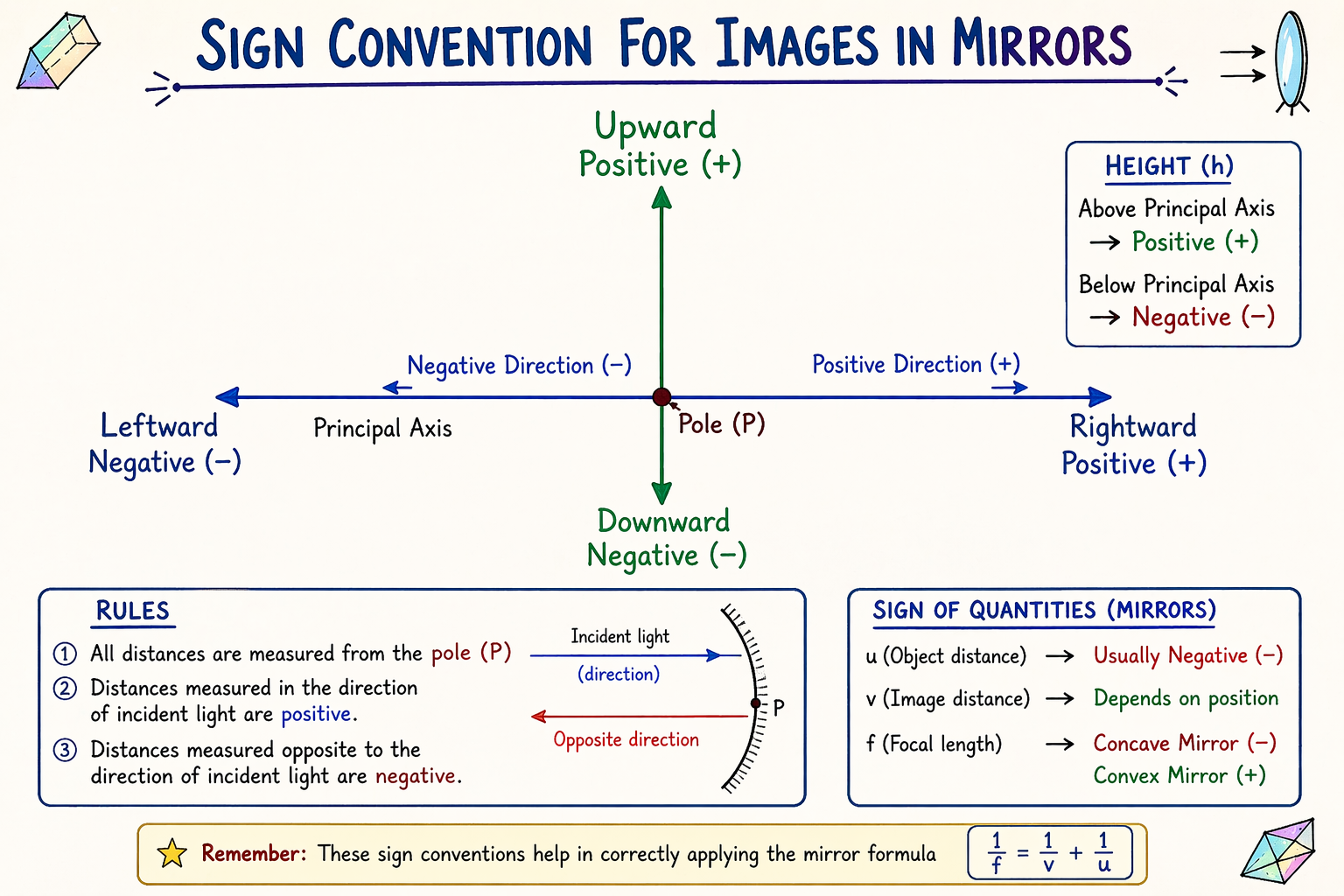
Sign Convention for Reflection by Spherical Mirrors
The New Cartesian Sign Convention uses the pole P as the origin:
- Object is always placed to the left of the mirror.
- Distances measured to the right of P are positive.
- Distances measured to the left of P are negative.
- Distances above the principal axis are positive.
- Distances below the principal axis are negative.
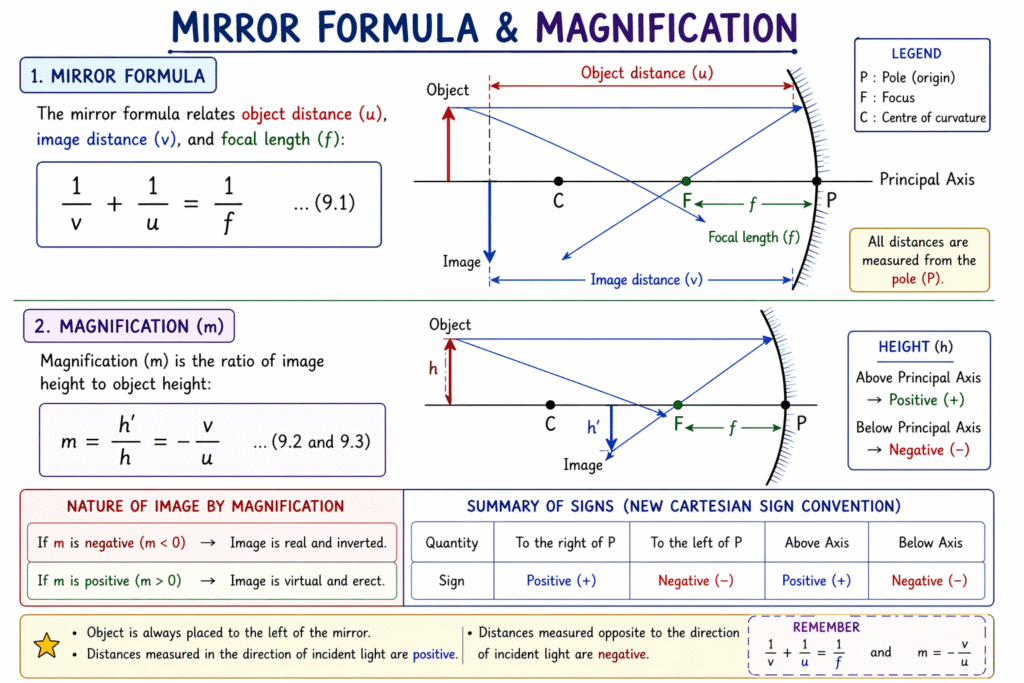
Mirror Formula and Magnification
Questions and Answers
Q1. Define the principal focus of a concave mirror.
The principal focus of a concave mirror is the point on the principal axis where all rays parallel to the principal axis converge after reflection.
Q2. The radius of curvature of a spherical mirror is 20 cm. What is its focal length?
10 cm
Q3. Name a mirror that can give an erect and enlarged image of an object.
A concave mirror gives an erect and enlarged image when the object is placed between the pole (P) and the principal focus (F).
Q4. Why do we prefer a convex mirror as a rear-view mirror in vehicles?
Convex mirrors always form a virtual, erect, and diminished image regardless of the object’s position. They also provide a wider field of view, allowing the driver to see more of the traffic behind.
Set 2 — Mirror Questions
Refraction of Light
When light travels from one transparent medium to another, it changes its direction at the interface. This bending of light is called refraction. Common examples include:
- A coin at the bottom of a water-filled bowl appears raised.
- A pencil partially dipped in water looks bent at the water surface.
- Letters appear raised when viewed through a glass slab.
Refraction happens because light travels at different speeds in different media.
Refraction through a Rectangular Glass Slab
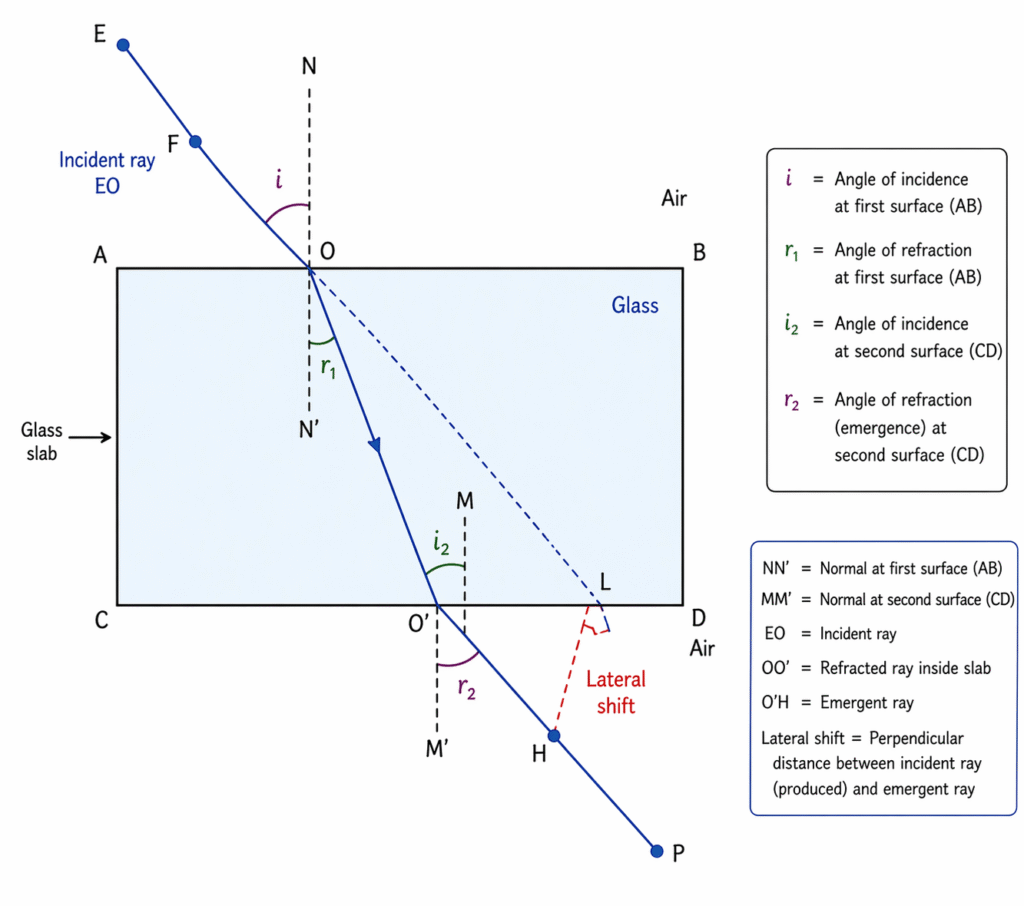
When a light ray passes through a rectangular glass slab:
- It bends toward the normal when entering glass from air (rarer to denser).
- It bends away from the normal when exiting glass to air (denser to rarer).
- The emergent ray is parallel to the incident ray but laterally shifted, because the bending at the two parallel faces is equal and opposite.
Laws of Refraction
- The incident ray, the refracted ray, and the normal to the interface at the point of incidence all lie in the same plane.
- Snell’s Law: The ratio of the sine of the angle of incidence to the sine of the angle of refraction is constant for a given pair of media and given colour of light.
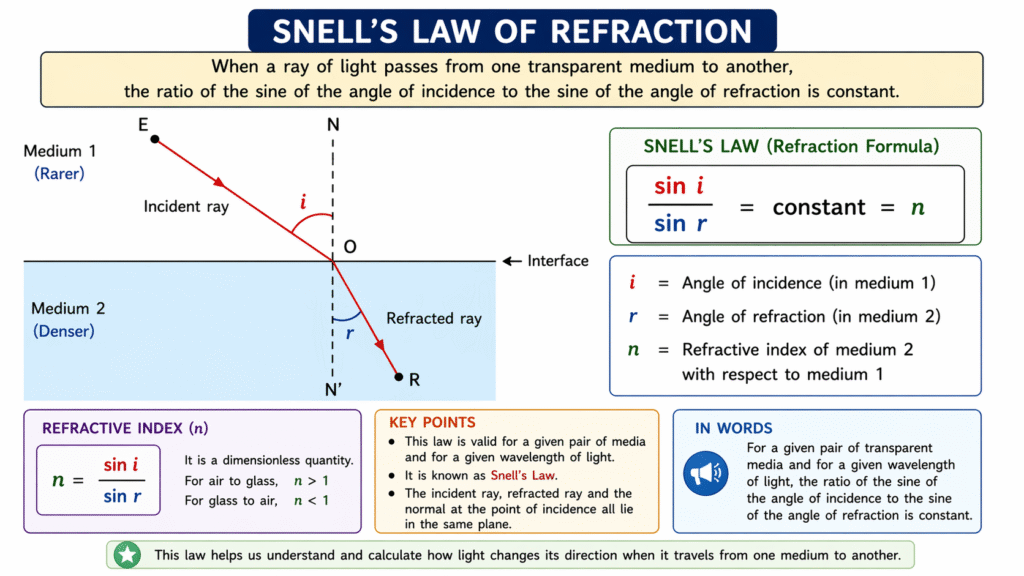
The Refractive Index
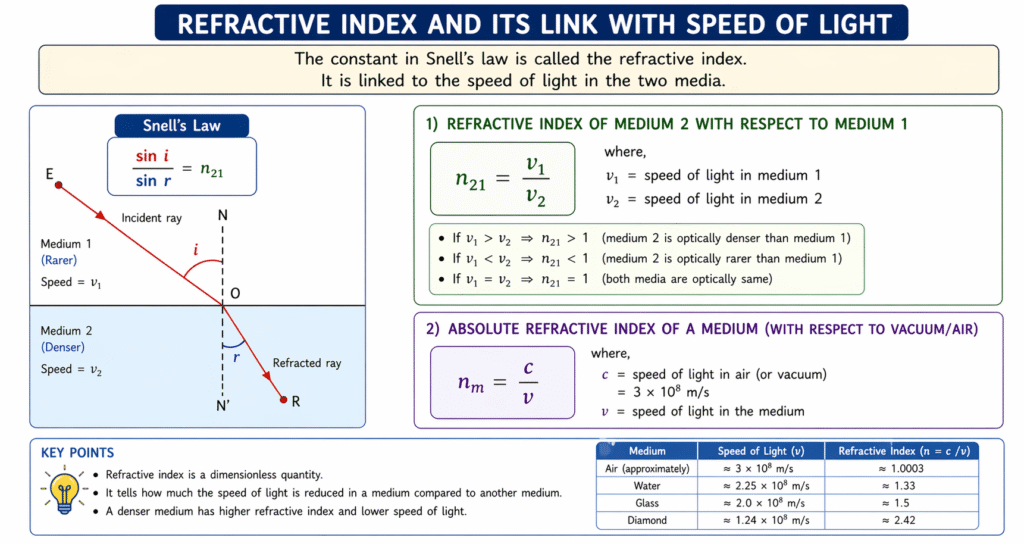
The constant in Snell’s law is called the refractive index. It is linked to the speed of light in the two media.
Refractive Index of Some Materials
| Material | Refractive Index | Material | Refractive Index |
|---|---|---|---|
| Air | 1.0003 | Crown glass | 1.52 |
| Ice | 1.31 | Rock salt | 1.54 |
| Water | 1.33 | Carbon disulphide | 1.63 |
| Alcohol | 1.36 | Dense flint glass | 1.65 |
| Kerosene | 1.44 | Ruby | 1.71 |
| Fused quartz | 1.46 | Sapphire | 1.77 |
| Turpentine oil | 1.47 | Diamond | 2.42 |
| Benzene | 1.50 | Canada Balsam | 1.53 |
A medium with a higher refractive index is optically denser. Light slows down and bends toward the normal in an optically denser medium.
Questions (Refraction Set)
Q1. A ray of light travelling in air enters obliquely into water. Does the light ray bend towards the normal or away from the normal? Why?
It bends towards the normal, because water is optically denser than air. Light slows down as it enters a denser medium, causing it to bend toward the normal.
Q2. Light enters from air to glass having refractive index 1.50. What is the speed of light in the glass? Speed of light in vacuum = 3×10⁸ m/s.
Q3. From Table 9.3, find the medium with highest and lowest optical density.
Highest optical density: Diamond (n = 2.42). Lowest optical density: Air (n = 1.0003).
Q4. In which of the following does light travel fastest – kerosene, turpentine, or water?
Light travels fastest in the medium with the lowest refractive index. From Table 9.3: Water (1.33) < Turpentine (1.47) < Kerosene (1.44). So light travels fastest in water.
Q5. The refractive index of diamond is 2.42. What is the meaning of this statement?
It means the ratio of the speed of light in air to the speed of light in diamond is 2.42. In other words, light travels 2.42 times slower in diamond than in air.
Refraction by Spherical Lenses
A lens is a transparent material bound by two surfaces, at least one of which is spherical.
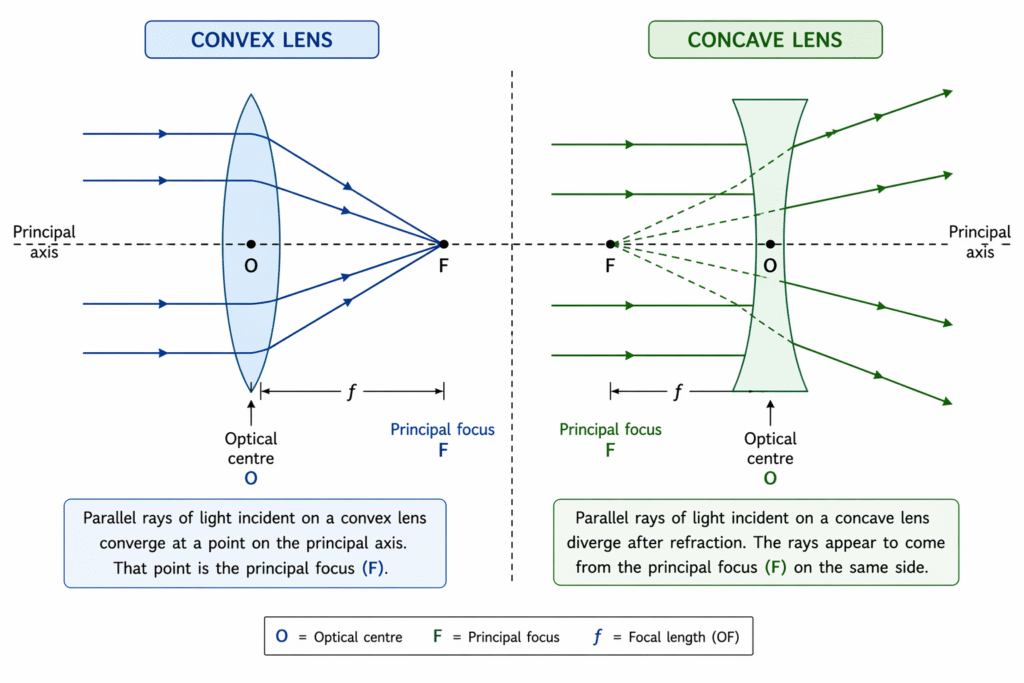
- Convex lens (converging lens): Thicker at the middle, bulges outward on both sides. Converges light rays.
- Concave lens (diverging lens): Thicker at the edges, curves inward on both sides. Diverges light rays.
Imp Terms for Lenses
| Term | Description |
|---|---|
| Optical Centre (O) | Central point of the lens; a ray through O passes without deviation |
| Principal Axis | Line through the two centres of curvature |
| Principal Focus (F) | Point where parallel rays converge (convex) or appear to diverge from (concave) |
| Focal Length (f) | Distance from O to F; positive for convex, negative for concave |
| Aperture | Effective diameter of the lens |
Image Formation by Lenses
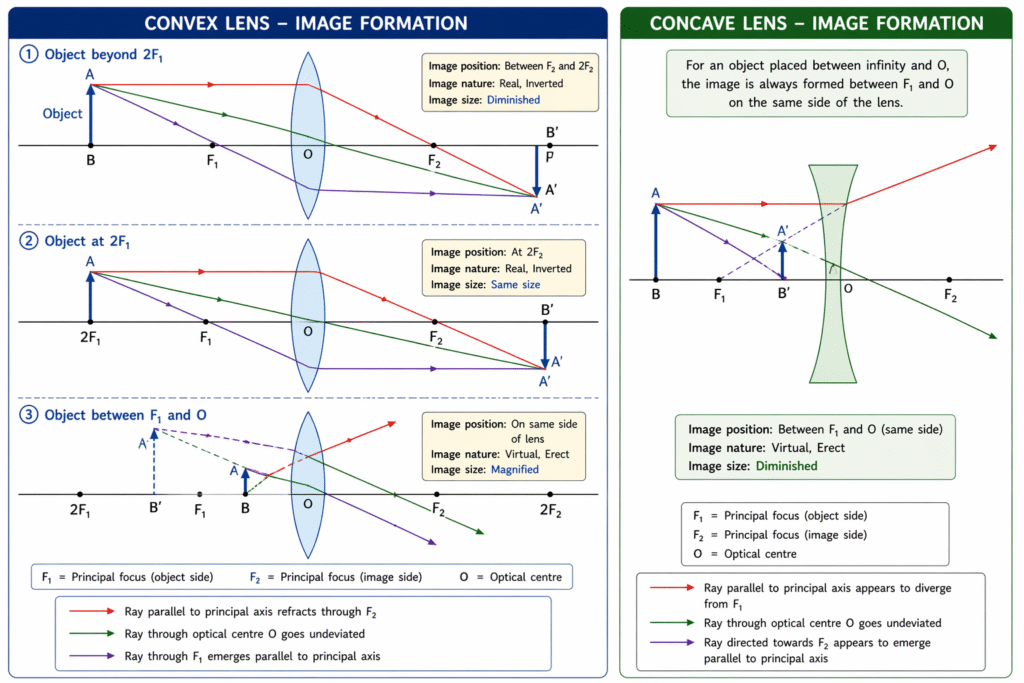
Convex Lens – Image Table
| Position of Object | Position of Image | Size of Image | Nature of Image |
|---|---|---|---|
| At infinity | At focus F₂ | Highly diminished, point-sized | Real and inverted |
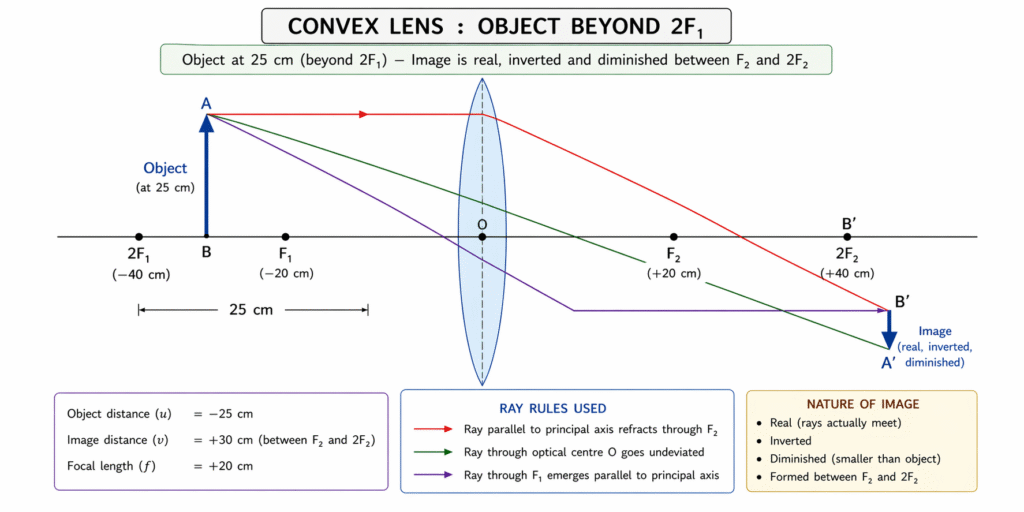
| Beyond 2F₁ | Between F₂ and 2F₂ | Diminished | Real and inverted |
| At 2F₁ | At 2F₂ | Same size | Real and inverted |
| Between F₁ and 2F₁ | Beyond 2F₂ | Enlarged | Real and inverted |
| At focus F₁ | At infinity | — | Image not formed |
| Between F₁ and O | Same side as object | Enlarged | Virtual and erect |
Concave Lens – Image Table
| Position of Object | Position of Image | Size of Image | Nature of Image |
|---|---|---|---|
| At infinity | At focus F₁ | Highly diminished, point-sized | Virtual and erect |
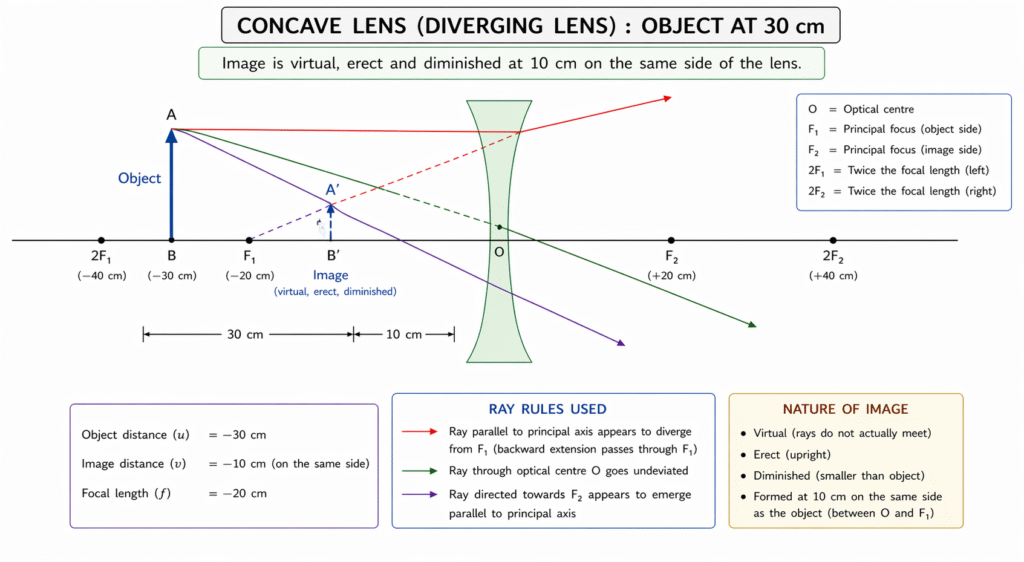
| Between infinity and O | Between F₁ and O | Diminished | Virtual and erect |
A concave lens always produces a virtual, erect, and diminished image regardless of the object’s position.
Rules for Drawing Ray Diagrams (Lenses)
- A ray parallel to the principal axis refracts through F₂ (convex) or appears to diverge from F₁ on the same side (concave).
- A ray through the principal focus F₁ emerges parallel to the principal axis after refraction.
- A ray through the optical centre O passes without any deviation.
Sign Convention for Spherical Lenses
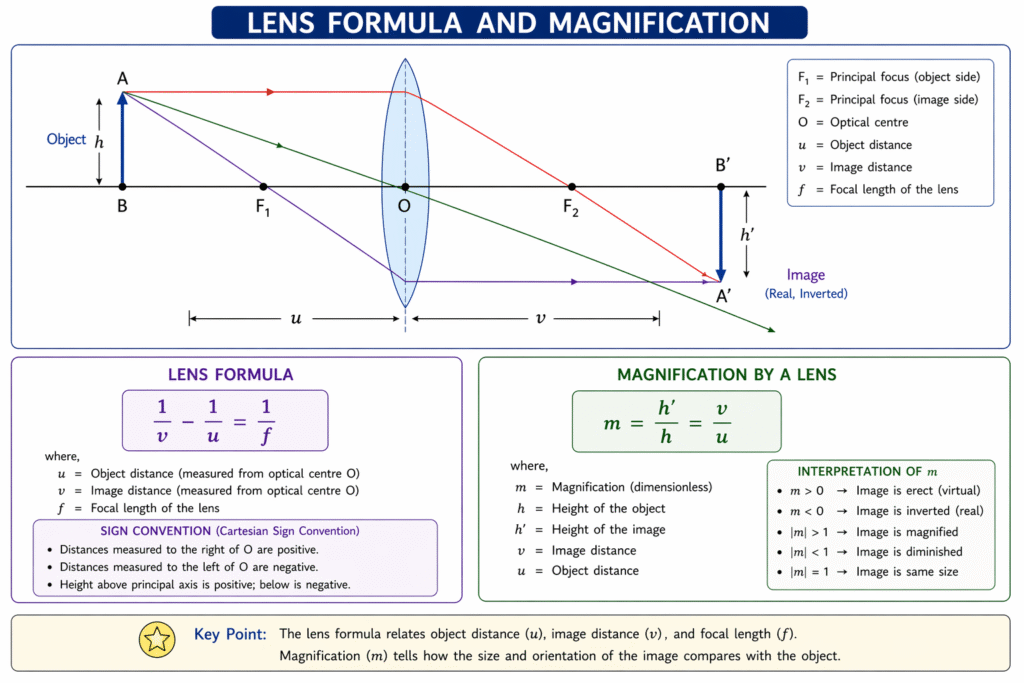
All distances are measured from the optical centre O:
- Distances in the direction of incident light (to the right) are positive.
- Distances opposite to incident light (to the left) are negative.
- Focal length of a convex lens: positive.
- Focal length of a concave lens: negative.
Lens Formula and Magnification
Power of a Lens
The power of a lens is the reciprocal of its focal length (in metres):
P = 1 / f …(9.11)
- ● SI unit: dioptre (D); 1 D = 1 m⁻¹
- ● Convex lens: Power is positive (+)
- ● Concave lens: Power is negative (−)
When several lenses are placed in contact, their net power is the algebraic sum:
P = P1 + P2 + P3 + …
This additive property is used by opticians during eye-testing to quickly calculate the required corrective lens.
Questions — Power of a Lens
Exercises – Solutions
Q1. Which material cannot be used to make a lens?
(d) Clay – Clay is opaque and cannot transmit light.
Q2. A concave mirror forms a virtual, erect, and larger image. Where is the object?
(d) Between the pole and its principal focus.
Q3. To get a real image of the same size from a convex lens, the object should be at:
(b) At twice the focal length (2F).
Q4. A spherical mirror and a lens each have focal length –15 cm. They are likely:
(a) Both concave – A negative focal length means concave mirror and concave lens.
Q5. Your image appears erect no matter how far you stand. The mirror is:
(d) Either plane or convex – Both always produce virtual, erect images.
Q6. To read small letters in a dictionary, you would prefer:
(c) A convex lens of focal length 5 cm – Short focal length convex lens gives greater magnification.
Q7. We wish to obtain an erect image using a concave mirror of focal length 15 cm. What should be the range of object distance?
Object should be placed between 0 and 15 cm (between pole P and principal focus F). The image formed is virtual, erect, and larger than the object.
Q8. Name the type of mirror used and give reason:
(a) Headlights of a car: Concave mirror – It converges light into a powerful parallel beam when the bulb is placed at its focus.
(b) Side/rear-view mirror: Convex mirror – It gives a wider field of view and always produces an erect, diminished image.
(c) Solar furnace: Concave mirror – It concentrates sunlight at the focus, generating intense heat.
Q9. If one half of a convex lens is covered with black paper, will it still form a complete image?
Yes, it will still form a complete image. Covering half the lens reduces the amount of light passing through, making the image less bright, but the image remains complete because every part of the lens forms the full image independently. You can verify this experimentally by covering half the lens and observing the image of a candle on a screen.
Q10. An object 5 cm long is held 25 cm from a converging lens of focal length 10 cm. Find the position, size, and nature of the image.
Q11. A concave lens of focal length 15 cm forms an image 10 cm from the lens. How far is the object?
Questions — Mirrors & Lenses
Download Free Mind Map PDF
This mind map contains all important topics of this chapter
Visit our Class 10 Science page for free mind maps of all Chapters