
Chapter 7 — Fractions
A fraction tells us how much each share is when a whole number of things is shared equally among a number of people. For example, if one roti is split equally between 2 children, each gets half a roti.
7.1 Fractional Units and Equal Shares
Which is bigger, 15 or 19? A common mistake is to think 19 is bigger because 9 is bigger than 5. But think of them as shares: sharing one roti among 9 children gives each a smaller piece than sharing among 5.
Figure it Out (Page 152)
1. Three guavas together weigh 1 kg. Each guava weighs about ___ kg.
Ans: 13 kg
2. 1 kg of rice packed into four equal packets. Each packet weighs ___ kg.
Ans: 14 kg
3. Four friends share 3 glasses of sugarcane juice equally. Each drinks ___ glass.
Ans: 34 glass
4. Big fish weighs 12 kg, small fish weighs 14 kg. Together they weigh ___ kg.
Ans: 34 kg
Knowledge from the Past
Fractions have been used in India since ancient times. In the Rig Veda, the fraction 34 is called tri-pada. Words for fractions in Indian languages today, like teen paav in Hindi and mukkaal in Tamil for 34, come from these ancient roots.
5. Arrange in order from smallest to biggest: one and a half, three quarters, one and a quarter, half, quarter, two and a half.
Ans: 14, 12, 34, 114, 112, 212
7.2 Fractional Units as Parts of a Whole
If a whole chikki is broken so that one small piece is 14, then a bigger piece containing three such 14 pieces measures 34 of the chikki. We can measure any part using a fractional unit.
Figure it Out (Page 155) — Fraction of each chikki piece
| Piece | a | b | c | d | e | f | g | h |
|---|---|---|---|---|---|---|---|---|
| Fraction | 112 | 14 | 18 | 16 | 18 | 16 | 124 | 124 |
7.3 Measuring Using Fractional Units
Take a paper strip as one unit. Folding it into 2 equal parts gives two pieces of 12 each. Folding again gives 4 equal parts of 14 each.
We describe a quantity by collecting together fractional units. For example, "3 times half" means 12 + 12 + 12 = 32, and "8 times 18" = 88 = 1.
Figure it Out (Page 158)
1. Continue the table of 12 for 2 more steps.
Ans: 6 times 12 = 62, and 7 times 12 = 72.
2. Make a similar table for 14.
Ans: 1 time = 14; 2 times = 24; 3 times = 34; 4 times = 44 = 1.
4. Addition statement for (a) 5 times 14 and (b) 9 times 14 of a roti.
Ans (a): 14+14+14+14+14 = 54. (b): nine 14 pieces = 94 = 2 + 14.
5. Match each fractional unit with its picture.
Ans: 13 → circle in 3 parts; 15 → circle in 5 parts; 16 → circle in 6 parts; 18 → circle in 8 parts.
7.4 Marking Fraction Lengths on the Number Line
The gap between 0 and 1 is one unit. If it is split into equal parts, each part is a fractional unit. For example, splitting 0 to 1 into two equal parts makes each part 12 unit long.
Figure it Out (Page 159 & 160)
P159 Q1. Unit split into 3 equal parts — length of the blue line.
Ans: 23
P159 Q2. Unit split into 5 equal parts — lengths of the blue lines.
Ans: 25 and 45
P159 Q3. Unit split into 8 equal parts — write the fractions.
Ans: 18, 28, 38, …
P160 Q3. How many fractions lie between 0 and 1?
Ans: An uncountable (endless) number of fractions.
P160 Q4. Length of the black line (blue line is 12).
Ans: 32
P160 Q5. Lengths of the black lines.
Ans: 65, 75, 85, 95
7.5 Mixed Fractions
Fractions greater than one
We can see how many whole units a fraction contains:
52 = 2 + 12 | 43 = 1 + 13 > 1
Figure it Out (Page 162 — top)
1. How many whole units in 72?
Ans: 3 whole units.
2. How many whole units in 43 and 73?
Ans: 1 whole in 43, and 2 wholes in 73.
Writing fractions greater than one as mixed numbers
Figure it Out (Page 162 — Q1, Q2, Q3)
1. Whole units in: a. 83 b. 115 c. 94
Ans: a. 2 b. 2 c. 2
2. Can all fractions greater than 1 be written as mixed numbers?
Ans: No. For example 84 = 2 is a whole number, so it cannot be written as a mixed number.
3. Write as mixed fractions.
| Fraction | Mixed number | |
|---|---|---|
| a | 92 | 412 |
| b | 95 | 145 |
| c | 2119 | 1219 |
| d | 479 | 529 |
| e | 1211 | 1111 |
| f | 196 | 316 |
Writing a mixed number as a regular fraction (Page 163)
For 3 + 34, since 1 = four 14's, we get (4×14)+(4×14)+(4×14)+(3×14) = 154.
Write the mixed numbers as fractions.
| a | b | c | d | e | f | |
|---|---|---|---|---|---|---|
| Mixed | 314 | 723 | 949 | 316 | 2311 | 3910 |
| Fraction | 134 | 233 | 859 | 196 | 2511 | 3910 |
7.6 Equivalent Fractions
Different fractions can stand for the same length or share. Using a fraction wall (paper strips), we can see that 12 = 24 = 48.
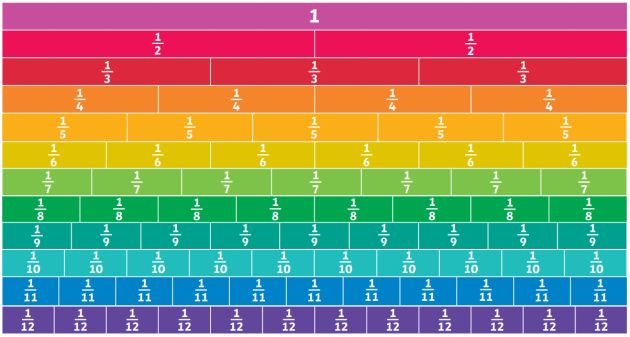
Figure it Out (Page 164)
1. Are 12 and 36 equal?
Ans: Yes.
2. Are 23 and 46 equivalent? Why?
Ans: Yes — they have the same length, which can be checked on the fraction wall.
3. How many 16 pieces make 12?
Ans: 3 pieces.
4. How many 16 pieces make 13?
Ans: 2 pieces.
Figure it Out (Page 165)
1. Are 36, 48, 510 equivalent? Why?
Ans: Yes — each equals 12, so their lengths are equal on the fraction wall.
2. Two equivalent fractions for 26.
Ans: 13 and 39 (others are possible too).
3. 46 = ? = ? = …
Ans: 46 = 23 = 69 = 812 = 1015 = …
Equivalent fractions using equal shares (Page 166)
When 1 roti is shared equally by 4 children, each gets 14. This can be written as facts:
Addition fact: 1 = 14+14+14+14
Multiplication fact: 1 = 4 × 14
1. Three rotis shared equally by four children.
Ans: Each child gets 34 roti.
Division: 3 ÷ 4 = 34.
Addition: 3 = 34+34+34+34.
Multiplication: 3 = 4 × 34.
2. Two rotis shared equally by four children.
Ans: Each gets 12 roti.
Division: 2 ÷ 4 = 24 = 12.
Addition: 2 = 12+12+12+12.
Multiplication: 2 = 4 × 12.
3. 2 cakes shared among 5 children — how much does Anil get?
Ans: 25 cake.
Figure it Out (Page 168)
1a. So, 54 = ?8
Ans: 10, so 54 = 108.
1b. So, 43 = 12?
Ans: 9, so 43 = 129.
1c. So, 75 = ?
Ans: One choice is 1410 (other equivalent options work too).
Comparing shares (Page 169–170)
Q (P170). Explain why 15 < 25, 37 < 47, 12 < 58.
Ans: With the same number of children but more units to share, each child gets a larger share.
Which of the two groups gives a larger share? Which was easier to compare?
Ans: In part 2, Group 1 share = 47, Group 2 share = 57, and 57 > 47. Part 2 is easier because the number of children is the same, so we just compare numerators.
Making same denominators (Page 171)
To compare 34 and 710, make both denominators the same. Using 40 (product of 4 and 10): 34 = 3040 and 710 = 2840. Since 3040 > 2840, we get 34 > 710.
Figure it Out (Page 172) — Same fractional unit
| Given pair | Equivalent (same denominator) | |
|---|---|---|
| a | 72, 35 | 3510 and 610 |
| b | 83, 56 | 166 and 56 |
| c | 34, 35 | 1520 and 1220 |
| d | 67, 85 | 3035 and 5635 |
| e | 94, 52 | 94 and 104 |
| f | 110, 29 | 990 and 2090 |
| g | 83, 114 | 3212 and 3312 |
| h | 136, 19 | 3918 and 218 |
Lowest terms (simplest form)
Example: 1620 — both are divisible by 4, so 16 ÷ 420 ÷ 4 = 45 (lowest terms). This can also be done step by step, e.g. 3660 → 1830 → 915 → 35.
Figure it Out (Page 173) — Lowest terms
| a | b | c | d | |
|---|---|---|---|---|
| Fraction | 1751 | 64144 | 126147 | 525112 |
| Lowest terms | 13 | 49 | 67 | 7516 |
7.7 Comparing Fractions
- Change all fractions to equivalent fractions with the same denominator.
- Compare the numerators — the larger numerator means the larger fraction.
Example: Compare 45 and 79. Using 45 as the common denominator: 45 = 3645 and 79 = 3545. Since 36 > 35, 45 > 79.
Figure it Out (Page 174)
1. Compare and justify.
Ans: a. 83 > 52 b. 49 > 37 c. 710 > 914 d. 125 > 85 e. 94 < 52
2. Write in ascending order.
Ans: a. 25 < 710 < 1115 b. 712 < 1924 < 56
3. Write in descending order.
Ans: a. 134 > 2516 > 78 > 1732 b. 125 > 54 > 34 > 712
7.8 Addition and Subtraction of Fractions
Adding fractions with the same denominator
Example: 25 + 15 = 35. And 47 + 67 = 107 = 137.
Adding fractions with different denominators — Brahmagupta's Method
- Change the fractions to equivalent fractions with a common denominator (a common multiple of the denominators).
- Add the numerators, keeping the same denominator.
- Write the answer in lowest terms if needed.
Example: 14 + 13 = 312 + 412 = 712.
Figure it Out (Page 179)
| Q1 | Sum | Answer |
|---|---|---|
| a | 27+57+67 | 137 |
| b | 34+13 | 1312 |
| c | 23+56 | 96 = 32 |
| d | 23+27 | 2021 |
| e | 34+13+15 | 7760 |
| f | 23+45 | 2215 |
| g | 45+23 | 2215 |
| h | 35+58 | 4940 |
| i | 92+54 | 234 |
| j | 83+27 | 6221 |
| k | 34+13+15 | 7760 |
| l | 23+45+37 | 199105 |
| m | 92+54+76 | 8312 |
2. Rahim mixes 23 L yellow paint with 34 L blue paint. Total green paint?
Ans: 1512 litres.
3. Geeta bought 25 m lace, Shamim bought 34 m. Total? Enough for a 1 m border?
Ans: Total = 1320 m. Yes, it is enough to cover the whole 1 m border.
Subtraction of fractions
- Change the fractions to the same denominator.
- Subtract the numerators, keeping the denominator.
- Reduce to lowest terms if needed.
Same denominator example: 67 − 47 = 27. Different denominator example: 34 − 23 = 912 − 812 = 112.
Figure it Out (Page 181 — same denominator)
| Problem | Answer | |
|---|---|---|
| 1 | 58 − 38 | 28 = 14 |
| 2 | 79 − 59 | 29 |
| 3 | 1027 − 127 | 927 = 13 |
Figure it Out (Page 182)
| Q1 | Problem | Answer |
|---|---|---|
| a | 815 − 315 | 13 |
| b | 25 − 415 | 215 |
| c | 56 − 49 | 718 |
| d | 23 − 12 | 16 |
2. Subtract as indicated.
Ans: a. 134 from 103 = 112 b. 185 from 233 = 6115 c. 297 from 457 = 167
3a. Jaya's school is 710 km away. She takes an auto for 12 km, then walks the rest. How far does she walk?
Ans: 710 − 12 = 15 km.
3b. Jeevika takes 103 min for a round; Namit takes 134 min. Who is faster, and by how much?
Ans: Namit takes less time, by 112 minutes.
7.9 A Pinch of History
In ancient India a fraction was called bhinna (Sanskrit for "broken"), also bhaga or ansha meaning "part" or "piece". The way we write fractions today started in India — the Bakshali manuscript (about 300 CE) already wrote them in a form close to ours.
Ancient Egyptian and Babylonian cultures mostly used only unit fractions (with 1 on top). Other fractions were written as sums of unit fractions, now called "Egyptian fractions", for example 1924 = 12 + 16 + 18. Indian methods later spread to Europe through the Arabs and came into common use around the 17th century.
- Two different unit fractions cannot add to 1 (since 12 is the largest and 12+12 uses the same unit twice).
- Three different unit fractions: only one answer — 12 + 13 + 16 = 1.
- Four different unit fractions: this has six possible solutions.
Imp Terms to Remember
- Fraction: the result of dividing a whole into equal parts and sharing equally.
- Fractional unit: one equal part of a whole (like 13).
- Numerator / Denominator: in 56, 5 is the numerator, 6 is the denominator.
- Mixed fraction: a whole number part plus a fraction part less than 1.
- Equivalent fractions: different fractions showing the same value.
- Lowest terms: numerator and denominator have no common factor except 1.
- Brahmagupta's method: make denominators equal, then add or subtract numerators.