
Understanding Mixtures
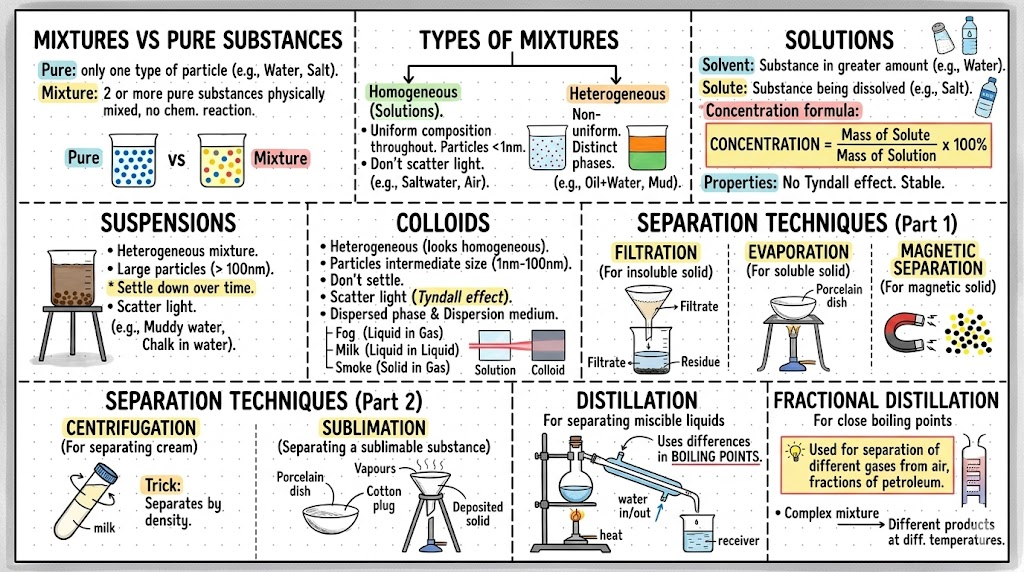
Mixtures are all around us—from the air we breathe to the food we eat. Understanding how to classify and separate mixtures helps us obtain pure substances needed in medicine, industry, and daily life.
1. How Can We Classify Mixtures?
Mixtures can be classified based on their uniformity of composition.
Homogeneous Mixtures (Solutions)
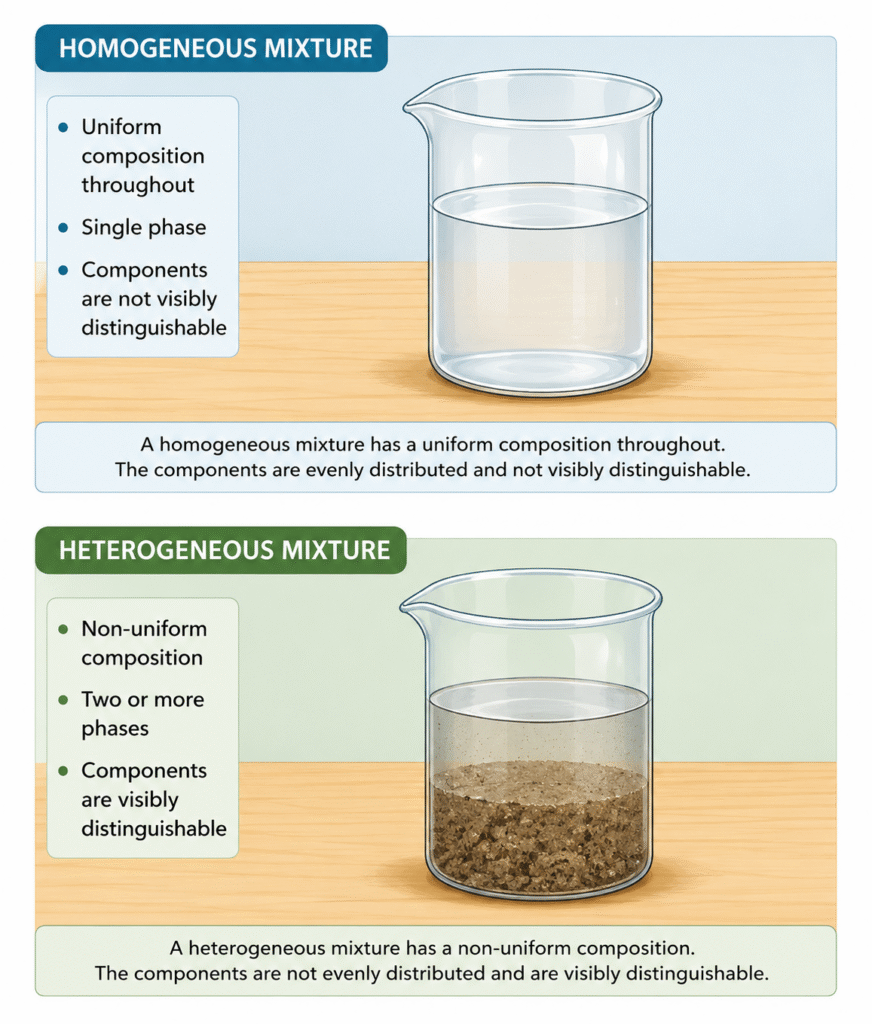
A homogeneous mixture has uniform composition throughout. When you dissolve sugar in water and stir it well, every sip tastes equally sweet—this is a homogeneous mixture, also called a solution. The sugar particles are evenly distributed and cannot be seen.
Examples of homogeneous mixtures:
- Vinegar (acetic acid in water)
- Aerated drinks like soda (carbon dioxide in water)
- Salt solution
- Brass (mixture of metals)
Heterogeneous Mixtures
A heterogeneous mixture does not have uniform composition. When you mix sand and water, the sand particles are easily visible and settle over time. The mixture is not uniform throughout.
Examples of heterogeneous mixtures:
- Sand and water
- Oil and water
- Milk (appears uniform but is actually heterogeneous)
Distinguishing Between Different Types of Mixtures
When you pass laser light through different mixtures, they behave differently:
- Salt and water (Solution): Light passes through without scattering; path not visible
- Chalk powder and water (Suspension): Light scatters; path becomes visible
- Milk and water (Colloid): Light scatters; path becomes visible even though mixture appears homogeneous
This scattering of light helps identify the type of mixture.
2. Solutions
Solutions are homogeneous mixtures formed when a solute (substance that dissolves) mixes with a solvent (substance that dissolves the solute). In sugar water, sugar is the solute and water is the solvent.
2.1 Concentration of a Solution
The concentration tells us how much solute is present in a given amount of solvent or solution. Getting the right concentration is essential in many situations:
- Preparing Oral Rehydration Solution (ORS) requires exact amounts of salt and sugar
- Farmers must mix the correct amount of pesticide with water
- Medicines need precise concentrations to be effective
The amount of solute dissolved in a given amount of solvent or solution is termed the concentration of the solution.
Dilip Mahalanabis, an Indian paediatrician, developed and implemented ORS treatment for dehydration caused by diarrhoea and cholera. This formulation has saved millions of lives worldwide after the World Health Organization popularized it.
2.2 How Do We Express Concentration?
Concentration can be expressed in several ways. The most common method uses percentages.
A. Mass by Mass Percentage (% m/m or % w/w)
This method tells us how many grams of solute are present in 100 grams of total solution.
Formula: Mass by mass percentage = (Mass of solute / Mass of solution) × 100
This method is used for:
- Labeling packaged foods (showing salt, sugar, protein content)
- Milk powder composition
- Spice mixtures
Example: If 10 g of salt dissolves in 90 g of water, what is the mass by mass percentage?
Solution:
- Mass of salt (solute) = 10 g
- Mass of water (solvent) = 90 g
- Total mass of solution = 10 g + 90 g = 100 g
- Mass by mass percentage = (10 g / 100 g) × 100 = 10% m/m
B. Mass by Volume Percentage (% m/v or % w/v)
This method tells us how many grams of solute are present in 100 milliliters of solution. It is used when measuring volume is easier than weighing.
Formula: Mass by volume percentage = (Mass of solute / Volume of solution) × 100
This method is commonly used in:
- Medicines and pharmaceuticals
- Laboratory solutions
- Glucose solutions
Example: If 5 g of glucose dissolves in water to make 100 mL of solution, what is the mass by volume percentage?
Solution:
- Mass of glucose (solute) = 5 g
- Volume of solution = 100 mL
- Mass by volume percentage = (5 g / 100 mL) × 100 = 5% m/v
A saline drip in hospitals is usually 0.9% m/v sodium chloride (common salt) in water—meaning 0.9 g of salt in 100 mL of solution. This concentration is safe for blood and replaces lost fluids in the body.
C. Volume by Volume Percentage (% v/v)
This method tells us how many milliliters of solute are present in 100 milliliters of solution. It is used when mixing two miscible liquids.
Formula: Volume by volume percentage = (Volume of solute / Volume of solution) × 100
This method is used in:
- Perfumes and cosmetics
- Vinegar (acetic acid in water)
- Alcoholic beverages
Example: If 1 mL of liquid pesticide mixes with water to form 100 mL of pesticide spray, what is the volume by volume percentage?
Solution:
- Volume of pesticide (solute) = 1 mL
- Total volume of solution = 100 mL
- Volume by volume percentage = (1 mL / 100 mL) × 100 = 1% v/v
Imp Note: In industries, weight by weight percentage (% w/w) is commonly used, as weight and mass are generally used interchangeably. Numerically, % m/m and % w/w are equal.
2.3 Solubility of Substances
Solubility is the maximum amount of solute that dissolves in a fixed quantity of solvent (100 mL or 100 g) at a given temperature. When no more solute can dissolve at that temperature, the solution is called a saturated solution.
Temperature affects solubility:
- For solid solutes in liquid solvents: solubility generally increases with temperature
- For gases dissolved in liquids: solubility generally decreases with temperature
Solubility Curves
A solubility curve shows how solubility changes with temperature. Different substances have different solubility patterns.
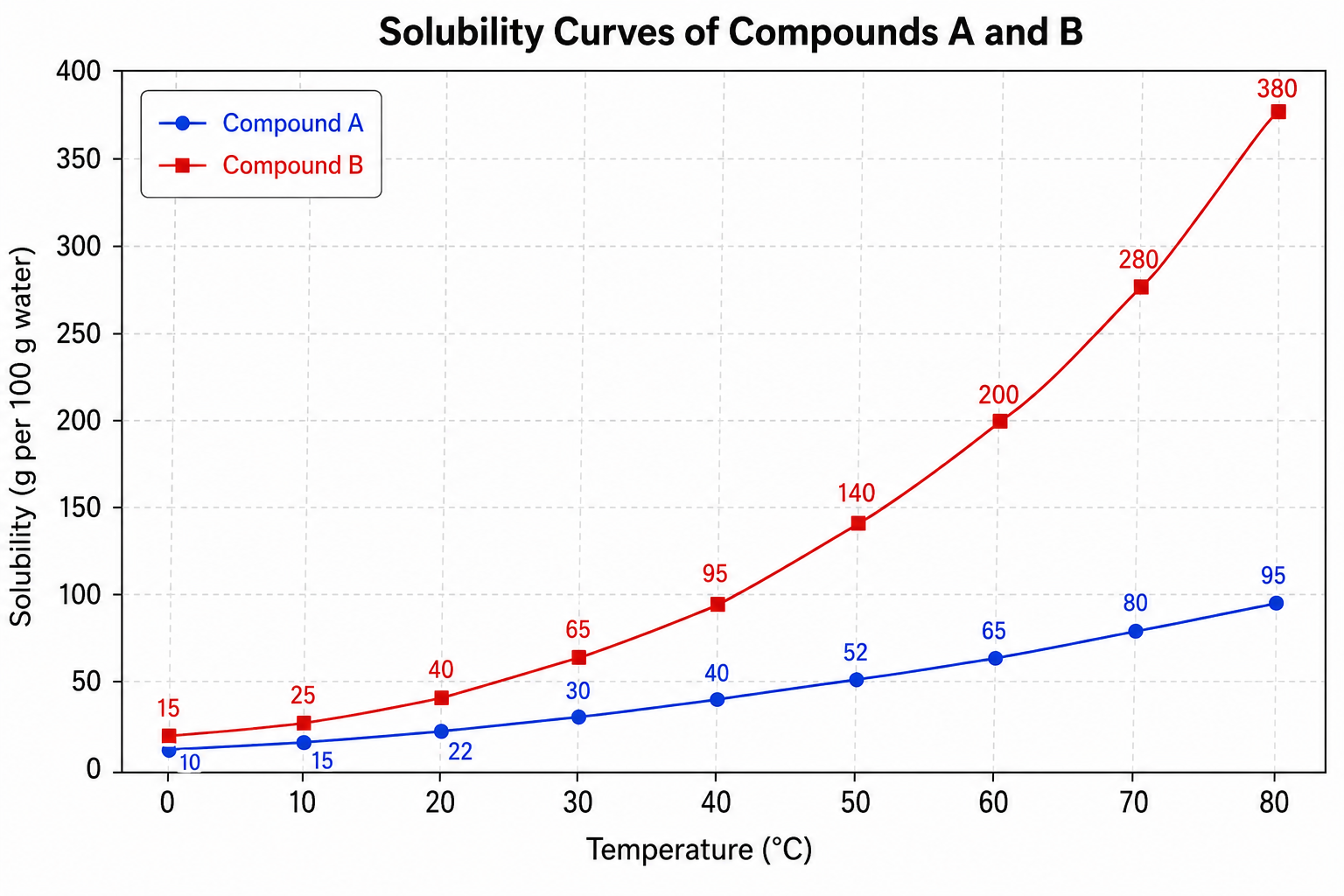
From solubility curves, you can:
- Determine how much solute dissolves at a specific temperature
- Compare solubility of different substances
- Predict what happens when a saturated solution cools
3. Methods of Separation of Homogeneous Mixtures
3.1 Crystallization
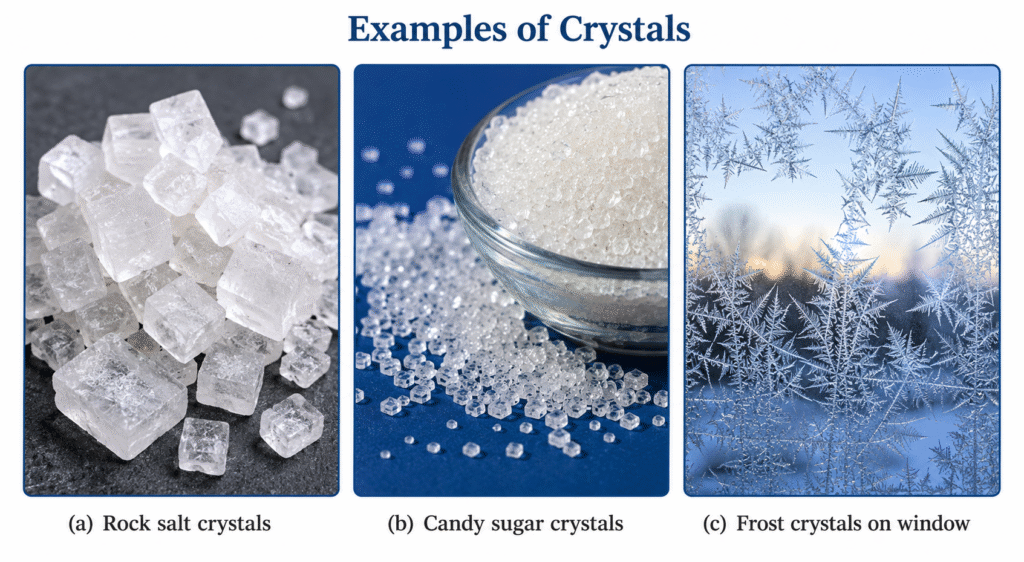
Crystallization is the process of forming crystals from a saturated solution. A crystal is a solid with particles arranged in a regular geometric pattern.
Natural crystals include:
- Rock salt crystals
- Sugar crystals (mishri in Hindi)
- Snowflakes (frozen water vapor)
- Frost on windows (ice crystals from water vapor)
Laboratory Crystallization Process
To prepare pure copper sulfate crystals:
- Take copper sulfate and add it to water in a beaker with a drop of dilute sulfuric acid
- Heat gently in a water bath while stirring
- Keep adding copper sulfate until the solution becomes saturated
- Filter the hot solution to remove insoluble impurities
- Allow the solution to cool slowly without disturbance
- Large, shiny, well-shaped blue crystals form
- Filter and rinse the crystals with cold water, then dry them
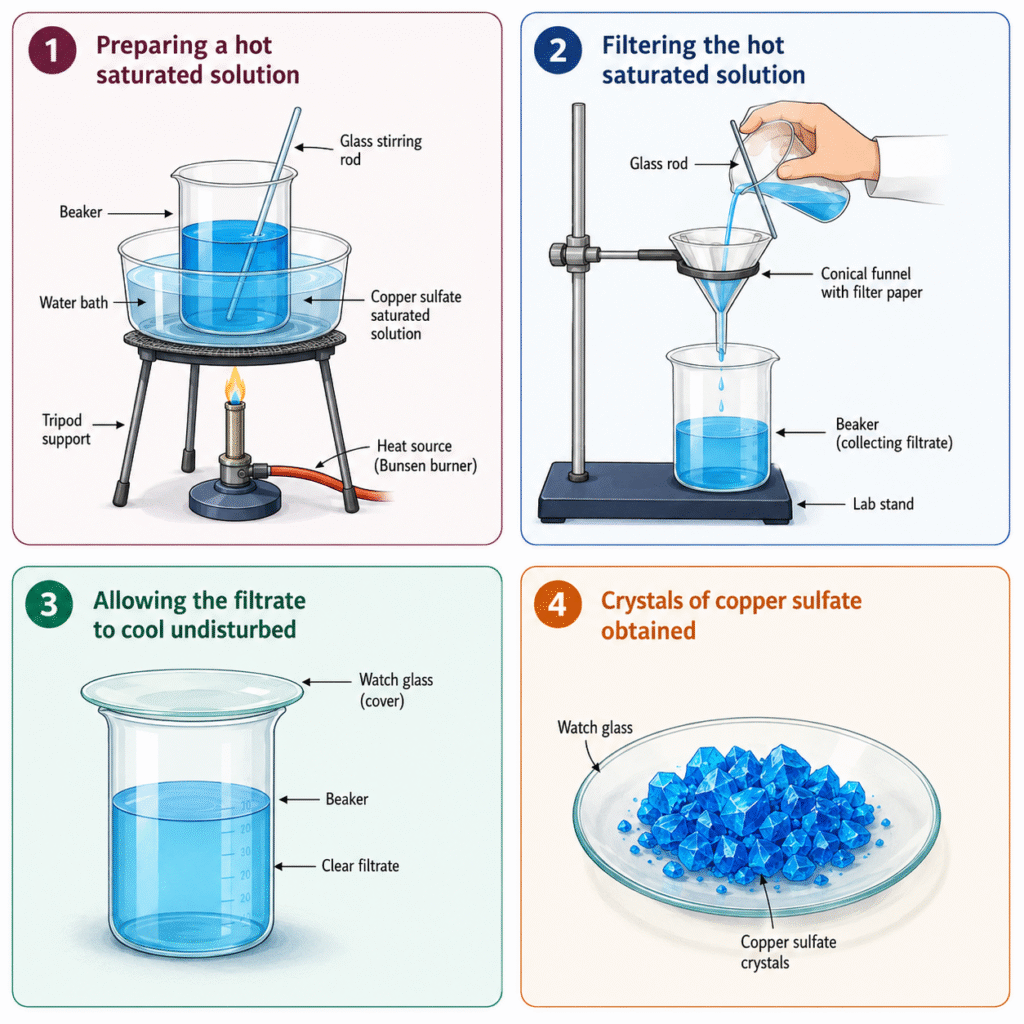
Why Slow Cooling Matters
Slow cooling gives particles enough time to arrange into larger, well-formed crystals. Rapid cooling produces smaller, less defined crystals.
Imp Note: Sulfuric acid is required for crystallization of only some salts, not all.
Applications of Crystallization
Crystallization is used for:
- Separating pure substances from mixtures
- Purifying compounds in laboratories
- Obtaining salt from seawater
- Manufacturing sugar from sugarcane juice
Salt Production from Seawater
Seawater → Evaporation in shallow ponds → Saturated solution → Further evaporation → Salt crystals
Natural Crystal Formations
Large natural crystals can be found in:
- Mines and caves (like Mawsmai Cave in Cherrapunji)
- Earth’s crust
- Quartz formations
In ancient India, crystallization of salt was practiced by coastal communities. Two types were produced:
- Panga salt: obtained by boiling concentrated sea brines
- Karkatch salt: produced by evaporation of seawater
3.2 Distillation
Distillation separates a homogeneous mixture of two miscible liquids by heating. The liquid with the lower boiling point vaporizes first, then the vapor cools and condenses back into pure liquid.
When to Use Distillation
Distillation works well when:
- Separating two liquids that differ in boiling point by at least 25°C
- Recovering a liquid from a solution containing dissolved solids
- You want to recover both the solvent and solute
The Distillation Process
Liquid → Heating → Vapour → Cooling → Liquid (Distillate)
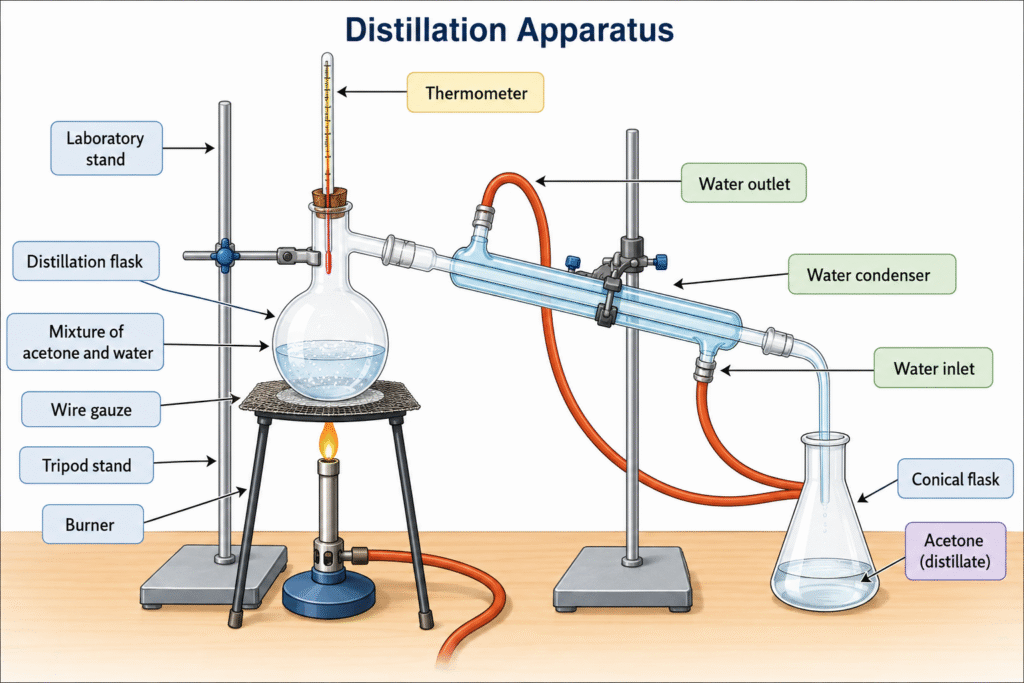
Example: Separating Acetone and Water
- Acetone boiling point: 56°C
- Water boiling point: 100°C
- Difference: 44°C (sufficient for distillation)
When heated:
- Acetone vaporizes first at 56°C
- Vapors pass through condenser
- Cool water circulates around condenser
- Acetone vapor condenses to liquid
- Pure acetone collects in receiving flask
- Water remains in distillation flask
Traditional Indian Application: Mitti ka Ittar
In Kannauj, Uttar Pradesh (the perfume capital of India), traditional distillation captures the earthy fragrance after first rain. The Deg-Bhapka method, passed down through generations, produces natural perfume called Mitti ka Ittar, which is in great demand worldwide.
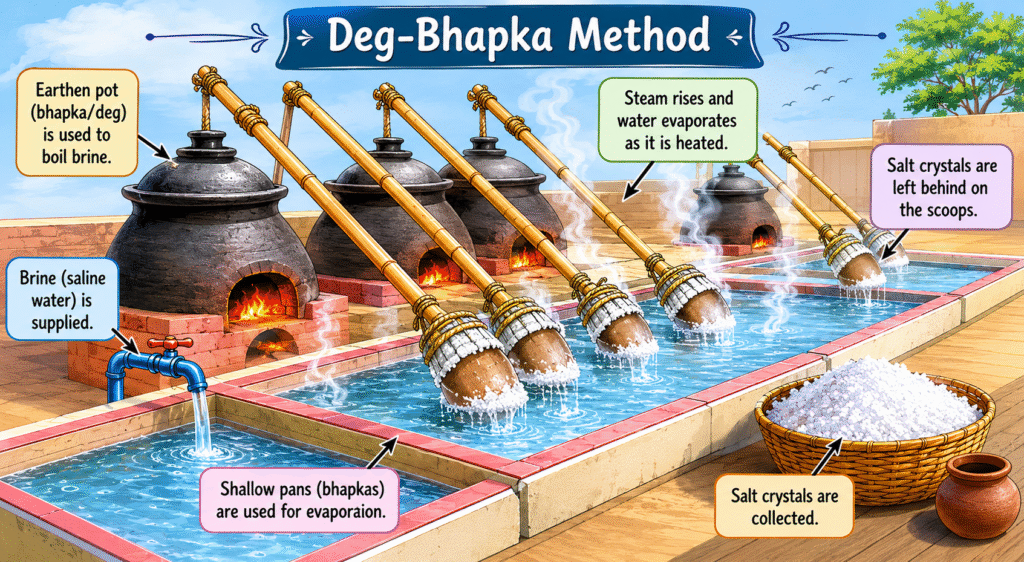
The Fragrance and Flavour Development Centre in Kannauj:
- Separates fragrance components from flowers and leaves
- Supports farmers in cultivating fragrance-producing plants
- Provides expertise for perfume businesses
Fractional Distillation
Fractional distillation separates mixtures with smaller differences in boiling points (less than 25°C). It is used in petroleum refineries to separate crude oil into useful products.
Crude petroleum contains mixtures of:
- Petroleum gas
- Petrol
- Aviation fuel (kerosene)
- Diesel
- Lubricating oil
- Bitumen
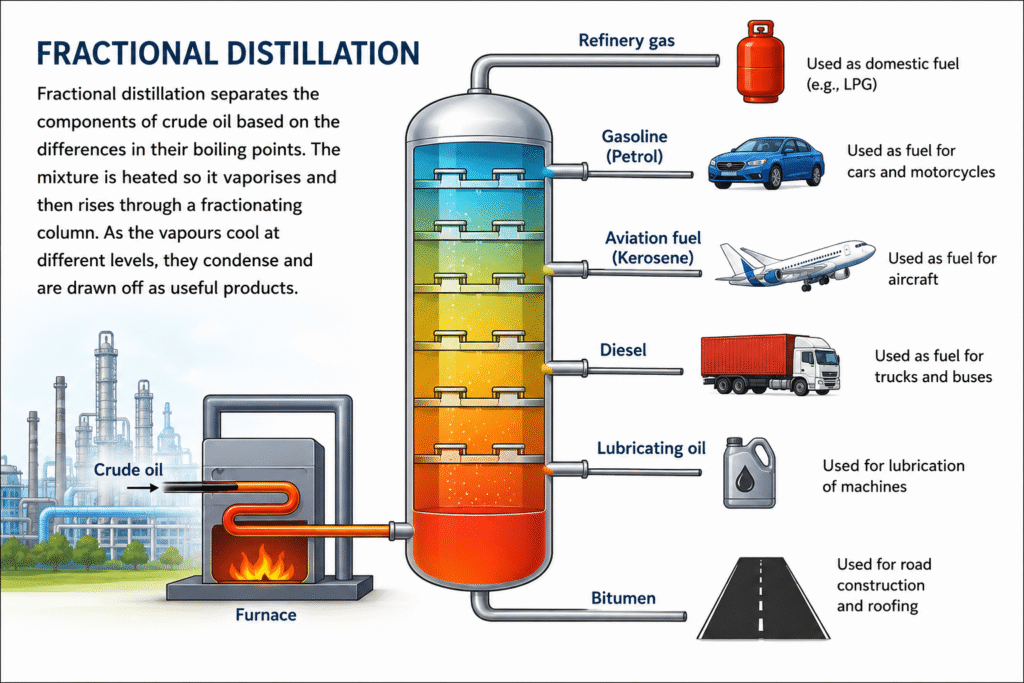
The gaseous fraction is compressed and liquefied to form Liquefied Petroleum Gas (LPG) used as domestic fuel.
3.3 Paper Chromatography
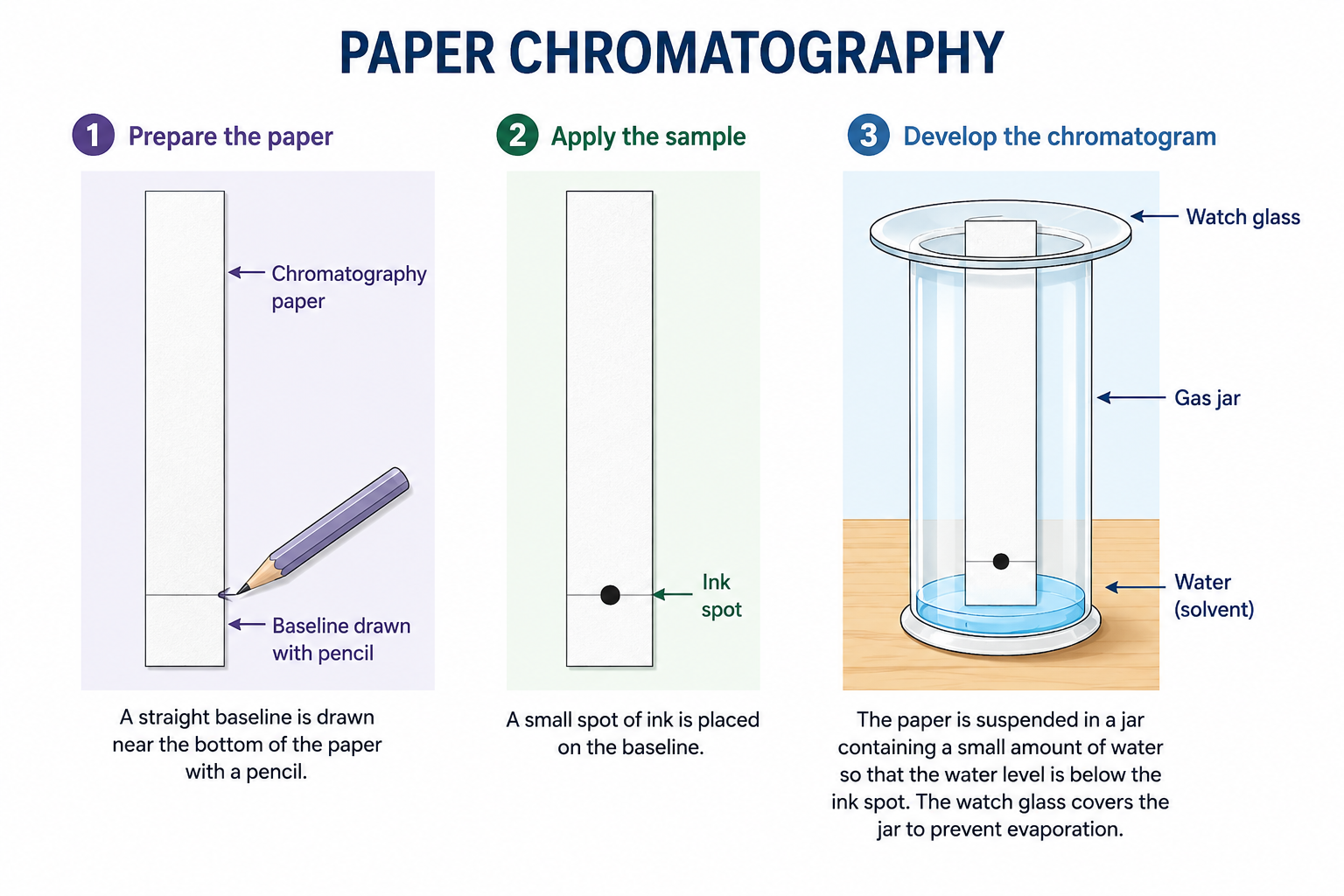
Paper chromatography separates components of a mixture based on differences in how they interact with the solvent and paper.
Performing Paper Chromatography
- Take a strip of chromatographic paper (or filter paper)
- Draw a horizontal line 2 cm from the bottom with pencil
- Mark a spot with the sample (like black sketch pen ink) at the center of the line
- Place the paper strip vertically in a container with a thin layer of water
- Ensure the water level is below the spot
- Watch as water rises through the paper
- Ink separates into different colored spots
How It Works
As water (solvent) rises through the paper:
- Different components in the ink move at different rates
- Components that interact more with water move faster
- Components that stick more to paper move slower
- This causes separation into distinct colored bands
Applications
Paper chromatography can separate:
- Colored dyes and inks
- Pigments from green leaves (spinach extract)
- Colored pigments from flower petals
- Food colors
Choosing the Right Solvent
Water works as a solvent for some substances, but others may require:
- Alcohol
- A mixture of solvents
The word ‘chromatography’ comes from Greek: chroma (color) + graphein (to write), meaning ‘writing with color’—because it was first used to separate colored substances.
4. How Can We Separate the Components of Heterogeneous Mixtures?
4.1 Separation of Two Immiscible Liquids
Immiscible liquids do not mix and form separate layers. Examples include:
- Oil and water
- Mustard oil and water
Using a Separating Funnel
- Pour the mixture of immiscible liquids into a separating funnel
- Let it stand undisturbed
- Two distinct layers form based on density
- The less dense liquid forms the upper layer
- The denser liquid forms the lower layer
- Open the stopcock slowly to drain the lower layer into a container
- Close the stopcock when the lower layer is almost fully drained
- Discard the small portion that may contain both liquids
- Collect the upper layer separately
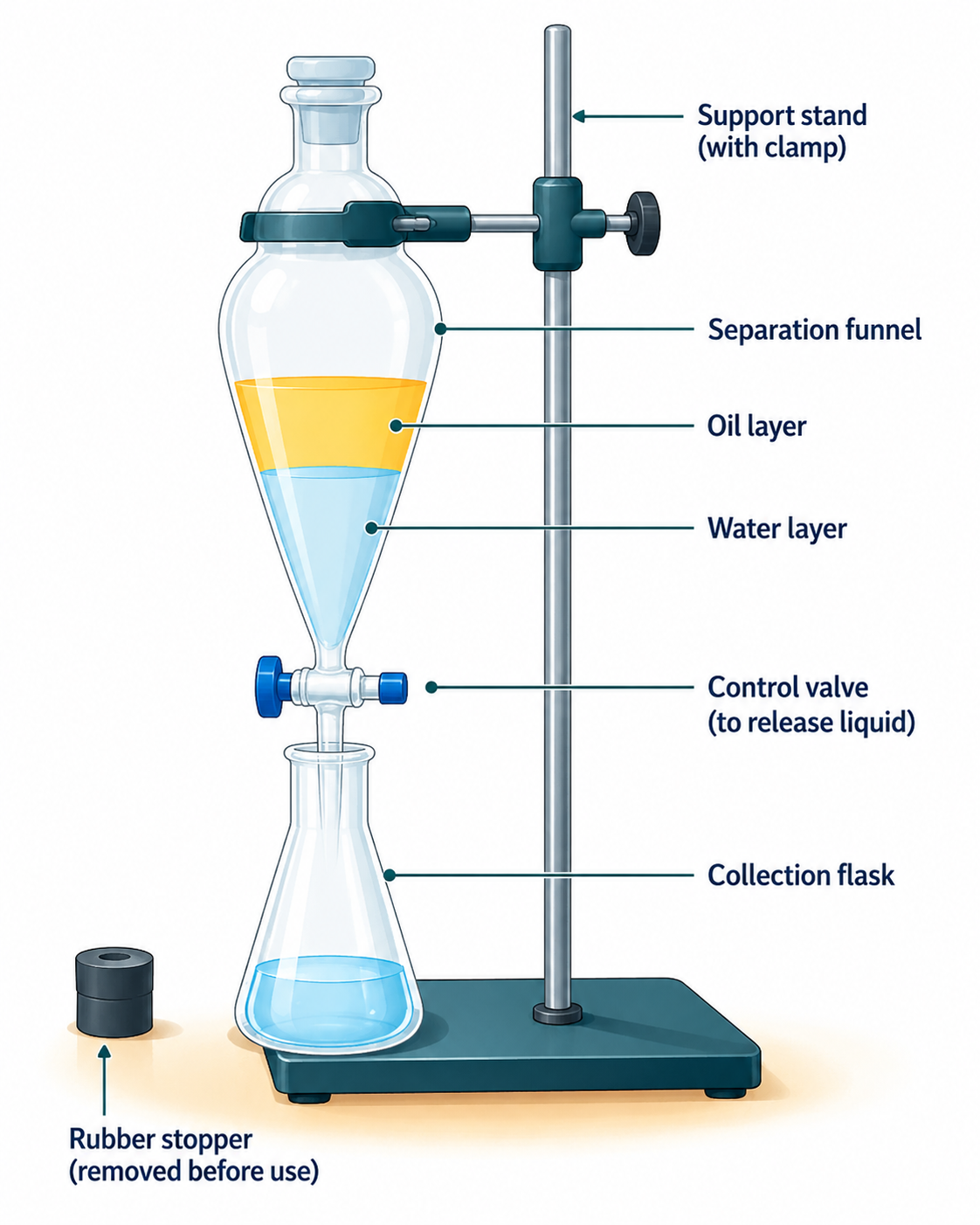
For mustard oil and water:
- Yellow mustard oil (less dense) forms the upper layer
- Water (more dense) forms the lower layer
4.2 Sublimation
Sublimation is the transition of a solid directly into vapor (below its melting point) without passing through the liquid state. The reverse process—when vapor cools and changes back to solid without becoming liquid—is called deposition.
Substances That Sublime
- Camphor
- Naphthalene
- Dry ice (solid carbon dioxide)
- Iodine
Separating Camphor from Sand
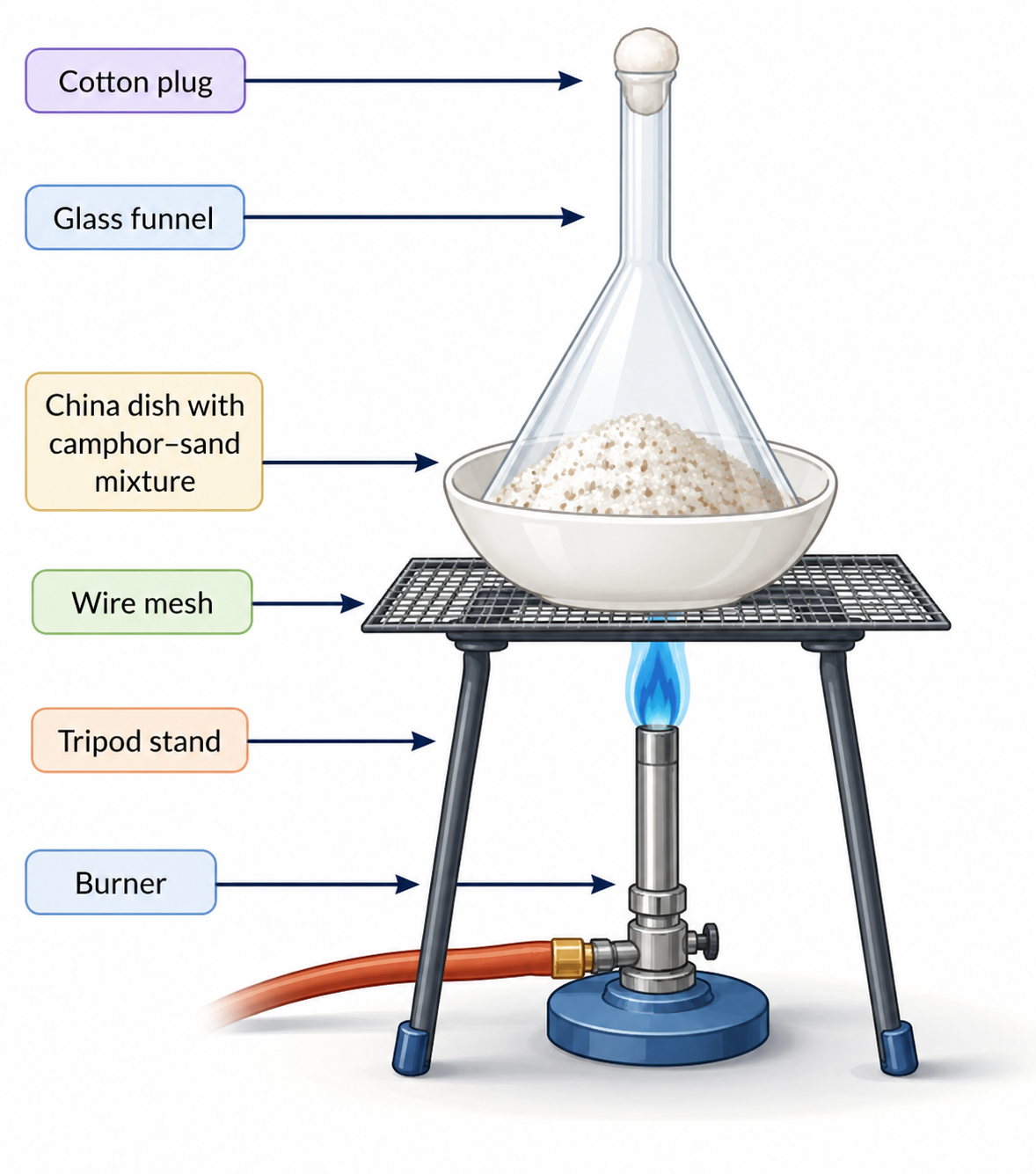
- Mix crushed camphor and sand in a china dish
- Place the dish on a tripod stand with wire gauze
- Invert a glass funnel (with cotton-plugged nozzle) over the dish
- Heat gently
- Camphor sublimes and deposits on the inner wall of the funnel
- Sand remains in the china dish
Why This Works
Camphor sublimes when heated, but sand does not. The camphor vapor rises and deposits as solid on the cooler funnel surface, leaving sand behind.
Practical Application
Dry ice (solid CO₂) used for ice cream storage undergoes sublimation—it changes directly from solid to gas without melting into liquid.
Alloys: Inseparable Mixtures
An alloy is a homogeneous mixture of two or more metals, or a metal and a non-metal. Metals don’t dissolve in each other at room temperature, but when melted and mixed at high temperatures, they form alloys upon cooling.
Common alloys:
| Alloy | Composition |
|---|---|
| Brass | ~80% copper + 20% zinc |
| Bronze | ~80% copper + 20% tin |
| Stainless steel | Iron + carbon (0.03-0.8%) + chromium (16-18%) + nickel (10-14%) + molybdenum (2-3%) |
Alloys cannot be separated by physical methods. They are made to create materials that are stronger, more rigid, or more corrosion-resistant than pure metals.
4.3 Suspensions
A suspension is a heterogeneous mixture in which solid particles do not dissolve but remain suspended throughout the liquid medium.
Characteristics of Suspensions
- Particles are large (more than 1000 nm in diameter)
- Particles are visible to the naked eye
- Particles settle when left undisturbed
- Can be separated by filtration
Examples of suspensions:
- Sand in water
- Sawdust in water
- Tea leaves in water
- Muddy water
Separating Mud from Water
Simple filtration may not completely clear muddy water because very fine particles pass through filter paper. For complete separation, use:
A. Centrifugation
Centrifugation uses rapid spinning to separate components based on density.
How It Works
- Place the mixture in tubes in a centrifuge machine
- Spin at high speed
- Centrifugal force (outward force during circular motion) pushes heavier particles to the bottom
- Lighter liquid remains at the top
- Separate the two layers
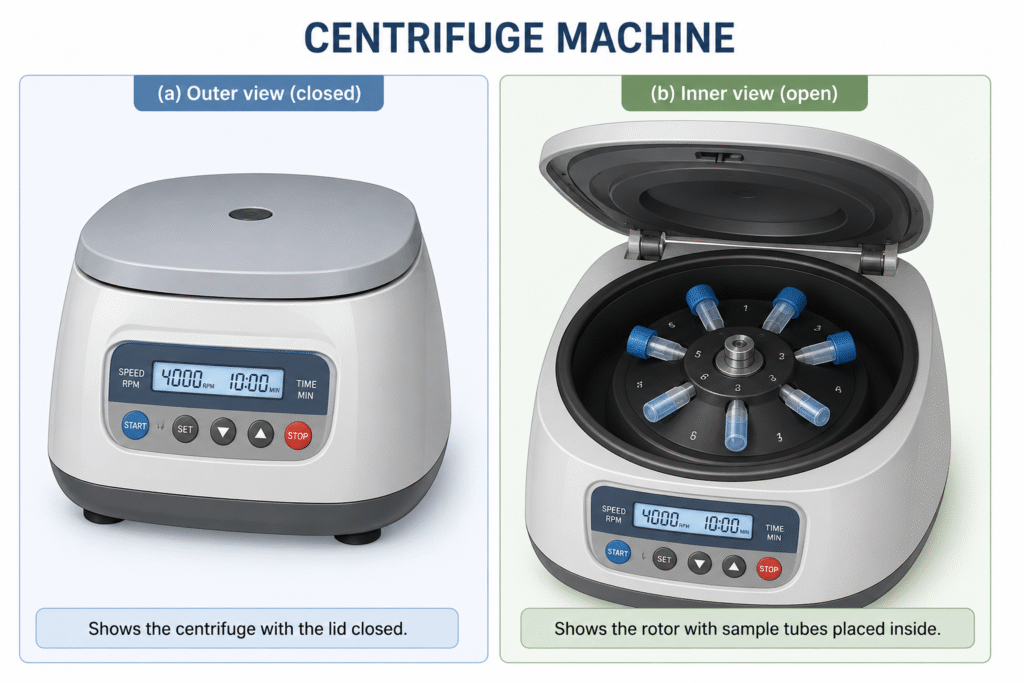
Think of the spinning game (folk dance called phugadi in Marathi and kikli in Punjabi). When you spin holding hands, you feel pulled outwards—this is similar to the force used in centrifugation.
Applications of Centrifugation
- Separating blood components (red blood cells, white blood cells, platelets, plasma)
- Chemical industries
- Medical diagnostics
The Paperfuge: Low-Cost Innovation
The paperfuge is a hand-powered device made from simple materials (cardboard disc, string, handles) that performs centrifugation without electricity. By spinning blood samples at high speed, it separates components and helps detect diseases like malaria and anaemia in remote areas.
This low-cost tool improves access to medical care in places without electricity.
B. Coagulation
Coagulation involves adding a substance (coagulant) to make fine suspended particles clump together into larger masses.
Process of Coagulation
- Add powdered alum (fitkari) to muddy water
- Alum acts as a coagulant
- Fine particles clump together into larger masses
- Larger clumps settle by gravity (sedimentation)
- Clear water can be separated by decantation or filtration
Other Applications of Coagulation
Cheese (paneer) formation from milk uses coagulation:
- Acid (lemon juice or vinegar) acts as the coagulant
- Milk proteins coagulate
- Cheese forms
4.4 Colloids
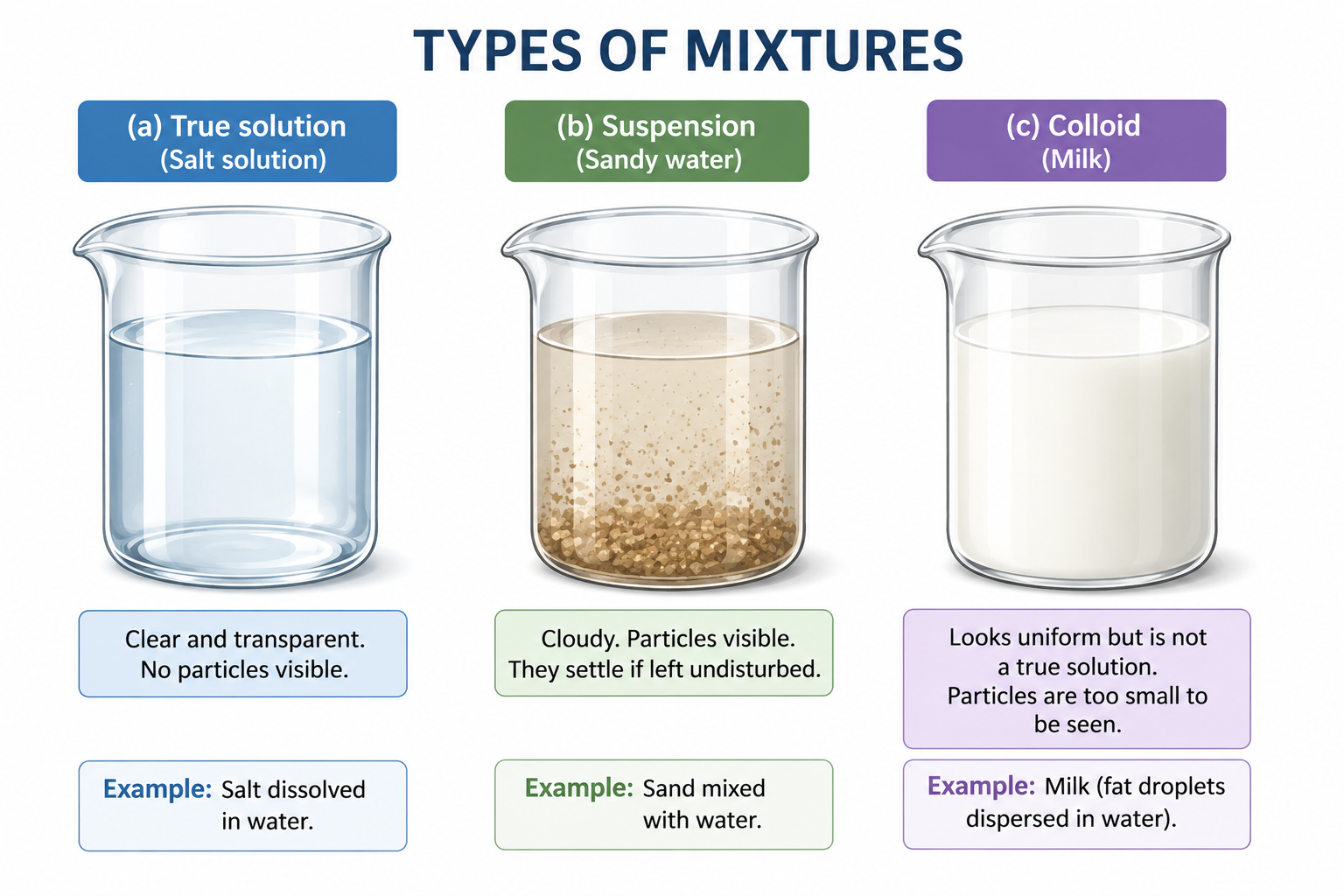
A colloid is a type of mixture that lies between solutions and suspensions. Blood is neither a true solution (we cannot see blood cells with naked eye) nor a suspension (cells don’t settle quickly)—it is a colloid.
Characteristics of Colloids
- Particles are intermediate in size (1-1000 nm in diameter)
- Particles are not visible to the naked eye
- Particles do not settle over time
- Appear homogeneous like solutions
- Scatter light (show Tyndall effect)
Examples of colloids:
- Blood
- Milk
- Tomato sauce
- Ice cream
- Fog
- Smoke
Components of a Colloid
- Dispersed phase: The solute-like component (scattered particles)
- Dispersion medium: The component in which dispersed phase is suspended
Emulsions
Emulsions are colloids where both dispersed phase and dispersion medium are liquids. They are classified as:
Oil-in-Water Emulsions
- Oil droplets dispersed in water
- Examples: Milk, vanishing cream
Water-in-Oil Emulsions
- Water droplets dispersed in oil
- Examples: Butter, body lotions, cold cream
Emulsifying Agents
Substances that stabilize emulsions are called emulsifying agents. For example:
- Proteins in milk act as emulsifying agents
- Proteins in butter act as emulsifying agents
You can make an emulsion by mixing a few drops of cooking oil with water containing soap solution and shaking thoroughly.
Medical Applications
Some medicines are prepared as emulsions to:
- Disperse them in water
- Make them easy to swallow
- Reduce greasy feeling
Blood Donation: Saving Lives
Blood donation saves lives. People in emergencies, during surgeries, or with serious illnesses may need blood transfusion (transfer of blood from a healthy person to a patient).
Donated blood is:
- Tested and blood group identified
- Separated into components (plasma, platelets, white blood cells, red blood cells) by centrifugation
- Stored safely in blood banks
- Supplied when required
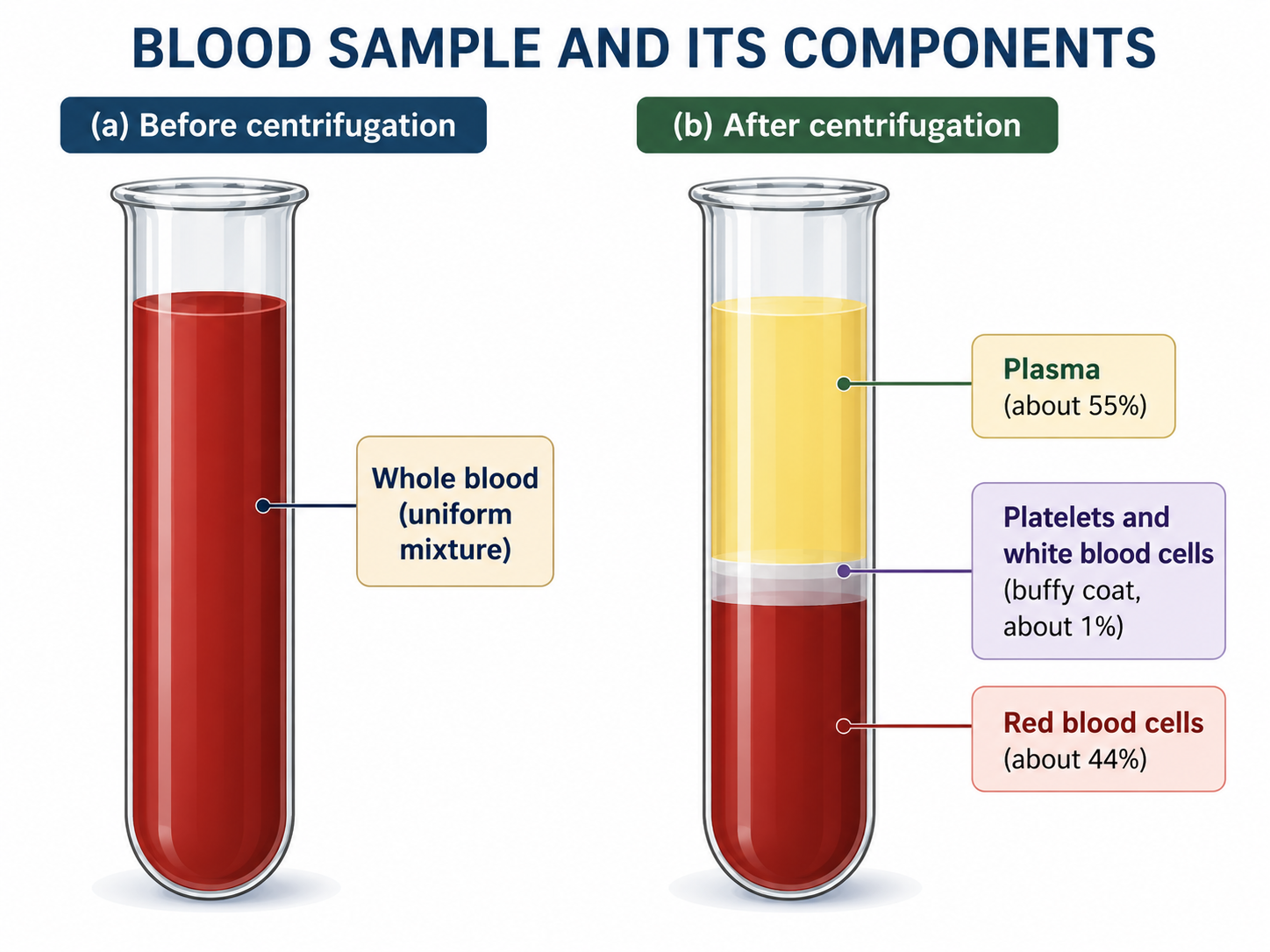
The body naturally replaces donated blood within a few weeks, making blood donation safe and helpful.
5. Tyndall Effect
The Tyndall effect is the scattering of light by particles in a colloid or suspension.
Observing the Tyndall Effect
When a beam of light passes through:
- Solution: Light passes through without scattering; path not visible
- Suspension: Particles scatter light; path becomes visible
- Colloid: Particles scatter light; path becomes visible
Everyday Examples
- Fine beam of sunlight entering a dark room through a small hole (dust particles scatter light)
- Floodlights in sports stadiums showing visible beams (dust and smoke particles scatter light)
- Bright rays of sunlight passing through gaps between tree leaves
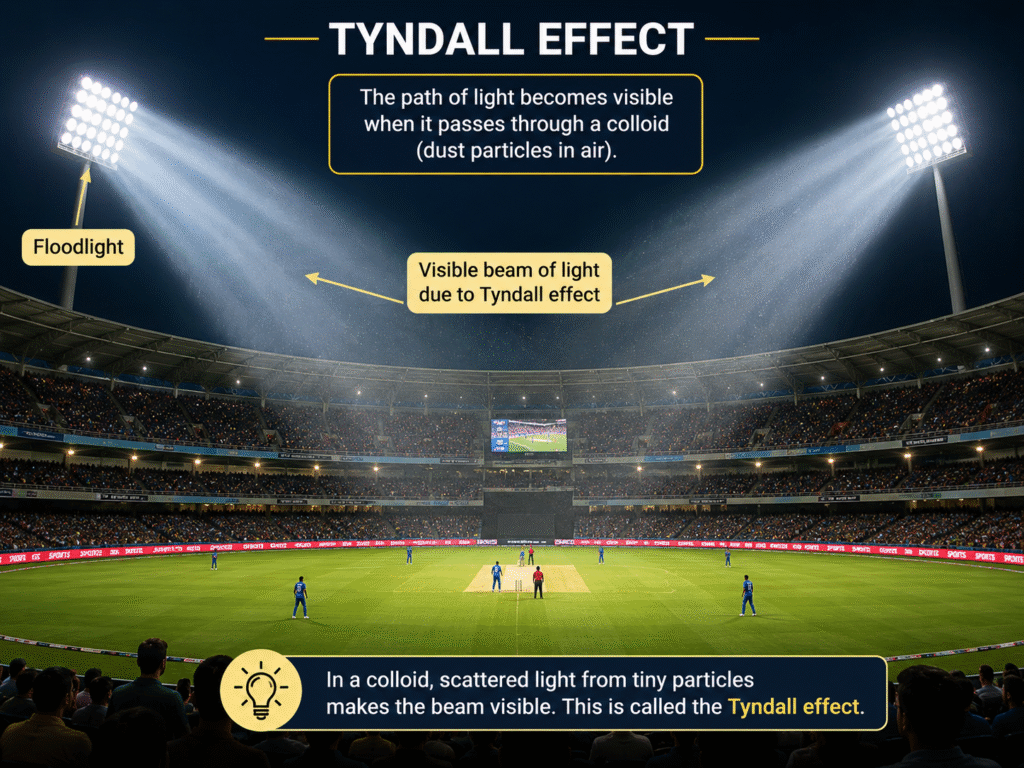
The Tyndall effect helps distinguish between solutions, suspensions, and colloids.
Comparison of Solutions, Suspensions, and Colloids
| Property | Solution | Suspension | Colloid |
|---|---|---|---|
| Nature | Homogeneous | Heterogeneous | Appears homogeneous |
| Particle size | Less than 1 nm | More than 1000 nm | 1-1000 nm |
| Visibility | Particles not visible | Particles visible | Particles not visible |
| Separation by filtration | Cannot be separated | Can be separated | Cannot be separated |
| Settling | Does not settle | Settles down | Does not settle |
| Tyndall effect | Does not show | Shows | Shows |
| Examples | Salt solution, sugar solution, brass | Muddy water, sand in water | Milk, blood, smoke, fog |
Environmental Importance of Separation
Separation processes occur naturally and in our bodies:
- Kidneys remove waste from blood
- Sewage treatment uses sedimentation, coagulation, and filtration before releasing water
Current environmental challenges requiring separation:
- Cleaning oceans and rivers from plastic waste
- Treating sewage water for reuse (flushing, watering plants)
- Sorting waste at home (dry waste for recycling, wet waste for composting)
- Recovering valuable materials (lithium from old batteries)
By improving separation and recycling methods, we can make the world cleaner, healthier, and more sustainable.
Solutions to Exercise Questions
Revise, Reflect, Refine
1. Which of the following mixtures are correctly classified as homogeneous (Hm) and heterogeneous (Ht)? Choose the correct option.
Answer: (iv) Muddy water—Ht, Milk—Ht, Blood—Ht, Brass—Hm
Explanation:
- Muddy water: Heterogeneous (sand particles visible and settle)
- Milk: Heterogeneous (it’s a colloid, not truly homogeneous)
- Blood: Heterogeneous (it’s a colloid with suspended cells)
- Brass: Homogeneous (it’s an alloy—uniform mixture of metals)
Why other options are incorrect:
- (i) Smoke is heterogeneous (solid particles in gas), not homogeneous
- (ii) Brass is homogeneous (alloy), not heterogeneous; Fog is heterogeneous, Vinegar is homogeneous; Muddy water is heterogeneous
- (iii) Milk is heterogeneous (colloid), not homogeneous
2. Which among the following mixtures show the Tyndall Effect?
Answer: (iii) a and c
Correct mixtures:
- (a) Air and dust particles—shows Tyndall effect (dust particles scatter light)
- (c) Starch and water—shows Tyndall effect (forms colloidal suspension)
Why these show Tyndall effect: Both are heterogeneous mixtures with particles large enough to scatter light.
Why others don’t:
- (b) Copper sulfate and water—forms true solution (particles too small)
- (d) Acetone and water—forms true solution (miscible liquids, homogeneous)
3. Complete Table 5.2 categorizing mixtures
Solution:
| Solution | Suspension | Colloid |
|---|---|---|
| Properties: Small-sized particles (less than 1 nm diameter); Particles remain evenly distributed; Transparent; Cannot be separated by filtration; Does not settle down | Properties: Large-sized particles (more than 1000 nm in diameter); Settles down when left undisturbed; Separates by filtration; Heterogeneous mixture | Properties: Moderate-sized particles (1-1000 nm); Particles remain evenly distributed; Does not settle down; Scatters light; Cannot be separated by filtration |
| Examples: Salt solution; Brass | Examples: Sand in water; Mud | Examples: Milk; Smoke; Butter |
4. Solve the following problems:
(i) Express concentration of cake ingredients
Given:
- Sugar: 75 g
- All-purpose flour: 420 g
- Sodium hydrogencarbonate: 5 g
- Total mass = 75 + 420 + 5 = 500 g
Using mass by mass percentage:
Sugar concentration = (75 g / 500 g) × 100 = 15% m/m
Flour concentration = (420 g / 500 g) × 100 = 84% m/m
Sodium hydrogencarbonate concentration = (5 g / 500 g) × 100 = 1% m/m
(ii) Calculate copper and zinc in brass
Given:
- Brass contains 70% copper by mass
- Total brass = 120 g
Copper mass = 70% of 120 g = (70/100) × 120 = 84 g
Zinc mass = Total brass – Copper mass = 120 g – 84 g = 36 g
Alternatively: Zinc = 30% of 120 g = (30/100) × 120 = 36 g
5. Cooking oil and water separation
Given: 1 liter cooking oil = 910 g
Density of oil = 910 g / 1000 mL = 0.91 g/mL Density of water = 1.0 g/mL
Will it form separate layers? Yes, oil and water are immiscible liquids.
Which substance on top? Oil will be on top because it has lower density (0.91 g/mL) than water (1.0 g/mL).
Separation method: Use a separating funnel.
Procedure:
- Pour mixture into separating funnel
- Let it stand until two distinct layers form
- Open stopcock to drain lower water layer into container
- Close stopcock before oil starts draining
- Collect oil separately
6. Assertion and Reason
Answer: (iii) A is true, but R is false.
Explanation:
- Assertion A is TRUE: Solutions do not exhibit the Tyndall effect because their particles are too small to scatter light
- Reason R is FALSE: Particles in solutions are SMALLER than 1 nm (not larger than 100 nm). Particles need to be between 1-1000 nm to scatter light effectively
7. Methods of separation for different mixtures
| Mixture | Method of separation | Reason for selection |
|---|---|---|
| Mud from muddy water | Filtration followed by coagulation and centrifugation | Larger mud particles can be filtered. For finer particles, add alum (coagulant) to clump particles together, then centrifuge or allow to settle, followed by decantation or filtration |
| Plasma from other components in blood sample | Centrifugation | Blood is a colloid. Rapid spinning separates denser components (cells) from lighter plasma based on density differences |
| Naphthalene and sand | Sublimation | Naphthalene sublimes on heating (changes directly from solid to vapor), while sand does not. Naphthalene vapor can be collected and deposited on a cool surface |
| Chalk powder and common salt | Add water, filtration, then evaporation | Salt dissolves in water but chalk doesn’t. Filter to separate chalk. Evaporate the filtrate to get salt crystals back |
| Common salt and water | Evaporation or distillation | Evaporation if only salt is needed (heat until water evaporates). Distillation if both salt and water are to be recovered |
| Oil from water | Separating funnel | Oil and water are immiscible liquids with different densities. They form separate layers which can be drained separately using a separating funnel |
| Pigments of the flower | Paper chromatography | Different pigments have different rates of movement on paper with a solvent. This separates them into distinct colored bands |
Mixtures that cannot be separated: Alloys like brass cannot be separated by physical methods because they form homogeneous solid solutions.
8. Separating two miscible liquids A and B
Given:
- Boiling point of A = 60°C
- Boiling point of B = 90°C
- Difference = 30°C
Method: Distillation
Reason: The boiling points differ by 30°C (more than 25°C minimum), making distillation effective.
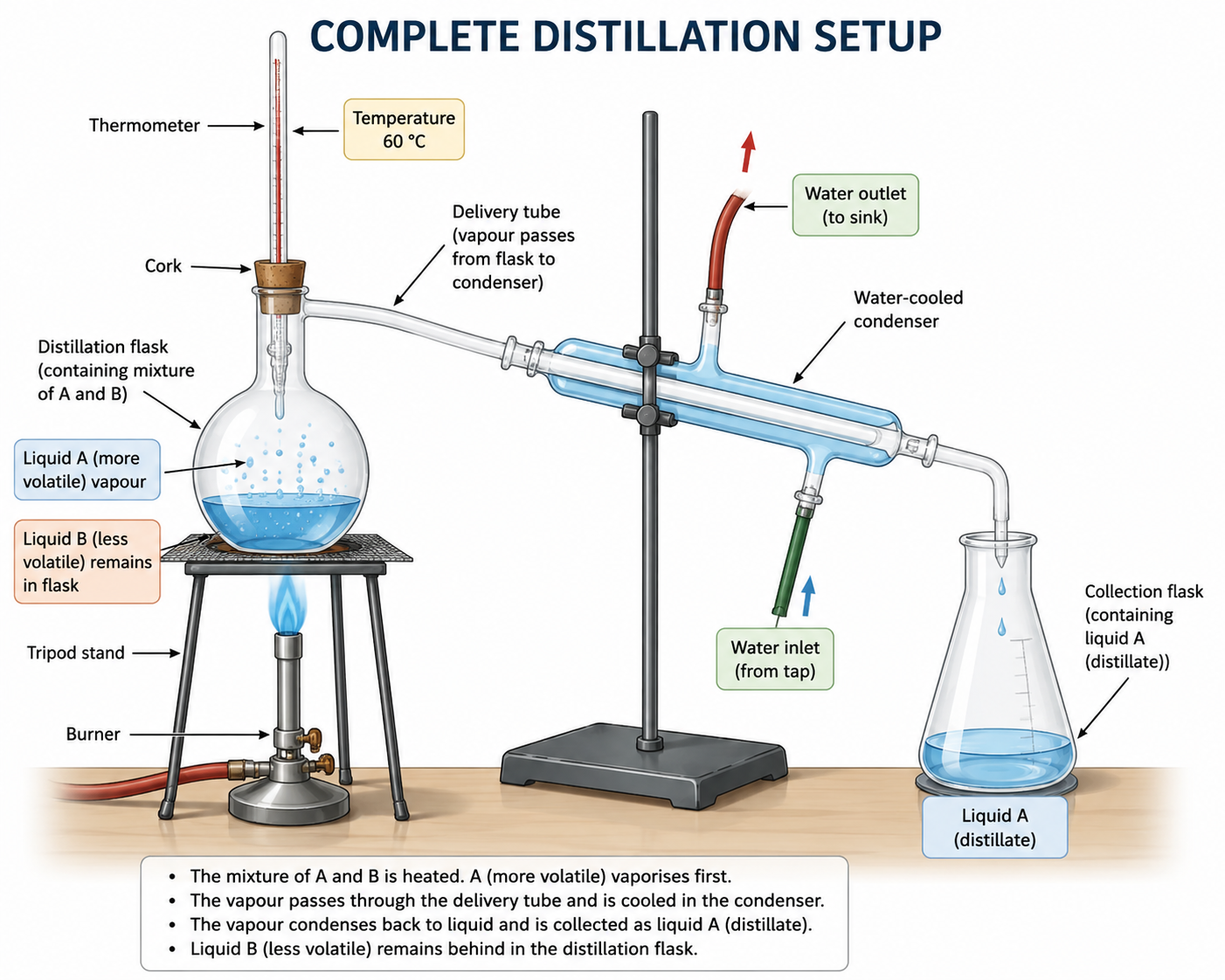
Procedure:
- Pour mixture into distillation flask
- Heat gradually
- Liquid A vaporizes first at 60°C
- Vapors pass through condenser
- Cold water cools the vapors
- Liquid A condenses and collects in receiving flask
- Liquid B (boiling at 90°C) remains in distillation flask
- Both liquids are now separated
9. Compare evaporation, crystallization, and distillation
| Aspect | Evaporation | Crystallization | Distillation |
|---|---|---|---|
| Process | Liquid changes to vapor at surface | Pure solid separates from saturated solution by controlled cooling | Liquid vaporizes by heating, then condenses back to liquid |
| Temperature | Occurs at any temperature below boiling point | Requires preparing saturated solution (often by heating), then slow cooling | Requires heating to boiling point |
| Products recovered | Only solid remains; liquid lost | Pure solid crystals obtained | Both liquid (distillate) and solid/other liquid can be recovered |
| Speed | Can be slow (depends on surface area, temperature) | Slow (requires time for crystal formation) | Relatively faster |
| Quality of product | Solid may contain impurities | Gives pure, well-formed crystals | Gives pure liquid |
When to prefer each:
Evaporation:
- When only the solid is needed
- Cost is a consideration (simple, inexpensive)
- Large-scale operations like salt production from seawater
- Example: Obtaining salt from salt solution
Crystallization:
- When pure, well-formed solid crystals are needed
- Purifying substances in laboratory
- When impurities must be removed
- Example: Purifying copper sulfate, making rock candy
Distillation:
- When both components need to be recovered
- Separating miscible liquids with sufficient boiling point difference
- When very pure liquid is required
- Example: Separating acetone and water; producing distilled water; petroleum refining
10. Blood as a colloidal mixture
(i) What would happen if blood behaved like a true suspension inside the body?
If blood were a true suspension:
- Blood cells would settle down due to gravity in blood vessels
- This would cause blockages in arteries and veins
- Blood circulation would stop
- Oxygen and nutrients wouldn’t reach all body parts
- Waste products wouldn’t be removed
- Person would not survive
The colloidal nature of blood keeps cells suspended and evenly distributed, ensuring continuous circulation.
(ii) In a blood sample, identify the dispersed phase and dispersion medium
- Dispersed phase: Blood cells (red blood cells, white blood cells, platelets)—these are the solid particles suspended in blood
- Dispersion medium: Plasma (liquid portion of blood)—this is the medium in which blood cells are dispersed
11. Separation sequence for sand, salt, and naphthalene mixture
Looking at the diagrams provided:
Correct sequence:
Step 1 (Diagram 1): Sublimation
- Heat the mixture gently
- Naphthalene sublimes (changes to vapor)
- Collect naphthalene on inverted funnel
- Sand and salt remain in the dish
Step 2 (Diagram 2): Add water and filtration
- Add water to the remaining mixture
- Salt dissolves in water, sand doesn’t
- Filter the mixture
- Sand remains on filter paper as residue
- Salt solution passes through as filtrate
Step 3 (Diagram 3): Evaporation
- Heat the salt solution (filtrate)
- Water evaporates
- Salt crystals remain
Complete sequence: Sublimation → Filtration → Evaporation
12. Why is distillation effective for separating water and acetone?
Distillation is effective because:
- Large boiling point difference:
- Acetone boiling point: 56°C
- Water boiling point: 100°C
- Difference: 44°C (well above the 25°C minimum)
- Selective vaporization:
- When heated, acetone vaporizes first at 56°C
- At this temperature, very little water vaporizes
- This allows clean separation
- Complete recovery:
- Acetone vapor condenses and collects as pure liquid
- Water remains behind in the distillation flask
- Both components can be recovered
- Miscibility not a problem:
- Although acetone and water mix completely, their different boiling points allow separation
- Physical mixing doesn’t prevent separation based on different physical properties
13. Solubility data analysis
(i) Mass of potassium nitrate needed for saturated solution
From table: Solubility of potassium nitrate at 40°C = 62 g per 100 g water
For 50 g water: Mass of potassium nitrate = (62 g / 100 g) × 50 g = 31 g
(ii) Observation when potassium chloride solution cools from 80°C to 25°C
From table:
- Solubility at 80°C = 54 g per 100 g water
- Solubility at 20°C = 35 g per 100 g water (closest to 25°C)
Observation: Crystals of potassium chloride will appear in the solution.
Explanation:
- Saturated solution at 80°C contains 54 g potassium chloride per 100 g water
- At 25°C (room temperature), only about 35 g can remain dissolved
- Excess amount (54 – 35 = 19 g) will separate out as solid crystals
- This is the principle of crystallization
(iii) Effect of temperature on solubility and comparison
Effect of temperature on solubility: Generally, solubility of solid salts in water increases with temperature. However, the rate of increase varies for different salts.
Comparison of the four salts (10°C to 80°C):
| Salt | Solubility at 10°C | Solubility at 80°C | Change | Rate of increase |
|---|---|---|---|---|
| Potassium nitrate | 21 g | 167 g | 146 g | Very steep increase |
| Sodium chloride | 36 g | 37 g | 1 g | Almost no change |
| Potassium chloride | 35 g | 54 g | 19 g | Moderate increase |
| Ammonium chloride | 24 g | 66 g | 42 g | Significant increase |
Analysis:
- Potassium nitrate shows the maximum increase (most temperature-sensitive)
- Sodium chloride shows almost no change with temperature
- Ammonium chloride shows significant increase
- Potassium chloride shows moderate increase
Practical implication: Potassium nitrate is best suited for purification by crystallization because cooling produces large amounts of crystals. Sodium chloride cannot be purified well by crystallization from water since its solubility barely changes with temperature.
14. Sugar solution concentrations
(i) Calculate mass percentage for each solution
Student A:
- Sugar = 20 g
- Water = 80 g
- Total solution = 20 + 80 = 100 g
- Concentration = (20/100) × 100 = 20% m/m
Student B:
- Sugar = 20 g
- Water = 100 g
- Total solution = 20 + 100 = 120 g
- Concentration = (20/120) × 100 = 16.67% m/m
Student C:
- Sugar = 30 g
- Water = 80 g
- Total solution = 30 + 80 = 110 g
- Concentration = (30/110) × 100 = 27.27% m/m
(ii) Most concentrated solution
Student C’s solution is most concentrated (27.27% m/m)
Explanation: Concentration depends on the ratio of solute to total solution, not just the amount of solute. Student C has:
- Highest proportion of sugar relative to total solution mass
- More sugar (30 g) in relatively less water (80 g)
- Although Student A has the same amount of water (80 g), Student C has more sugar dissolved in it
The Journey Beyond
15. Identify distillation setup and applicable mixtures
(i) Separation technique marked as ‘S’: Distillation
(ii) Label the apparatus:
- A: Thermometer
- B: Water condenser (Liebig condenser)
- C: Receiving flask / Collection flask
(iii) Mixtures that can be separated by distillation:
Using the boiling point data from Table 5.5:
| Solvent | Boiling Point |
|---|---|
| Water | 100°C |
| Acetone | 56°C |
| Alcohol | 78°C |
| Chloroform | 61°C |
| Benzene | 80°C |
Analyzing each mixture:
(a) Water—Acetone: ✓ Can be separated
- Difference = 100°C – 56°C = 44°C (>25°C minimum)
(b) Water—Salt: ✗ Can be separated, but distillation is not the best method
- Salt doesn’t vaporize; simple evaporation would work better
- However, if pure water is needed, distillation can be used
(c) Acetone—Alcohol: ✓ Can be separated
- Difference = 78°C – 56°C = 22°C
- Though less than 25°C, fractional distillation can be used
(d) Sand—Salt: ✗ Cannot be separated by distillation
- Both are solids; distillation works for liquids
- Use dissolution in water and filtration instead
(e) Alcohol—Chloroform: ✓ Can be separated
- Difference = 78°C – 61°C = 17°C
- Requires fractional distillation due to small difference
(f) Alcohol—Benzene: ✗ Difficult to separate by simple distillation
- Difference = 80°C – 78°C = 2°C (too small)
- Would require fractional distillation with a very efficient column
Best candidates for simple distillation: (a) Water—Acetone
Require fractional distillation: (c) Acetone—Alcohol, (e) Alcohol—Chloroform