
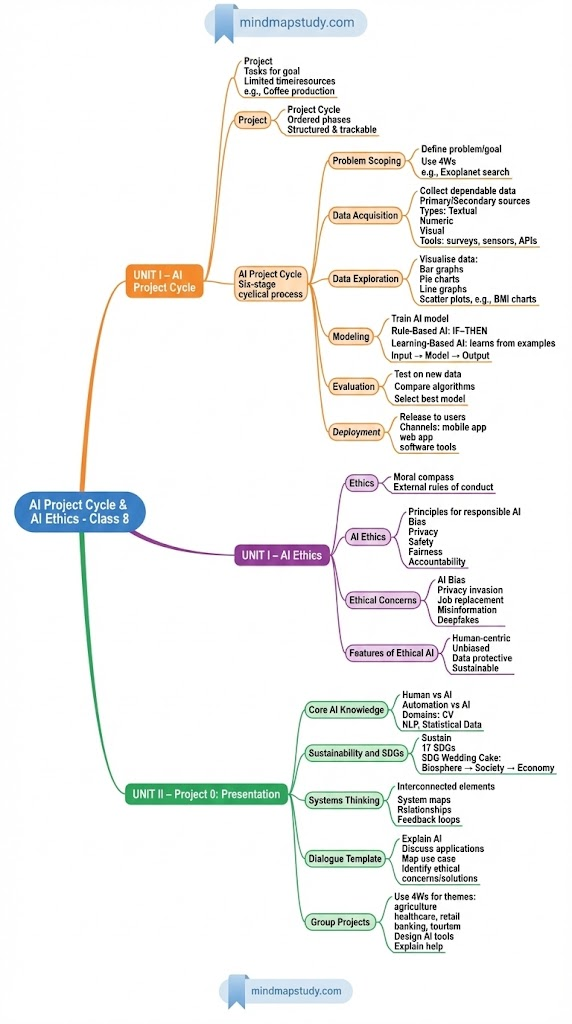
AI Project cycle
Lesson Title: AI Project Cycle and its stages
The AI project cycle is a repeating set of stages that helps you move from a real-world problem to a working AI solution in a structured way. It makes projects easier to plan, track, and improve.
1.1 Recap
Sustainability
- “Sustain” means to maintain, support, withstand, or endure.
- Sustainability means maintaining our world so that land, air, water, and food can support present and future generations.
- We must use resources responsibly instead of wasting or polluting them.
Society and Sustainability
- Society refers to the people around us—families, neighbours, communities.
- Real sustainability is possible only when most people in society follow sustainable habits.
- If some groups are not sustainable, full sustainability cannot be achieved.
Sustainable Development Goals (SDGs)
- SDGs are 17 goals created by the United Nations in 2015.
- They focus on areas like poverty, health, education, environment, and peace.
SDG Wedding Cake
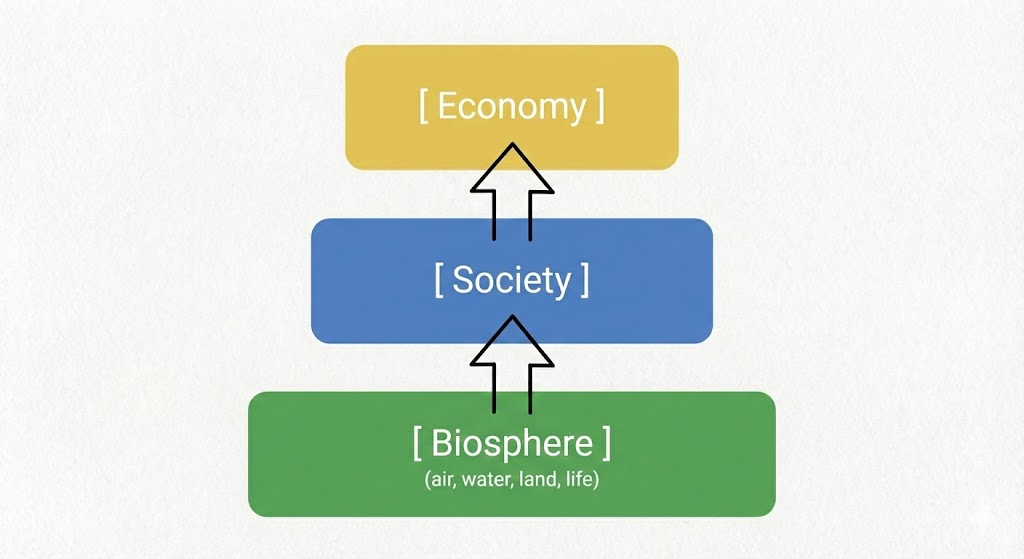
- Economy must serve society.
- Both must live within the limits of the biosphere (Earth’s life systems).
Systems Thinking
- A system is a group of interconnected things.
- Systems behave differently from their individual parts because everything affects everything else.
- We draw systems using system maps: elements as circles/boxes, relationships as arrows, loops as chains of cause and effect.
Fox–rabbit example:
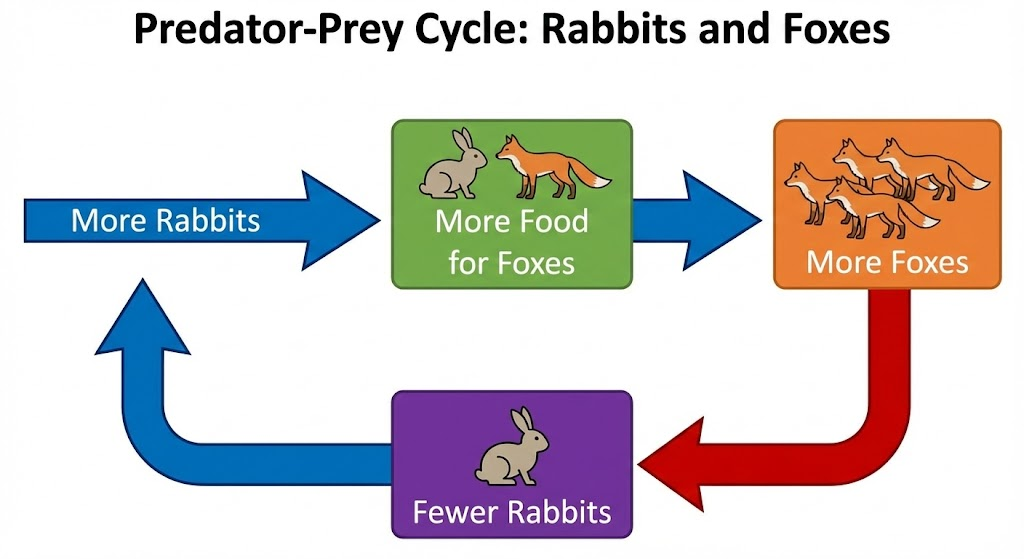
Basics of a system map:
- Every element is connected.
- Some arrows are longer (showing time delay).
- To change outcomes, you can change elements or the relationships; changing relationships is usually more powerful.
Example elements in a coral reef system: Coral Reefs, Algae, Pollution, Water Temperature, Storms, Marine Life.
1.2 Introduction to Project and Project Cycle
What is a Project?
- A project is a series of tasks or activities done with limited time and resources to reach a specific goal.
- Example: building a science model, making a survey report, creating a small website.
What is a Project Cycle?
- A project cycle is the sequence of phases through which a project progresses.
- Different projects can have slightly different phase names, but all follow an ordered flow.
1.3 Example: Coffee Production System
We use coffee production to understand projects and project cycles.
Steps in coffee production:
- Harvesting – picking ripe coffee cherries.
- Processing – removing the fruit around the bean.
- Roasting – roasting beans to develop flavour and aroma.
- Packaging – sealing roasted coffee products.
ASCII flow:
[Harvesting] → [Processing] → [Roasting] → [Packaging]
Fill in the blanks – Solutions
- H → Harvesting
- P → Processing
- R → Roasting
- P → Packaging
This cycle is repeated every harvest season to maintain quality.
1.4 What is an AI Project Cycle?
- AI project cycle is the cyclical process followed to complete an AI project.
- It walks you through all major steps of building an AI solution.
- It helps you:
- create AI projects more easily
- finish AI projects faster
- clearly understand the process.
Example theme: Finding an Earth-like exoplanet
- Exoplanet: any planet beyond our solar system.
- Goal: identify planets with Earth-like characteristics using space data.
Overall cycle diagram:
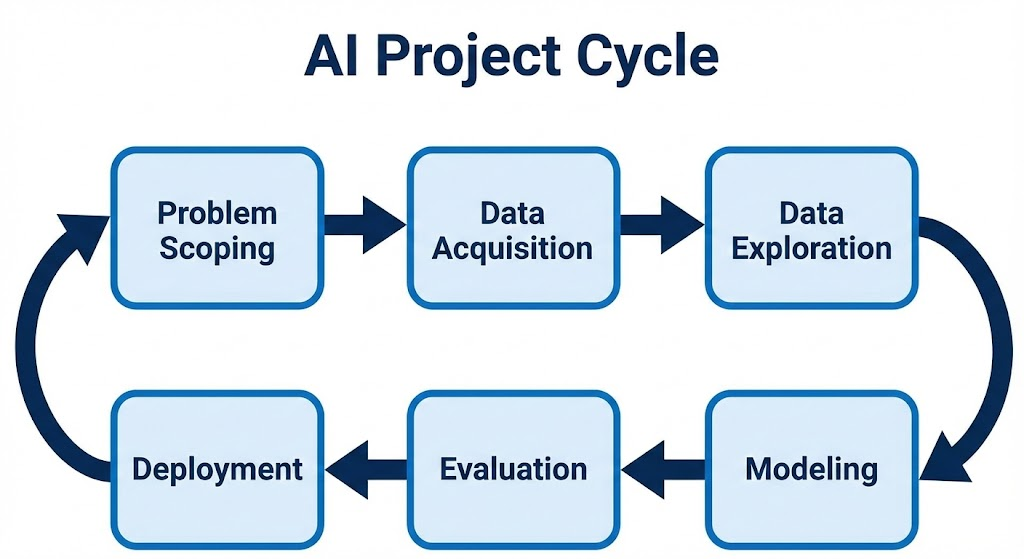
1.5 Stages of AI Project Cycle
The AI project cycle has six stages:
- Problem Scoping
- Data Acquisition
- Data Exploration
- Modeling
- Evaluation
- Deployment
1.5.1 Problem Scoping
Problem Scoping is about defining a clear goal and understanding what exactly you want the AI system to do.
- It is like first finding the goalpost before kicking a football.
- Includes:
- identifying the problem
- understanding all its aspects
- developing a vision for the solution.
We use the 4Ws Problem Canvas:

4Ws – Exoplanet Example (Solutions)
WHO – Who has the problem?
- Stakeholders: Space organisations, Human race.
- They have telescopes on land and in space to collect data.
WHAT – What is the nature of the problem?
- Problem: Identifying an Earth-like exoplanet using existing resources.
- Space travel is limited and costly.
- We know it is a problem through research papers, documentaries, and news.
WHERE – Where does the problem arise?
- Context: Rising sea levels, melting polar ice caps, and pollution of air, soil, and water on Earth.
WHY – Why is it worth solving?
- Stakeholders want to find an Earth-like exoplanet as close to the solar system as possible.
- It will help analyse astronomical data, predict planetary conditions, and simulate life-supporting ecosystems far away.
Problem Statement Template – Solution
Template:
Our [stakeholders] have a problem that [issue/need] when/while [context]. An ideal solution would [benefit].
Filled example – Finding an exoplanet:
Our space organisations and the human race have a problem that they need to find an Earth-like exoplanet when/while using their existing resources. An ideal solution would help in analysing astronomical data, predicting planetary conditions, and simulating life-supporting ecosystems on distant worlds.
Do it yourself – Air Pollution (Model Answer)
Problem: Air pollution in our city harms people’s health and reduces children’s outdoor playtime.
- WHO: City residents (especially children, elderly), city authorities.
- WHAT: Poor air quality causing breathing issues and less outdoor time.
- WHERE: Busy roads, industrial zones, crowded residential areas.
- WHY: Cleaner air will protect health, allow safe outdoor play, and help authorities make better pollution-control plans using AI predictions.
Sample problem statement:
Our city residents and local authorities have a problem that air pollution is damaging health and limiting children’s outdoor play when/while living in polluted parts of the city. An ideal solution would use AI to monitor and predict air quality so effective steps can reduce pollution and protect people.
1.5.2 Data Acquisition
Data Acquisition is Stage 2, where you collect the data needed to solve the AI problem.
- Data must be dependable and correct.
- Different methods give data in different forms.
Types of data:
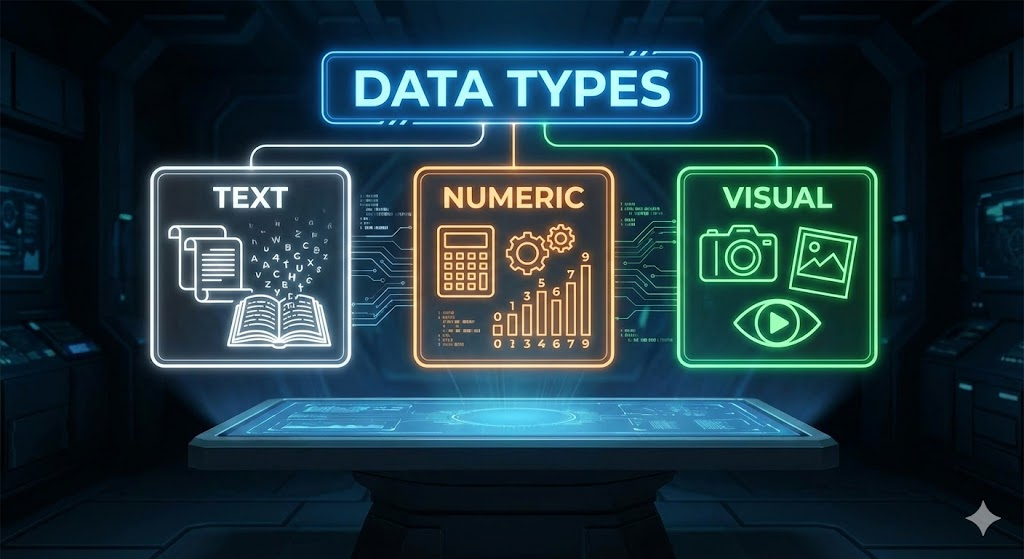
- Textual data – text documents, logs, articles.
- Numeric data – numbers in tables (age, marks, prices).
- Visual data – images and videos.
Sources of data:
- Primary (fresh data for your project)
- surveys and questionnaires
- experiments and sensor readings
- manual labelling (e.g., tagging images)
- APIs from internet-connected devices.
- Secondary (already collected)
- government open-data portals
- public dataset repositories.
Exoplanet Use Case – Data Acquisition
- After defining the problem, data is gathered from space missions and telescopes.
- Brightness vs time readings and related parameters are collected and cleaned.
- Extra features may be generated if required.
1.5.3 Data Exploration
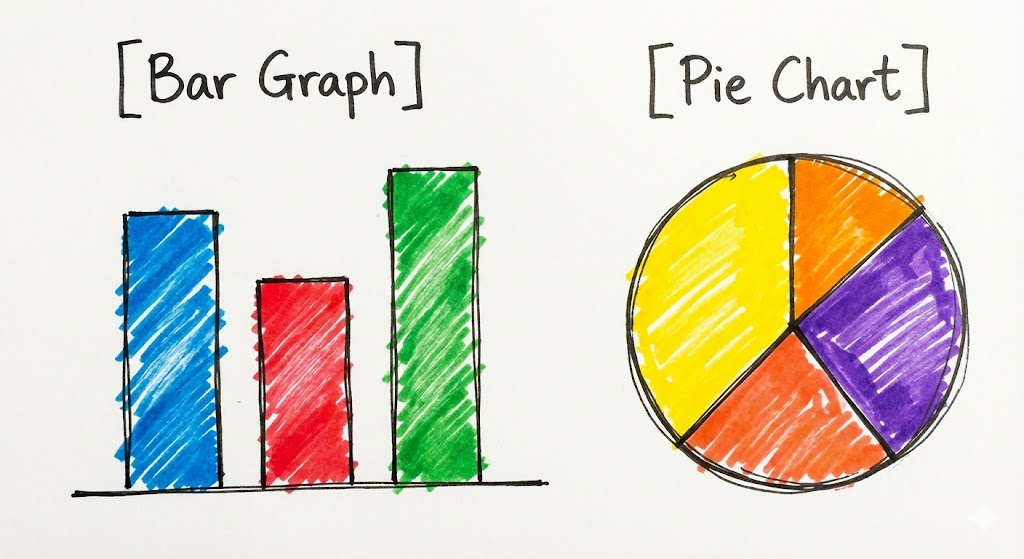
Data Exploration is Stage 3. Here you visualise data so that humans can quickly understand it.
- Visual forms make it easier to see patterns and trends.
- Data can be shown using:
Exoplanet Use Case – Data Exploration
- Telescopes record star brightness over time while a planet passes in front.
- This is time-series data; plotting brightness vs time shows “dips” (light curves) that can indicate a transit.
- Scatterplots and line graphs are used to explore this data.
Activity: Data Acquisition and Exploration – Solutions
Part 1: Acquisition
For each student, collect:
- Name
- Height
- Weight
- Age
- Residence
- Favourite Hobby
Create a table with one row per student and columns for each parameter.
Part 2: Exploration
- Calculate BMI for each student using:
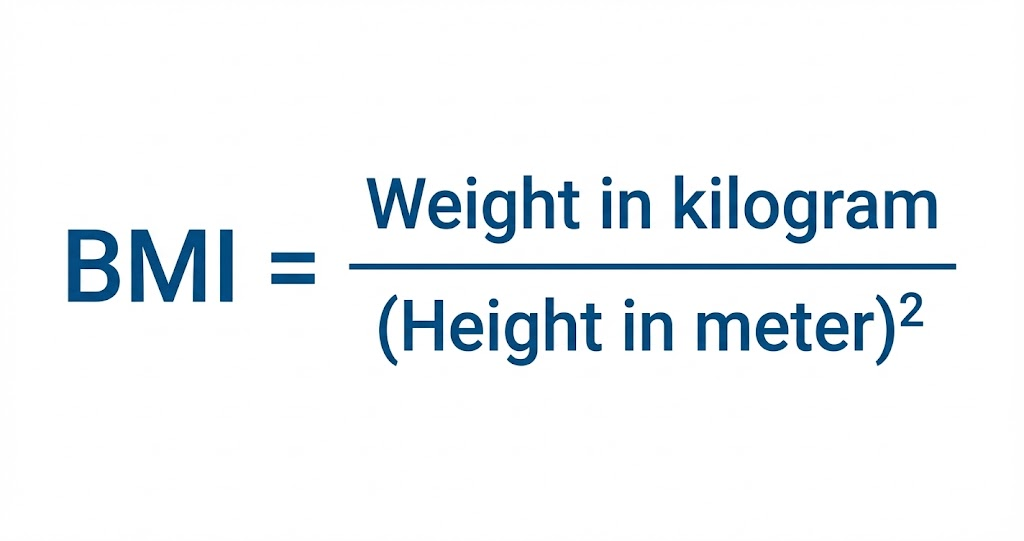
- Put each BMI into a category:
- Underweight: BMI < 18.5
- Normal: 18.5 – 24.9
- Pre-Obesity: 25 – 29.9
- Obesity: ≥ 30
- Draw:
- Pie chart of BMI categories.
- Bar graph for one pair:
- Student Name vs BMI
- Student Name vs Height
- Student Name vs Age
- Draw:
- Pie chart for one parameter: BMI, Hobby, or Residence.
From these charts you can answer:
- Tallest student in class.
- Residence of the shortest student.
- Number of students in the “fit” (Normal BMI) category.
- Most loved hobby in the class.
Test Yourself – Data Exploration (Answer)
Q: What does data exploration mean?
A: Finding useful trends in the data using charts and graphs.
1.5.4 Modelling
Stage 4 is Modeling. Here you create and train an AI model that can solve the identified problem.
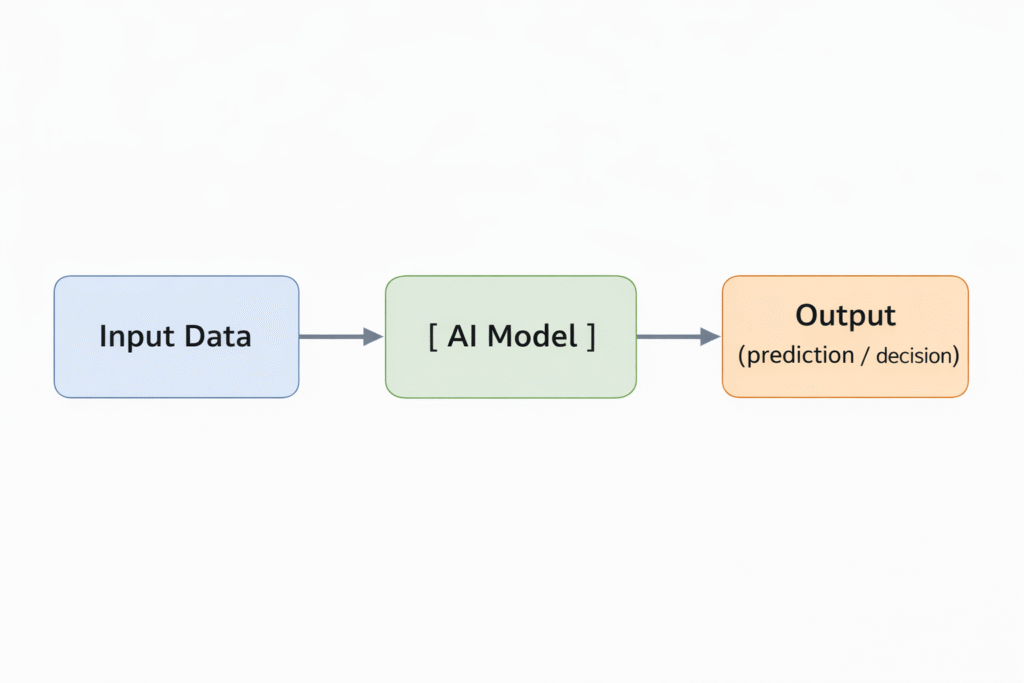
- The AI model learns from data collected in Data Acquisition.
- You give input to the AI, and it gives output based on patterns it has learned.
ASCII pipeline:
Exoplanet Use Case – Modelling
- Goal: detect the light-curve pattern that shows whether a star’s brightness data is “transit” or “non-transit”.
- Several machine learning or deep learning algorithms can be used for this classification.
Types of Models
Models are simplified structures that show how things work so we can predict or decide.
Rule-Based AI
- Uses fixed IF–THEN rules written by humans.
Examples:
This kind of AI is less common for complex tasks now because it cannot learn new rules by itself.
Learning-Based AI
- Learns rules from data and past experience.
- No need for humans to write every rule.
Example idea:
Discussion – Sample Answers
- Creating machines that learn independently is okay if humans set clear limits, goals, and safety rules.
- It can benefit everyday life (healthcare, transport, education) but may also cause problems (job loss, privacy issues) if not controlled.
1.5.5 Evaluation
Stage 5 is Evaluation.
- You test models using data to check performance.
- You compare different algorithms and choose the one that works best.
Exoplanet example: try multiple models, keep the one that correctly detects transits most often.
1.5.6 Deployment
Stage 6 is Deployment.
- You make your AI solution available to real users.
- It can be a mobile app, website, or integrated tool.
ASCII:
For exoplanets, the model could be deployed as a web tool where astronomers upload brightness data and receive transit detection results.
Try Yourself – Answers
Q1. Does modeling mean creating an AI model?
- Yes. In modeling, we select and train the appropriate AI model as per the problem statement.
Q2. Can we use AI on mobile phones?
- Yes. Many mobile apps use AI for features like face unlock, voice assistants, and filters.
AI Project Cycle Quiz – Answers
- The AI project cycle is a:
b) Cyclical process guiding AI development from start to finish. - Primary goal of problem scoping:
a) To define the specific problem the AI will address. - 4W Canva is helpful for:
b) Defining clear objectives in problem scoping. - In AI projects, data acquisition refers to:
d) The source from which the data is collected. - NOT a benefit of data exploration:
a) Makes it difficult to identify patterns and trends in data. - Main purpose of the modeling stage:
b) To build a computer program that can solve the identified problem. - FALSE statement about AI project cycle:
c) It is a rigid, inflexible process that cannot be adapted to different situations. - Most relevant data for predicting flight delays:
d) Historical data on flight delays and cancellations.
Short answer suggestions
- What is the AI project cycle?
It is a structured, cyclical set of stages that guide an AI project from problem definition to deployment. - What are the stages and their importance?
- Problem Scoping – clarifies the real problem and goal.
- Data Acquisition – provides correct, relevant data.
- Data Exploration – helps humans understand data patterns.
- Modeling – builds the AI model that learns from data.
- Evaluation – checks performance, chooses the best model.
- Deployment – releases the solution for real users.
Session – 2
AI Ethics
Lesson Title: AI Ethics
AI Ethics helps us think about what is right and wrong when we create and use AI systems so that they help people fairly and safely.
1.13 Introduction
Burger scenario
You are in charge of burgers in a fast-food restaurant. You drop a burger on a dirty floor and your boss says, “Just pick it up and serve it!”
- If you serve it: the customer might get sick and lose trust in the restaurant.
- If you refuse: you protect the customer’s health and keep your honesty, even if your boss is angry.
Other reflection questions:
- Is it okay to lie sometimes?
- Is it okay to steal food for a starving family?
- Is what most people decide always right?
What is Ethics?
- Ethics deals with external rules of conduct for a group or culture.
- It is like a moral compass that guides us to decide what is good or bad, fair or unfair.
ASCII:
Ethics tries to answer questions:
- What is the difference between good and evil?
- Is good and evil the same for everyone?
- How do we make decisions that affect others?
- Are we responsible for how our AI solutions are used?
1.14 AI Ethics
- AI Ethics is a system of moral principles for responsible development and use of AI.
- It guides how data is collected, stored, and used and how risks are handled.
- AI has many advantages but can also create risks, inequalities, and divisions.
- Policies and regulations are needed so AI benefits humanity as a whole.
Activity: Video “AI Ethics: Why It Matters?” – Sample Answers
- AI impacts daily life through recommendations, navigation, digital assistants, security systems, and more.
- AI becomes a concern when it is biased, misused for spying, spreads fake content, or invades privacy.
- People and organisations can be accountable by testing AI, being transparent, protecting data, and following ethical guidelines.
Main ethical concerns:
- AI Bias – unfair results when trained on biased data.
- Privacy Issues – using personal data without proper permission.
- Job Replacement – AI doing jobs faster than humans and reducing opportunities.
- Misinformation – creating fake but realistic news, images, or videos.
1.15 Importance of AI Ethics
- Many AI systems show bias linked to race, gender, or economic status.
- Bias means unfairly supporting or opposing someone or something.
- AI bias appears when the training data itself is biased.
Examples:
- Virtual assistants often use female voices by default.
- This reflects a stereotype that helpers or assistants should sound female.
- Searching for “salons” often gives female salons at the top.
- This assumes that most people searching are female.
- Yes, this is a bias; it can be called a negative bias because it ignores many male users.
Bias usually comes from developers or old data patterns, not from the machine itself. To improve AI, we must detect and reduce these biases.
Integrating ethics into AI aims to ensure:
- Human-centric design
- Unbiased decisions
- Data protection
- Sustainable AI solutions
ASCII:
Short meanings:
- Human-centric – puts human well-being first.
- Unbiased – avoids unfair favouring of groups.
- Data Protective – respects privacy and secures information.
- Sustainable – considers long-term social and environmental impact.
Balloon Debate – Reflection hints
- Using AI for jobs is ethical only if workers are supported, reskilled, and work conditions improve.
- Income sharing may need new policies like profit sharing or social support.
- AI health tools must be affordable and available to all, not just rich people.
- AI can be a boon (healthcare, environment, education) or a bane (spying, fake news) depending on use.
- Humans can stay ahead of AI by improving skills like creativity, ethics, empathy, and problem-solving.
Test Yourself – AI Ethics (Answers)
- Ethics primarily deals with:
b) External rules of conduct - In daily life, ethics serves as:
b) Moral compass - Ethics addresses questions like:
b) What is right or wrong - One question ethics asks about decision-making:
c) How decisions impact others - Primary purpose of AI Ethics:
b) To inform responsible development and use of AI - Need for AI ethics policies:
c) To ensure responsible development and use of AI - Key feature of integrating ethics into AI:
d) Ensuring human-centric AI solutions - Why integrate ethics into AI:
c) To ensure sustainable AI solutions
Reflection Time – Suggested Points
- Ethics shapes conduct by helping people choose fair, safe, and honest actions, even when nobody is watching.
- Policies and frameworks ensure that AI designers and users cannot misuse AI without facing consequences.
- Parameters for ethical AI: human-centric design, fairness, transparency, privacy, security, and sustainability.
- Ethical AI protects sensitive information through minimal collection, encryption, and clear data-use explanations, building trust.
- Sustainable AI solutions are needed so technology does not damage the environment or society over time.
Unit – 2
Project 0: Presentation
Lesson Title: Project 0: Presentation
This unit helps you revise all the concepts and use a project template to create a clear dialogue and mini-project based on AI.
2.1 Concepts at a glance
Artificial Intelligence and its applications
- Human Intelligence: mental ability to decide, solve, and learn.
- Artificial Intelligence: machine’s ability to decide, solve, and learn like a human.
Automation Vs Artificial Intelligence
| Automation | Artificial Intelligence |
|---|---|
| Way to make machines work on their own | Way to make machines think on their own |
| Makes physical work easy (lifting, moving) | Makes mental work easy (predicting, suggesting) |
| Examples: washing machine, printer | Examples: face unlock, self-driving cars, Siri etc. |
Interesting AI Applications
- YouTube video suggestions
- Google Maps navigation
- Digital assistants – Alexa, Siri, Google Assistant
- Self-driving cars
- AI fitness apps
- AI in music and arts
Three domains in AI
- Computer Vision – lets machines see and understand images/videos.
- Natural Language Processing (NLP) – lets machines understand human language.
- Statistical Data – lets machines understand and analyse numbers.
AI and the society – Sustainability
- Sustainability means maintaining the world we live in by using resources responsibly.
- Earth’s resources are limited; if we overuse or pollute them, future generations will suffer.
- Sustainability encourages equal sharing and avoiding waste.
Society & Sustainability
- Society is people around us.
- For full sustainability, everyone in society must participate.
- If some groups are not sustainable, overall sustainability fails.
Sustainable Development Goals (SDGs)
- 17 goals created in 2015 by the United Nations.
- Each goal has multiple targets related to people and planet.
AI Project Cycle – Quick View
- Cyclical process with six stages:
- Problem Scoping
- Data Acquisition
- Data Exploration
- Modeling
- Evaluation
- Deployment
Systems Thinking
- A system is a group of interconnected things.
- System maps show components and how they affect each other.
- Examples: water cycle, school system, digestive system, food chains.
AI Ethics – Recap
- AI Ethics is a moral framework guiding responsible AI development and use.
- Integrating ethics into AI ensures solutions are:
- Human-centric
- Unbiased
- Data-protective
- Sustainable
Let’s Reflect – MCQ Answers
- Human Intelligence is mainly about:
b) Mental ability to make decisions, solve problems, and learn - AI is defined as:
c) Machine’s ability to make decisions, solve problems, and learn - Primary purpose of automation:
b) To make machines work on their own - Primary purpose of AI:
b) To make machines think on their own - Domain focused on understanding language:
b) Natural Language Processing (NLP) - Statistical Data enables machines to understand:
b) Numerical data such as age, prices, temperature, humidity - Primary purpose of Computer Vision:
b) To enable machines to see and understand images and videos - Meaning of “Sustain”:
b) To maintain, support, withstand, or endure - Sustainability aims to solve:
c) Limited resources for future generations - The AI Project Cycle is:
b) A cyclical process followed to complete an AI project
2.2 Dialogue on the AI Project Template
This activity helps you build a conversation about AI with your “best friend” using the project template.
Below are sample lines you can adapt.
Step 0 – Friends Forever!
- Draw you and your best friend.
- Write their name and yours.
Step 1 – Defining Artificial Intelligence
Best Friend: “Hey! Can you tell me what is AI?”
You: “AI is when machines learn from data so they can make decisions and solve problems somewhat like humans.”
Step 2 – Applications of Artificial Intelligence
Best Friend: “I heard AI is used in YouTube, Maps, and Alexa. Have you used AI anywhere?”
You: “Yes, I see AI when YouTube suggests videos, Google Maps gives routes, and my phone uses face unlock.”
Step 3 – Domains in Artificial Intelligence
Best Friend: “Can we divide these AI uses into domains?”
You: “Yes. Computer Vision for images, NLP for language, and Statistical Data for numbers and predictions.”
Step 4 – AI use case
Best Friend: “How would I use AI to help others?”
You: “We could build an AI that predicts air quality in our city and warns people with breathing problems.”
Step 5 – AI use case – Domain
Best Friend: “Which AI domain does this idea belong to?”
You: “Mainly Statistical Data, because it uses numeric pollution and weather data; if we used images of the sky, we might add Computer Vision too.”
Step 6 – AI use case Project Cycle
Best Friend: “What is the AI project cycle and why do we need it?”
You: “It is a six-stage loop—Problem Scoping, Data Acquisition, Data Exploration, Modeling, Evaluation, Deployment. It keeps our project organised and clear.”
Step 6.1 – Problem Scoping
You apply the 4Ws to air pollution just like we did in the model answer: WHO (residents, authorities), WHAT (poor air), WHERE (city hotspots), WHY (protect health and plan better).
Step 6.2 – Data Acquisition
You: “We can get data from air-quality sensors, weather stations, and government open-data websites.”
Step 6.3 – Data Exploration
You: “We’ll draw graphs of AQI vs time and compare different areas to see pollution patterns.”
Step 6.4 – Modelling
You: “Our model will take inputs like temperature, wind speed, and past AQI and output predicted AQI for the next day.”
Step 6.5 – Evaluation
You: “We will test predictions against real AQI values. If accuracy is low, we’ll try better features or different algorithms.”
Step 6.6 – Deployment
You: “We can deploy it as a mobile app or website that shows colour-coded AQI forecasts so people can plan outdoor activities safely.”
Step 7 – AI Ethics
Best Friend: “What about AI Ethics?”
You: “AI Ethics makes sure our system is fair and safe—like not exposing users’ exact home locations and not ignoring poorer areas.”
Step 7.1 – AI Ethics
You: “Possible concerns: data privacy, unequal coverage across neighbourhoods, and clear explanation of predictions. We’ll solve these by anonymising locations, covering all parts of the city, and providing simple explanations in the app.”
Download Free Mind Map from the link below
This mind map contains all important topics of this chapter