
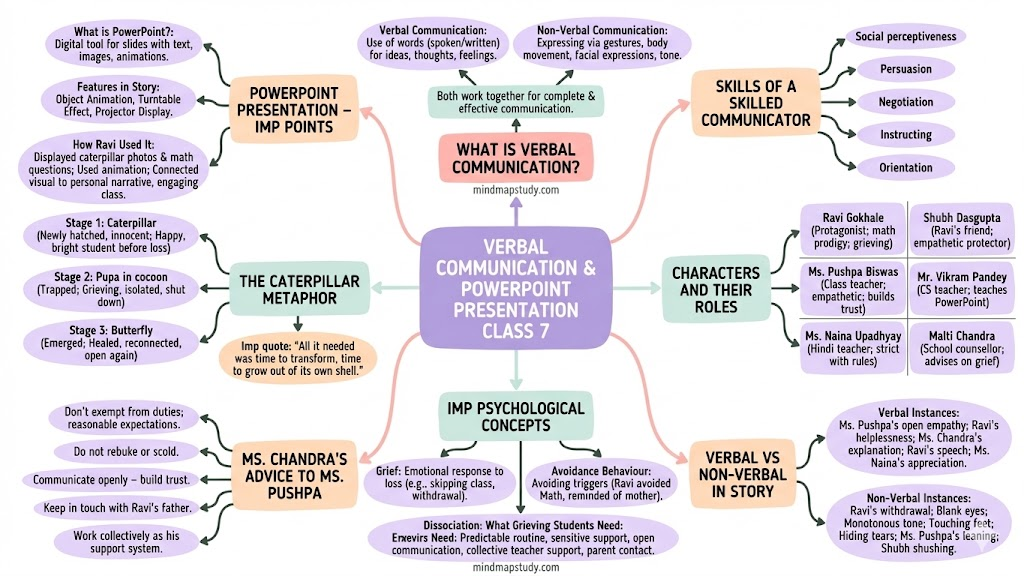
Verbal Communication and PowerPoint Presentation teaches how words, gestures, and open conversation help us connect with others and express ourselves honestly. Work through the story, assessments, and crossword below.
Verbal Communication and Power Point Presentation
What is Verbal Communication?
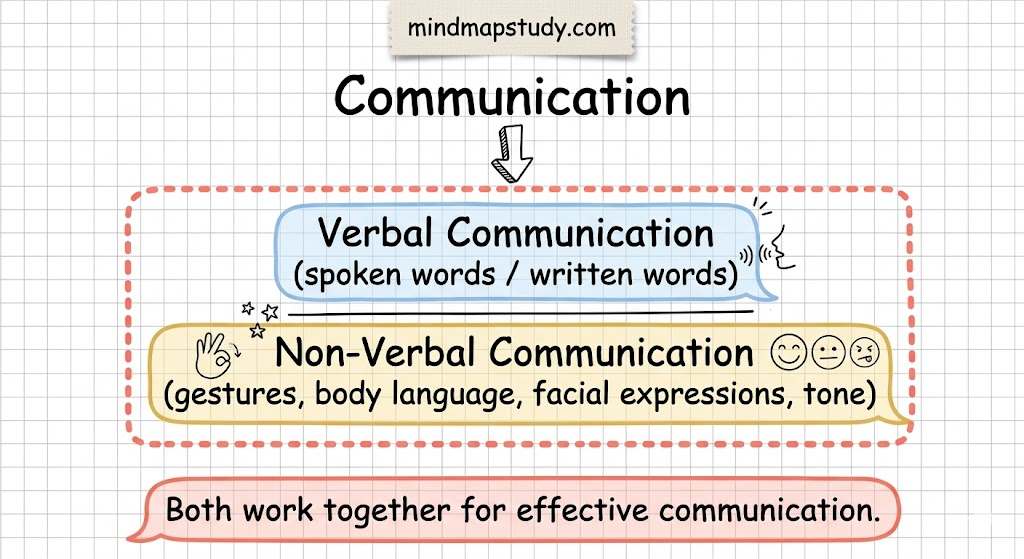
Verbal communication is the use of words — spoken or written — to share ideas, thoughts, and feelings with others. It helps us accurately define our experiences and express ourselves clearly.
Non-verbal communication, on the other hand, expresses ideas through gestures, body movement, facial expressions, and tone of voice — without using words.
Both types work together to build complete and meaningful communication.
A skilled communicator selects the right words, sounds, and gestures to build shared understanding and negotiate positive outcomes through:
- Social perceptiveness
- Persuasion
- Negotiation
- Instructing
- Orientation
Characters
| Character | Description |
|---|---|
| Ravi Gokhale | Protagonist; a math prodigy who lost his mother to COVID-19 and developed an aloof, withdrawn personality due to grief |
| Shubh Dasgupta | Ravi’s childhood friend; empathetic and protective of Ravi |
| Ms. Pushpa Biswas | Mathematics teacher and class teacher of 7-A; empathetic and unconventional in her teaching approach |
| Mr. Vikram Pandey | Computer Science teacher; charming and always willing to help colleagues and students |
| Ms. Naina Upadhyay | Hindi teacher; strict with rules and task submissions |
| Malti Chandra | School counsellor; perceptive, calm, and professional |
Story
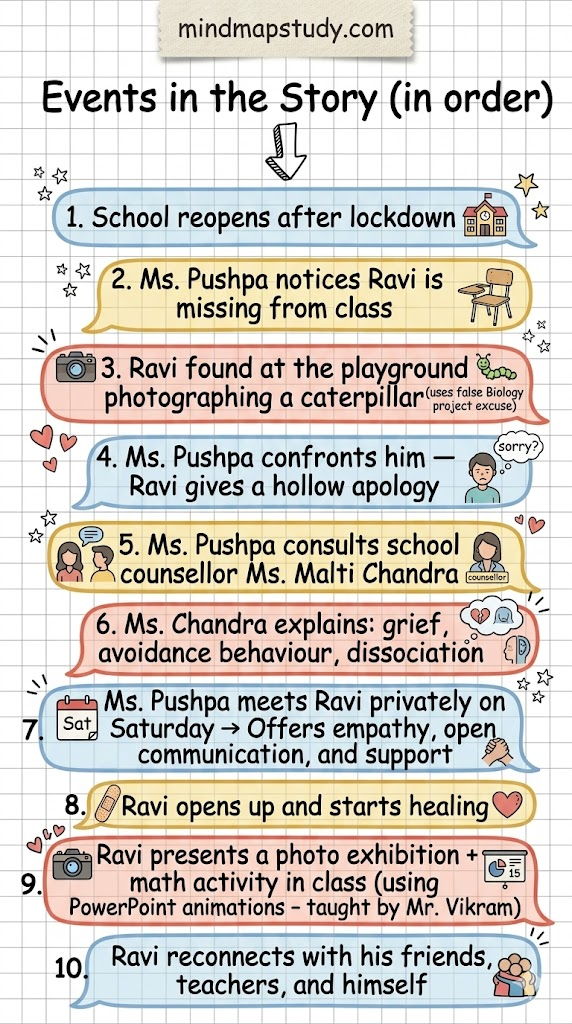
The story follows Ravi Gokhale, a student of Class 7-A who was known as a math prodigy and model student. After losing his mother to COVID-19, Ravi changed completely — he skipped online classes, stopped completing assignments, and began avoiding social situations.
On the first day back at school after lockdown, Ms. Pushpa Biswas noticed that Ravi was absent from her Mathematics period. She found him on the school playground photographing a caterpillar, having borrowed the school’s DSLR camera on a false pretext.
Verbal and Non-Verbal Communication in the Story
Verbal Communication:
- Ms. Pushpa asking Ravi: “How can I help you, Ravi?” — direct, open, honest spoken communication.
- Ravi saying: “I don’t know what you can do, Ma’am.” — expressing helplessness in words.
- Ms. Pushpa sharing her own story of losing her dog Timmy — using words to create empathy.
- Ms. Chandra explaining avoidance behaviour and dissociation to Ms. Pushpa — informational verbal communication.
- Ravi’s presentation speech to his class — persuasive and expressive verbal communication.
- Ms. Naina saying: “Chhatra mein bohut farak dikh raha hai. Aapki wajah se.” — verbal appreciation.
Non-Verbal Communication:
- Ravi not turning around when Ms. Pushpa called him — body language showing emotional withdrawal.
- Ravi’s blank, glazed eyes — facial expression communicating deep grief.
- Ravi’s hollow, monotonous apology — tone of voice conveying emotional disconnection.
- Ravi touching Ms. Pushpa’s feet — non-verbal gesture of respect and gratitude.
- Ravi bending down to hide his tears — body language expressing vulnerability.
- Ms. Pushpa leaning forward — non-verbal gesture of attentiveness and care.
- Shubh shushing the class — a protective non-verbal action.
Imp Concept: Grief and Communication
| Behaviour | What It Means |
|---|---|
| Avoiding the Math classroom | Avoidance behaviour — the subject reminded him of his mother |
| Hollow apologies, blank stare | Dissociation — mind locks away unbearable experiences |
| Lying about the Biology project | Grief causing loss of sense of responsibility |
| Refusing to greet the teacher | Social withdrawal due to trauma |
| Opening up to Ms. Pushpa | Healing begins with genuine empathy and trust |
Imp Concept: PowerPoint Presentation
The story introduces PowerPoint as a modern communication tool through Ravi’s photo exhibition in class.
Ravi used:
- Object Animations — to make the pupa appear to move.
- Slide transitions — to move from one photograph to the next.
- Images and questions embedded within slides to engage the class.
Mr. Vikram Pandey offered to teach the full class Object Animations and Turntable effects in their next Computer Science class.
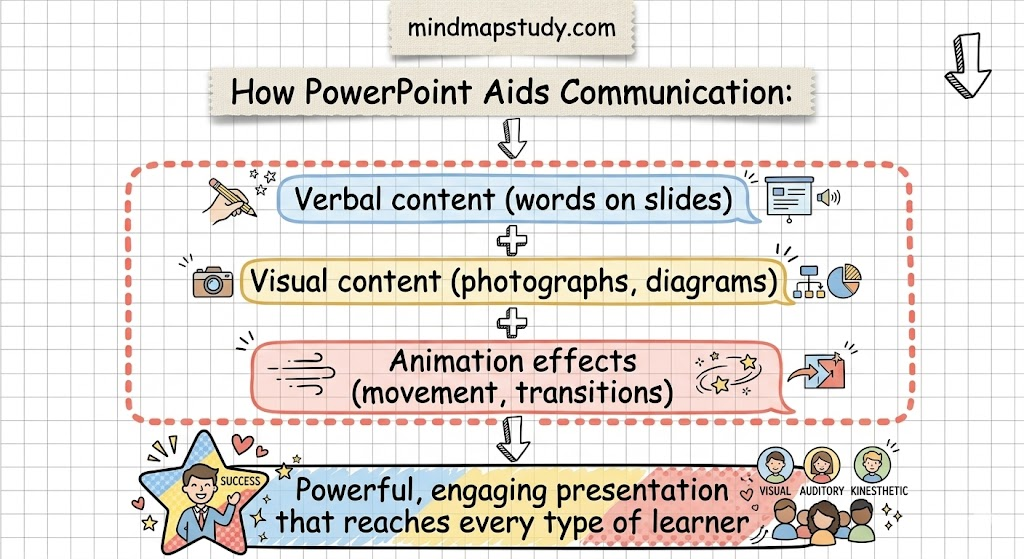
PowerPoint Imp Features mentioned in the story:
- Object Animation: Makes individual objects on a slide move.
- Turntable Effect: Rotates objects for visual impact.
- Projector Display: Projects slides for the whole class to see at once.
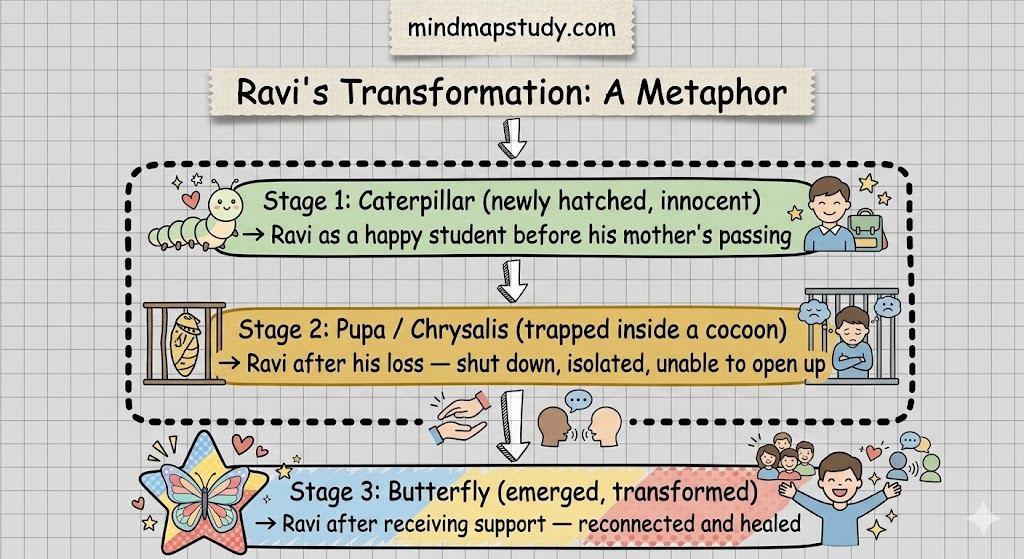
Metaphor in the Story: The Caterpillar
Ravi uses the metamorphosis of a caterpillar as a metaphor for his own grief and transformation:
Ravi’s Imp quote:
“All it needed was time to transform, time to grow out of its own shell.”
Assessments – Solutions
1. Which unique teaching method did Ms. Pushpa adopt for her class?
Ms. Pushpa allowed Ravi to teach the class instead of teaching herself. Ravi presented a photo exhibition of the caterpillar he had photographed, pairing each photograph with a mathematical question that the class had to answer in numbers only. This combined photography, nature, mathematics, and PowerPoint animation in one session.
2. Why did Ravi choose to skip his Mathematics lesson?
Ravi skipped his Mathematics lesson because his mother was also a Mathematics teacher. Attending the Math period reminded him painfully of her, triggering what Ms. Chandra called avoidance behaviour. He went to the playground to photograph a caterpillar as a way to cope and used a false Biology project excuse to justify being out of class.
3. What counsel did Ms. Chandra provide to Ms. Pushpa? Was it an effective approach?
Ms. Chandra advised Ms. Pushpa to:
- Not exempt Ravi from duties — grieving children need a predictable routine.
- Keep reasonable expectations without scolding or rebuking him.
- Communicate openly and build his trust.
- Keep in touch with Ravi’s father.
- Work collectively with all teachers as his support system.
Yes, the approach proved very effective. Ravi opened up during the private Saturday meeting and eventually presented confidently in front of the whole class.
4. How did Ms. Pushpa gain the trust of Ravi?
Ms. Pushpa gained Ravi’s trust by:
- Starting with a sincere apology: “I am so…sorry.”
- Sharing a personal story — losing her pet dog Timmy — to show she understood grief.
- Telling him he could talk about his mother whenever he was ready.
- Offering extra time for his academic submissions.
- Assuring him she would speak with all other teachers on his behalf.
5. What metaphor does Ravi use to explain his mental state?
Ravi uses the metamorphosis of a caterpillar into a butterfly. Just as a caterpillar goes through a painful, enclosed stage in a cocoon before emerging, Ravi had been trapped inside his own grief. With time and support, he was able to emerge and transform.
6. Cite instances of verbal and non-verbal communication in the story.
Already covered in the section above under “Verbal and Non-Verbal Communication in the Story.”
Think and Write – Suggested Answers
1. Was it necessary for Ravi to open up rather than hide his grief?
Opening up was far more helpful. When Ravi kept his feelings locked inside, he showed avoidance behaviour, dissociation, and social withdrawal. Once Ms. Pushpa created a safe space for honest communication, Ravi started healing and returned to class with renewed confidence.
2. How can a student support a classmate in mourning?
- Give them space without pressure.
- Avoid discussing their loss in public without consent (as Shubh demonstrated).
- Check in gently with a kind word.
- Inform a trusted teacher if the classmate seems to be struggling badly.
3. What are anniversary effects or grief triggers?
Anniversary effects are emotional reactions that occur on dates or in situations associated with the lost person. Ravi’s Math class was a grief trigger because his mother was also a Math teacher. Birthdays, places, objects, or even smells can act as grief triggers.
4. Why do we feel affected by the death of someone we may not have personally known?
Humans are naturally empathetic. Hearing about someone’s death reminds us of our own loved ones and our shared experience of loss. Empathy connects us across personal boundaries.
5. How will you cope with a crisis of faith or purpose following loss?
- Allow yourself time to grieve — do not rush the process.
- Talk openly to someone you trust.
- Maintain your daily routine for stability.
- Find a healthy outlet like Ravi found in photography.
- Remember that healing, like metamorphosis, takes its own time.
Multiple Choice Questions – Solutions
1. Having realised the true reason behind Ravi’s non-conformist nature, Ms. Pushpa feels .
- Answer: b. Remorseful — She regretted scolding him without understanding his grief.
2. “Along with a sharp mouth,” quipped in Aayaan. The tone is .
- Answer: d. Witty — Aayaan’s remark was clever and playful, making the class laugh.
3. “But don’t you think it’s our turn to blossom as well?” The accurate inference is .
- Answer: b. The teachers have now begun to introspect and grow.
Crossword – Answers with Meanings
| Clue | Answer | Meaning |
|---|---|---|
| Vertical 1: Say something indistinctly and quietly | MUMBLE | To speak in a low, unclear way |
| Vertical 2: Being calm and without emotion | STOIC | Not showing feelings; emotionally controlled |
| Vertical 3: Dull, tedious and repetitive | MONOTONOUS | Lacking variety; boring sameness |
| Vertical 5: To whiten a wall with paint | WHITEWASH | To paint walls white |
| Vertical 7: Come to realize or understand | PERCEIVE | To become aware of something |
| Vertical 8: A person with exceptional abilities | PRODIGY | Someone, usually young, with extraordinary talent |
| Across 4: Perplexed | CONFOUNDED | Confused and surprised |
| Across 6: Complete change of character or appearance | METAMORPHOSIS | A complete transformation |
| Across 9: Adapt for use in a different purpose | REPURPOSE | To use something in a new way |
| Across 10: Dull or dreamy expression | GLAZED | A blank, unfocused look in the eyes |
Download Mind Map
This mind map contains all important topics of this chapter
Visit our Class 7 Skill Development page for free mind maps of all Chapters