

Time management is planning and controlling how much time to spend on specific activities. When you manage your time well, you can get more work done in less time. This skill helps you throughout life and makes you successful in all areas.
Time is the most precious resource we have. Unlike money or other things, once time passes, we cannot get it back. That’s why learning to use time wisely from a young age is so valuable.
Body Language and Appearance
The Positive Posture
Good posture shows confidence and helps you feel better. Here’s what positive posture looks like:
- Sitting or standing upright with hands placed by the sides
- Keeping the head upright and levelled
- Not leaning forward or backward
- Standing in relaxed manner
- Exhibiting interest with a smile
The Negative Posture
Poor posture can affect how others see you and how you feel. Signs of negative posture include:
- Fatigue and negative mood
- Slouching to one side shows disinterest
- Hunched shoulders indicate lack of confidence and low self-esteem
- Forward head posture affects the alignment of the body
- Frowning face gives negative facial expressions
A Disciplined Dressing for School
Being well-groomed and properly dressed shows respect for yourself and others. For school, this means:
- Trimmed Nails
- Well-combed and trimmed hair
- Ironed uniform
- Polished shoes with tied laces
- Independent to wear school tie and belt
- A straight sitting posture in the classroom
The Story of Richa: Learning Time Management

Meet the Characters
Richa: A fun-seeking girl who often gets late for school. She remains in bed for too long and doesn’t get up on time. She is lazy and careless about organizing her things.
Mom: An educated woman who is good at time management. She expects Richa to value time and wants to help her daughter learn this imp skill.
Day 1: When Things Go Wrong
The alarm rings at 7:00 a.m. Mom calls Richa to wake up, but Richa asks for just 5 more minutes. Mom reminds her that the bus will arrive in 10 minutes.
Mom has already packed Richa’s tiffin, but Richa continues to delay getting up. When she finally wakes up, she faces multiple problems:
Problem 1: Cannot Find Socks Richa asks Mom where her socks are. Instead of helping immediately, Mom tells her to look for herself. Richa finds them near the study table.
Problem 2: Missing Shoe One of Richa’s shoes is missing. Mom reminds her that she never keeps her things in place. Richa finds the shoe under the bed.
Problem 3: Cannot Find Tie and Belt Richa cannot find her tie and belt. Mom suggests they might be in the living room where she left them yesterday. Richa realizes she forgot about them.
Problem 4: Unpolished Shoes Mom notices that Richa’s shoes are not polished and don’t look good. Richa says she is already late and has to submit a very imp project today. She cannot miss school.
The Accident
When the bus honks, Richa runs outside in a hurry. But she stumbles on the stairs and falls down. She gets hurt and cries. Mom helps her get up, but the bus leaves without waiting.
Richa is very upset because she worked really hard on her project and now cannot submit it.
The Lesson
Mom takes Richa to her room and gives her an imp lesson. She says: “Dear, effective time management and positive frame of mind always helps in enhancing your appearance.”
Mom asks Richa to change her uniform. Then she makes Richa do the following:
Step 1: Pick up the socks and shoes that she threw away
Step 2: Take out the belt that she carelessly threw under the bed
Step 3: Put the belt and socks in the shoes and place them in the shoe rack
Step 4: Take a hanger and place the belt and tie on it
Step 5: Change the uniform and hang it properly in the closet
Mom explains that if Richa is organized, she will never be late. Time management means keeping things in their proper place so you can find them easily.
Day 2: Success with Time Management
The next day, the alarm rings at 6:45 a.m. This time, Richa wakes up immediately. She says “Good Morning, Mom” and Mom is happy to see her up on time.
Richa opens the closet and takes out her uniform that is hanging properly. She feels relaxed and says “Wow! I will get ready on time.”
After coming out of the washroom, Richa takes the belt and tie that are hanging on the hanger. She puts them on easily.
Then she looks for her socks and shoes. She remembers: “Oh! I kept them in the shoe rack yesterday.”
She takes the shoes from the shoe rack and realizes she still has plenty of time. She decides to polish her shoes as well.
When Richa comes to the dining table, Mom is impressed. She says: “Oh Wow! Richa. You are on time.”
Richa shows her polished shoes proudly. Mom notices she is in proper school uniform too.
Mom’s Wisdom: “That is because you have managed your time perfectly well. If you are organized, you will never be late.”
Richa thanks her mother and promises to always remember this lesson. She drinks her milk, Mom combs her hair, and Richa is ready to go.
When the bus honks, Richa moves towards it confidently with a bright smile. She is happy and feels good about herself.
Connection Between Time Management and Appearance
The story shows an imp connection between time management and how you look. When Richa managed her time well:
- She had time to polish her shoes
- Her uniform was properly ironed and ready
- Her tie and belt were easy to find
- She could have breakfast peacefully
- She felt happy and confident
When you are organized and manage time well, you automatically look better because:
- You are not rushing, so you don’t make mistakes
- You have time to groom yourself properly
- You feel calm and confident, which shows in your posture
- You can smile and be friendly with others
Assessment Questions and Solutions
A. Choose the Correct Option
Question 1: Which of the following best describes time management? a) Maximum work completed in a defined time period b) Planning the amount of time we spend on certain activities c) Tracking of tasks that need to be completed
Answer: b) Planning the amount of time we spend on certain activities
Explanation: Time management is specifically about planning and controlling how you spend your time on different activities. While completing work and tracking tasks are related to time management, the core definition is about planning.
Question 2: Which of the following is imp to take into consideration when organizing day to day priorities? a) Preparing “to-do” lists b) Prioritizing tasks when setting a schedule c) Setting only those goals that match your lifestyle
Answer: b) Prioritizing tasks when setting a schedule
Explanation: When organizing daily priorities, the most imp thing is to prioritize tasks properly. This means deciding which tasks are most imp and should be done first. While to-do lists help, prioritizing is more imp.
Question 3: Which of the following are time management strategies you can use immediately to make the most of your time? a) Use your best and most appropriate time of the day b) Keep your momentum c) Reward yourself d) All the above
Answer: d) All the above
Explanation: All these strategies help in time management:
- Using your best time means doing imp work when you have most energy
- Keeping momentum means continuing with your work without breaks
- Rewarding yourself motivates you to manage time better
B. Make a Detailed Time Log
For this activity, you need to track your daily schedule for one full day. Here’s a sample format:

Analysis: a) In this example, 2 hours were wasted (playing on phone and watching TV unnecessarily) b) Yes, changes are needed. The wasted time can be used for reading, hobby activities, or helping family c) Changes to make:
- Reduce phone time to 30 minutes only
- Watch only educational programs on TV for 30 minutes
- Use saved time for reading or creative activities
C. Think and Suggest
Question 1: Have you ever missed a deadline? If yes, how did you go about it? If not, how do you ensure that you are not falling behind?
Sample Answer: Yes, once I missed submitting my project on time because I kept postponing it. When I realized I missed the deadline, I:
- Apologized to my teacher honestly
- Explained what happened
- Asked if I could submit it late with a penalty
- Completed the project immediately
- Learned to start work early from that experience
If you haven’t missed a deadline: I ensure I don’t fall behind by:
- Writing down all deadlines in a planner
- Breaking big tasks into smaller parts
- Starting work as soon as it is assigned
- Checking my planner every day
- Asking for help if I’m stuck
Question 2: You have returned after a week-long holiday and you find your homework too much pending. How would you prioritize your work?
Answer: When there’s too much pending work, I would prioritize like this:
Step 1 – Make a List Write down all pending homework with submission dates
Step 2 – Identify Urgent Work Mark homework that is due tomorrow or very soon as “urgent”
Step 3 – Identify Imp Work Mark homework that carries high marks or is for major subjects as “imp”
Step 4 – Create Priority Order
Priority 1: Urgent AND Imp (due soon + high marks)
Priority 2: Urgent but less imp (due soon + lower marks)
Priority 3: Imp but not urgent (high marks + more time available)
Priority 4: Neither urgent nor imp (lower marks + more time available)
Step 5 – Make a Schedule
- Day 1: Complete Priority 1 items
- Day 2: Complete Priority 2 items
- Day 3: Complete Priority 3 items
- Day 4: Complete Priority 4 items and review all work
Step 6 – Avoid Distractions No TV, phone, or games until Priority 1 and 2 are done
D. Match the Correct Option
Question 1: Time management is the process of planning Answer: ii. the best way to organize the things
Question 2: Failing to manage your time can lead to Answer: i. missed deadlines
Question 3: Time Management is imp to Answer: iv. everyone
Question 4: Postpone unnecessary activities until Answer: v. the work is done
Question 5: Multitasking is a great way Answer: iii. to finish things quickly
Glossary: Imp Words to Know
Grab: To obtain or consume quickly
- Similar words: grip, catch
- Example: Richa grabbed her shoe from under the bed
Honk: To blow a horn in a loud sound
- Similar words: to give a call
- Example: The bus honked to tell Richa to hurry
Stumble: To trip or momentarily lose one’s balance; almost fall
- Similar words: fall, slip
- Example: Richa stumbled on the stairs because she was rushing
Closet: A tall cupboard or wardrobe with a door, used for storage
- Similar words: cupboard, wardrobe
- Example: Richa hung her uniform properly in the closet
Confidently: In a self-assured way that expresses faith in oneself or one’s abilities
- Similar words: having conviction
- Example: Richa walked confidently towards the bus the next day
Practical Time Management Tips for Students
Morning Routine
Before School:
- Set alarm for the same time daily
- Keep uniform ready the night before
- Place shoes, socks, tie, and belt in one place
- Pack school bag the previous night
- Have a checklist of things needed
After School
Evening Routine:
- Change out of uniform immediately
- Hang uniform properly
- Place shoes in shoe rack
- Complete homework before playing
- Prepare for next day before sleeping
Weekend Organization
Use Weekends Wisely:
- Clean and organize your room
- Polish all school shoes
- Check if any uniform needs ironing
- Complete any pending homework
- Prepare for upcoming week
Benefits of Good Time Management
When you manage time well, you get:
Personal Benefits:
- Less stress and worry
- More time for fun activities
- Better sleep because you’re not worried
- Improved confidence
- Sense of achievement
Academic Benefits:
- Better grades
- Homework completed on time
- No missed deadlines
- More time for revision
- Participation in extra activities
Social Benefits:
- More time with friends and family
- Can help others
- Better relationships
- People trust you more
- Teachers and parents are proud
Common Time Wasters to Avoid
Students often waste time on:
- Excessive Screen Time: Spending hours on phone, TV, or games
- Disorganization: Looking for lost items
- Procrastination: Postponing work for later
- Perfectionism: Spending too much time on small details
- No Planning: Starting day without a plan
How to Create a Daily Schedule
Basic Schedule Template
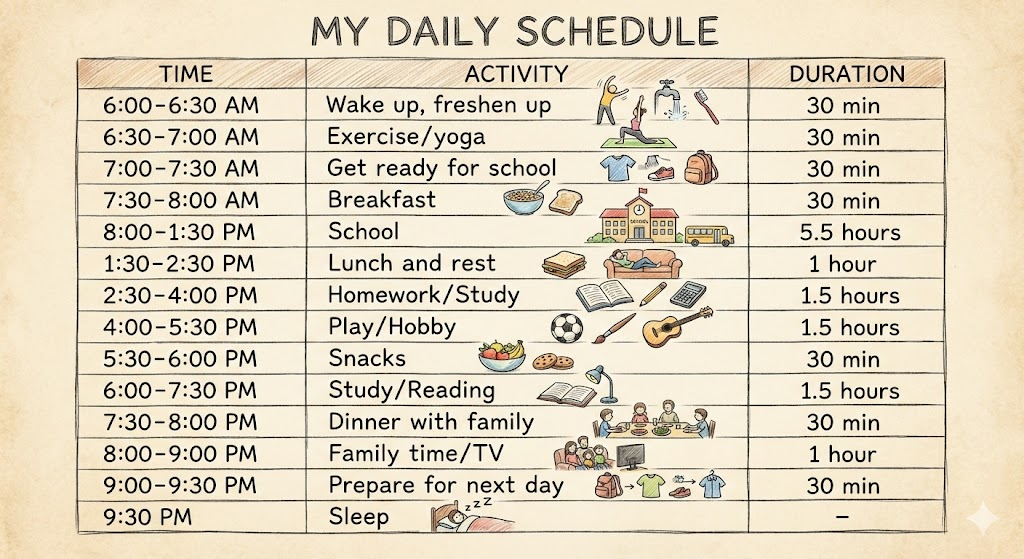
Adjusting the Schedule
You can adjust this based on:
- Your school timings
- Homework load
- Extra classes or tuitions
- Personal preferences
- Family routines
The imp thing is to stick to the schedule once you make it.
Download Free Mind Map from the link below
This mind map contains all important topics of this chapter