
🧠 Control and Coordination
Nervous system, reflex arc, human brain, plant hormones, tropisms, animal hormones — all topics, all questions answered simply.
Table of Contents
Toggle1 What is Control & Coordination?
Living organisms constantly respond to changes in their environment. A cat runs when it sees a mouse. We pull our hand back when we touch something hot. Plants grow toward sunlight. All these are controlled responses — not random movements.
For controlled movement to happen, three things must occur in order: detect a change → process the information → respond appropriately. In multicellular organisms, specialised tissues handle this — the nervous system (for fast responses) and the endocrine system (for slower, long-lasting responses using hormones).
Fig. 1 – Control & Coordination chain: every response follows this exact sequence — black arrows show the direction of information flow
2 The Neuron — Structure & Impulse Transmission
The basic unit of the nervous system is the neuron (nerve cell). Specialised neurons have receptor tips (dendrites) that detect changes. Information travels as an electrical impulse through the neuron and is passed to the next neuron via a chemical signal across a synapse.
Fig. 2 – Neuron: (i) Dendrite tips → receive incoming red signals from sense organs; (ii) Electrical impulse travels along axon (blue arrow →); (iii) At synapse, orange chemical dots cross the gap to trigger the next neuron (green →)
Parts of a Neuron and their Functions
| Part | Function | Nature of Signal |
|---|---|---|
| Dendrites | Receives information from sense organs or previous neuron | Chemical → Electrical |
| Cell body | Contains nucleus; processes information | Electrical impulse |
| Axon | Carries electrical impulse from cell body to nerve ending | Electrical impulse |
| Nerve ending / Synapse | Releases chemical messengers to cross gap to next cell | Electrical → Chemical |
At the synapse (gap between two neurons), the electrical impulse converts to a chemical signal. Chemicals called neurotransmitters are released, cross the gap, and restart an electrical impulse in the next neuron. Synapses ensure impulses travel in one direction only.
3 Reflex Action & Reflex Arc
A reflex action is a sudden, automatic response to a stimulus that does NOT require conscious thought. It is extremely fast because the signal bypasses the brain and is processed in the spinal cord directly.
Examples: Pulling hand away from fire, knee-jerk reaction, blinking when something comes near the eye, pupil shrinking in bright light.
Fig. 3 – Reflex arc: Signal travels from receptor through spinal cord (NOT brain) directly to effector for instant response. Brain receives the info simultaneously but the hand has already moved.
Reflex action: Automatic, no thinking needed, controlled by spinal cord. Very fast (milliseconds). Example: pulling hand from fire.
Voluntary action: Involves conscious thought, controlled by cerebrum (brain). Example: writing, walking, picking up a pencil.
4 Human Brain — Three Regions
The brain is the main coordinating centre of the body. Together with the spinal cord, it forms the Central Nervous System (CNS). The peripheral nervous system (cranial nerves + spinal nerves) connects CNS to the rest of the body.
The brain has three major regions: Forebrain, Midbrain, Hindbrain.
Fig. 4 – Human brain: blue = forebrain (thinking), green = midbrain (relay), purple = cerebellum (balance), red = medulla (involuntary actions)
| Brain Region | Part | Function |
|---|---|---|
| Forebrain | Cerebrum | Thinking, memory, voluntary actions, sensory perception (sight, hearing, smell, taste) |
| Hypothalamus | Regulates hunger, thirst, body temperature; controls pituitary gland | |
| Pituitary gland | Master endocrine gland — releases hormones that control other glands | |
| Midbrain | — | Relay between forebrain and hindbrain; some involuntary actions (pupil reflex) |
| Hindbrain | Cerebellum | Balance, posture, precision of voluntary movements (walking, riding bicycle, picking pen) |
| Medulla oblongata | Controls all involuntary actions: heartbeat, blood pressure, breathing, salivation, vomiting |
5 Protection of Nervous Tissue
🧠 Brain Protection
Brain sits inside a bony box (cranium/skull). Inside the skull, the brain is surrounded by a fluid-filled membrane (cerebrospinal fluid) which acts as a shock absorber against impact.
🦴 Spinal Cord Protection
The spinal cord runs through the vertebral column (backbone) — a bony tube of stacked vertebrae that completely encloses and protects it.
6 How Nervous Tissue Causes Action in Muscles
When a nerve impulse reaches a muscle fibre, the muscle cell changes its shape by shortening. This is done by special contractile proteins (actin and myosin) inside muscle cells that rearrange in response to the electrical impulse.
Voluntary muscles (skeletal muscles) — controlled consciously by cerebrum. Example: hand muscles.
Involuntary muscles (smooth and cardiac muscles) — NOT under conscious control. Example: heart, stomach, intestine.
7 Coordination in Plants — Two Types of Movement
Plants have no nervous system and no muscles. Yet they respond to stimuli. Plants show two types of movement:
⚡ Independent of Growth
Very fast movement caused by change in water content of cells (cells swell or shrink). No growth needed.
Example: Mimosa pudica (touch-me-not / chhui-mui) — leaves fold within seconds of being touched.
🌱 Dependent on Growth (Tropisms)
Slow, directional movement caused by unequal growth on two sides of an organ, driven by hormones like auxin.
Example: Shoot bending toward light (phototropism).
Plant cells change shape by changing the amount of water in them. When touched, cells at the base of the leaf lose water and shrink → leaf droops/folds. When undisturbed, cells refill → leaf opens back. Information travels cell-to-cell via chemical-electrical signals (no specialised nerve tissue).
8 Plant Hormones
Plant hormones (also called phytohormones) are chemical messengers that are made in one part of the plant and travel to another part where they cause an effect. They coordinate growth, development and responses to the environment.
| Hormone | Where Made | Function | Effect |
|---|---|---|---|
| Auxin | Shoot tip | Promotes cell elongation. Causes phototropism | Cells on shaded side grow longer → shoot bends toward light |
| Gibberellins | Young leaves, seeds | Promotes stem elongation and seed germination | Plants grow taller |
| Cytokinins | Fruits, seeds, roots | Promotes cell division | Faster growth in fruits and seeds |
| Abscisic Acid (ABA) | Leaves, stems | Inhibits growth; causes stomata to close | Wilting of leaves in drought; seed dormancy |
Auxin and phototropism: Light comes from one side → auxin diffuses to the shaded (dark) side of the shoot → cells on the shaded side grow longer → shoot bends toward the light. The light side grows less. This is why plants always appear to "lean" toward a window.
9 Tropisms — Directional Growth Movements
A tropism is directional growth of a plant part in response to an external stimulus. It can be positive (toward stimulus) or negative (away from stimulus).
Fig. 5 – Four types of tropisms: Phototropism (light), Geotropism (gravity), Hydrotropism (water), Chemotropism (chemicals) — arrows show direction of growth response
10 Hormones in Animals — Endocrine System
Animals have a second coordination system alongside the nervous system — the endocrine system. Endocrine glands secrete hormones directly into the bloodstream. Hormones are carried to target organs all over the body, causing slower but longer-lasting effects than nerve impulses.
Adrenaline — The "Fight or Flight" Hormone
When an animal (or person) is scared, excited, or in danger, the adrenal glands (on top of kidneys) release adrenaline into the blood. This prepares the body to either fight or run away:
✦ Heart beats faster → more O₂ to muscles
✦ Breathing rate increases → more O₂ in
✦ Blood diverted from digestive system and skin → to skeletal muscles
✦ Pupils dilate → better vision
✦ Liver releases glucose → more energy available
Feedback Mechanism
Hormone levels are controlled by a feedback mechanism. Example: Blood sugar rises → pancreas detects this → releases more insulin → insulin reduces blood sugar → insulin secretion decreases. This self-regulating loop keeps hormone levels in balance.
11 Endocrine Glands & Hormones
| Hormone | Gland | Function / Effect |
|---|---|---|
| Growth Hormone (GH) | Pituitary gland | Stimulates growth of all organs and tissues. Deficiency → dwarfism; excess → gigantism |
| Thyroxin | Thyroid gland | Regulates carbohydrate, protein & fat metabolism for balanced growth. Needs iodine. Deficiency → goitre (swollen neck) |
| Insulin | Pancreas (islets of Langerhans) | Lowers blood glucose level. Deficiency → diabetes mellitus |
| Testosterone | Testes | Development of male secondary sex characteristics during puberty (voice, hair, muscle growth) |
| Oestrogen | Ovaries | Development of female secondary sex characteristics; regulates menstrual cycle |
| Adrenaline | Adrenal glands (on kidneys) | Fight-or-flight response: increases heart rate, breathing rate; diverts blood to muscles |
| Releasing hormones | Hypothalamus | Stimulates pituitary to release specific hormones (e.g. growth hormone releasing factor) |
| Parathormone | Parathyroid glands | Regulates calcium and phosphate levels in blood |
We need iodine in our diet because the thyroid gland uses it to make thyroxin. Without iodine, the thyroid cannot produce thyroxin. The thyroid keeps trying to make more (swells up) → condition called goitre (enlarged thyroid = swollen neck). That's why iodised salt is important!
12 All Questions & Answers
Walking: A voluntary action that requires conscious thought and is initiated and controlled by the cerebrum (forebrain). It involves coordination of many muscle groups simultaneously, fine-tuned by the cerebellum. It takes time to decide to walk and can be stopped or changed at will.
(1) The electrical impulse triggers the release of chemical neurotransmitters from vesicles at the axon terminal.
(2) These chemicals diffuse across the synaptic gap.
(3) They bind to receptor molecules on the dendrite of the next neuron.
(4) This creates a new electrical impulse in the next neuron.
This one-way chemical crossing ensures impulses travel in only one direction.
(1) The information about the stimulus is also sent simultaneously to the brain via sensory neurons — so the brain becomes aware of what happened (you feel the pain after your hand has already moved).
(2) The brain established and can modify some reflex arcs (e.g., conditioning). For life-threatening situations, the spinal cord handles the immediate response; the brain processes the experience afterwards.
• Very rapid (within seconds)
• Not caused by growth — caused by sudden change in water content (turgor) in cells at the base of leaves
• Reversible — leaves open again once stimulus is removed
• Does not involve hormones
Shoot bending toward light (phototropism):
• Very slow (over hours/days)
• Caused by growth — auxin accumulates on the shaded side, causing cells there to elongate more
• NOT reversible in the same way — the growth has already happened
• Controlled by the hormone auxin
Materials: Two growing seedlings with roots visible, a tray, dry soil on one side and wet soil on other side, OR two glass trays.
Procedure:
1. Take two similar pots. Fill one with uniformly moist soil. Fill the other so that one side is dry and the other side has water-logged/moist soil.
2. Plant germinated seeds in both pots.
3. Keep the pot with uniform moisture as a control. In the experimental pot, water only from one side.
4. Observe the direction of root growth after 3–5 days.
Observation: In the experimental pot, roots grow toward the moist (water) side, curving away from the dry side. In the control pot, roots grow straight down.
Conclusion: Roots show positive hydrotropism — they grow toward water.
(1) Endocrine glands (like pancreas, thyroid, adrenal glands) produce hormones.
(2) Hormones are secreted directly into the bloodstream (no ducts — hence called ductless glands).
(3) Blood carries hormones to target organs all over the body.
(4) Target cells have specific receptors for hormones that trigger a specific response.
(5) Hormone levels are regulated by a feedback mechanism.
Unlike nerve impulses (fast, localised), hormones act slowly but can affect the entire body for a longer time.
• Heart rate increases → more blood (and O₂) reaches muscles
• Breathing rate increases → more O₂ enters the body
• Blood is redirected from digestive system and skin → to skeletal muscles
• Liver releases stored glucose → more energy available immediately
• Pupils dilate → better vision
All these changes together prepare the body for fight or flight — to either confront danger or escape it quickly.
Since the body cannot produce enough insulin naturally, patients are given injections of synthetic insulin to replace the missing hormone. This brings blood glucose levels back to normal. Insulin cannot be given orally (as a pill) because stomach acid would destroy it — so injections are necessary.
Cytokinin is a plant hormone that promotes cell division. Insulin is secreted by the pancreas (animal), thyroxin by the thyroid gland (animal), oestrogen by the ovaries (animal). Only cytokinin is a plant hormone.
The synapse is the tiny gap (junction) between two neurons where chemical neurotransmitters are released to carry the signal across. Dendrite = receiving end, Axon = transmitting wire, Impulse = the electrical signal itself.
• Thinking → controlled by cerebrum (forebrain)
• Regulating heart beat → controlled by medulla oblongata (hindbrain)
• Balancing the body → controlled by cerebellum (hindbrain)
All three functions are performed by different parts of the brain.
When receptors don't work:
• Faulty photoreceptors → blindness or colour-blindness (cannot distinguish colours)
• Faulty auditory receptors → hearing loss / deafness
• Faulty pain receptors → cannot feel pain → dangerous (no warning of injury; e.g. people with leprosy)
• Faulty thermoreceptors → cannot detect temperature → risk of burns without realising it
• Faulty olfactory receptors → anosmia (cannot smell), as seen during COVID-19 infection
Function: Neurons are specialised to:
• Receive information from environment (via dendrites)
• Generate and carry electrical impulses (along axon)
• Pass information to other neurons or muscles/glands (via synapse — chemical signal)
The entire nervous system is a network of billions of neurons working together to detect, process, and respond to information.
(1) Light hits the plant from one side.
(2) Auxin is produced at the shoot tip.
(3) Auxin migrates to the shaded (darker) side of the shoot — away from the light.
(4) The higher concentration of auxin on the shaded side stimulates those cells to elongate (grow longer) more than the cells on the lit side.
(5) Because the shaded side grows faster, the shoot bends toward the light source.
This is called positive phototropism (shoot bends toward light). Roots show negative phototropism (roots grow away from light).
(1) Sensory signals going UP to the brain — the person loses sensation (touch, pain, temperature) in body parts below the injury. They cannot feel if they are injured.
(2) Motor signals coming DOWN from the brain — the person loses voluntary muscle control below the injury point. They cannot walk or move limbs.
(3) Reflex arc signals — reflex arcs passing through that part of the spinal cord are disrupted, so reflexes in that region are lost.
(4) Autonomic nerve signals — control of bladder, bowel, and blood pressure may be affected.
(1) Hormones are synthesised at one location (e.g., auxin made at shoot tip).
(2) They are transported (via diffusion or through plant tissues) to another part of the plant where they are needed.
(3) They cause their effect at the target location (e.g., auxin causes cell elongation).
(4) Different hormones work for different functions: Auxin/Gibberellins (promote growth), Cytokinins (promote cell division), Abscisic acid (inhibits growth, closes stomata in drought).
This is slower than nervous system coordination but can affect the entire plant continuously.
• Organisms could not respond appropriately to stimuli (danger, food, light, temperature)
• Different body parts would not work together efficiently
• Internal conditions (body temperature, blood sugar, heart rate) could not be maintained
• Growth and development would be disorganised
Control and coordination ensures that:
✦ The body detects changes in environment
✦ Appropriate, proportional responses are generated
✦ All body parts work in harmony (e.g., muscles, glands, organs)
✦ Internal homeostasis (balance) is maintained for survival
• Happen continuously, automatically, all the time
• Controlled by mid-brain and hind-brain (medulla)
• Examples: heartbeat, breathing, digestion, blood pressure, salivation
• We are not even aware these are happening most of the time
Reflex actions:
• Happen suddenly in response to a specific stimulus
• Controlled by the spinal cord (reflex arc)
• Examples: pulling hand from fire, sneezing, blinking, knee-jerk
• They are rapid responses to environmental changes — not continuous
Key difference: Involuntary actions are ongoing background processes; reflex actions are sudden one-time responses to stimuli. Both bypass conscious thought, but their control centres differ.
• Uses electrical impulses along neurons
• Very fast (milliseconds)
• Short-lived effect (stops when impulse stops)
• Reaches only cells connected by nerve tissue
• Specific and localised response
• Brain and spinal cord are the control centres
Hormonal System (Chemical):
• Uses chemical messengers (hormones) through blood
• Slower (seconds to minutes)
• Long-lasting effect (hormones persist in blood)
• Can reach every cell in the body via bloodstream
• Widespread, generalised response (whole-body effect)
• Endocrine glands are the control centres
Similarity: Both systems coordinate body functions; both involve communication between cells; both work together (e.g., adrenaline affects both nervous and hormonal responses).
• Caused by change in water content (turgor) of cells at leaf base — cells swell or shrink
• No nervous system, no muscles involved
• Information travels via electrical-chemical signals cell to cell (no specialised nerve tissue)
• Very fast for a plant but no true muscle action
• Not caused by growth
• Reversible — leaves reopen
Movement of our legs:
• Caused by contraction of muscle fibres due to nerve impulses
• Requires a complete nervous system: brain → motor nerve → muscle
• Involves specialised proteins (actin, myosin) in muscle cells shortening
• Can be voluntary (walking — cerebrum) or involuntary (reflex — spinal cord)
• Depends on electrical impulses + chemical signals (neurotransmitters)
• Immediate and strong mechanical force generated
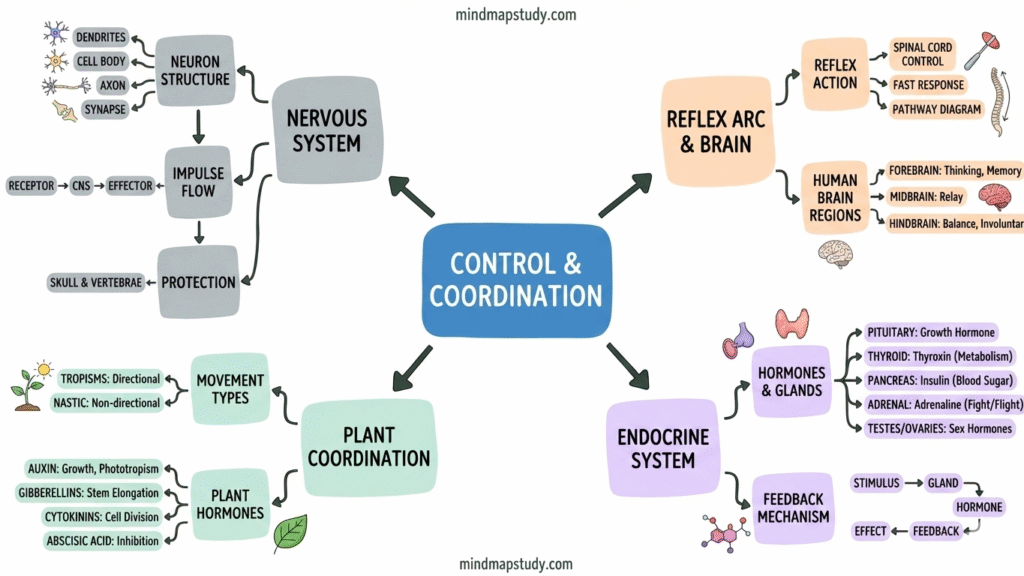
Download Free Mind Map from the link below
This mind map contains all important topics of this chapter
Visit our Class 9 Kaveri page for free mind maps of all Chapters