
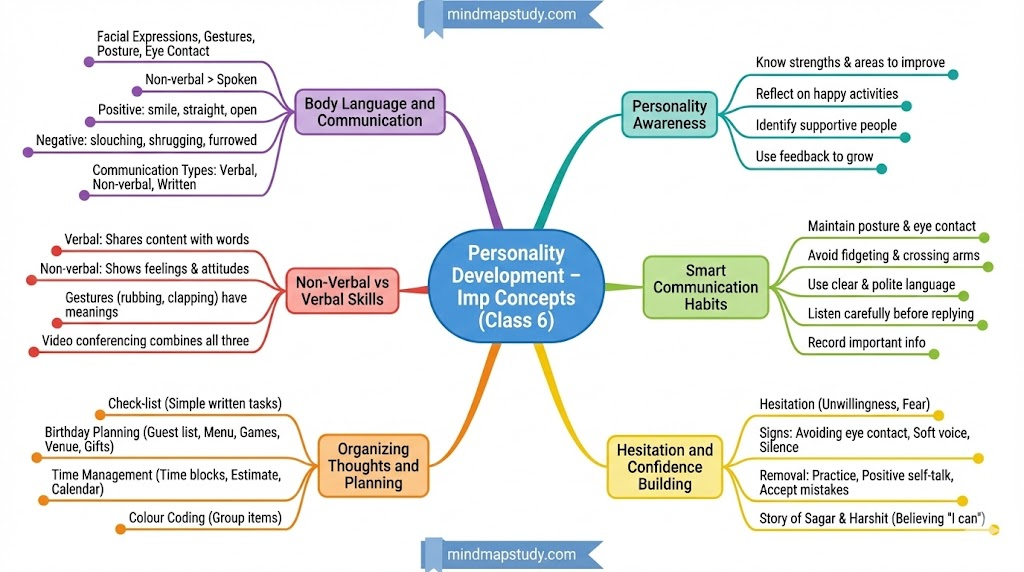
This chapter uses stories and dialogues to show personality development is shaped by body language, planning, and self-confidence. It highlights that facial expressions, gestures, posture, and eye contact often tell more about us than our spoken words. When we understand these non-verbal signals, we can express ourselves better, read others’ emotions, and appear more confident and organised in daily life.
CHARACTERS
- Ms Rashmi – English teacher, calm and confident.
- Aryan – 11-year-old boy, curious and mischievous.
- Disha – 11-year-old girl, patient and attentive.
- Raj – 10-year-old boy, thin, mischievous, curious.
- Ravi – 11-year-old boy, tall, thin, likes football and biographies.
- Shaurya – 10-year-old boy, intelligent and thoughtful.
- Uday – 10-year-old boy, tall and thin.
- Teacher from Nepal – friendly visiting teacher.
- Students from Nepal – boys and girls joining via video conference.
- School Peon – helpful support staff.
ORGANIZING THOUGHTS
- Aryan – birthday boy planning his party.
- Aryan’s Grandmother and Grandfather – wise and supportive.
- Aryan’s Mother and Father – guide him in planning and time management.
CONFIDENCE BUILDING
- Shaurya – hesitates to perform guitar on stage.
- Shaurya’s Grandmother – motivates him with a story.
- Soumya – 12-year-old girl, supportive.
- Sagar and Harshit – boys in the well story showing courage and belief.
- Villagers and Uncle Puri – help reveal the moral of self-belief.
STORY
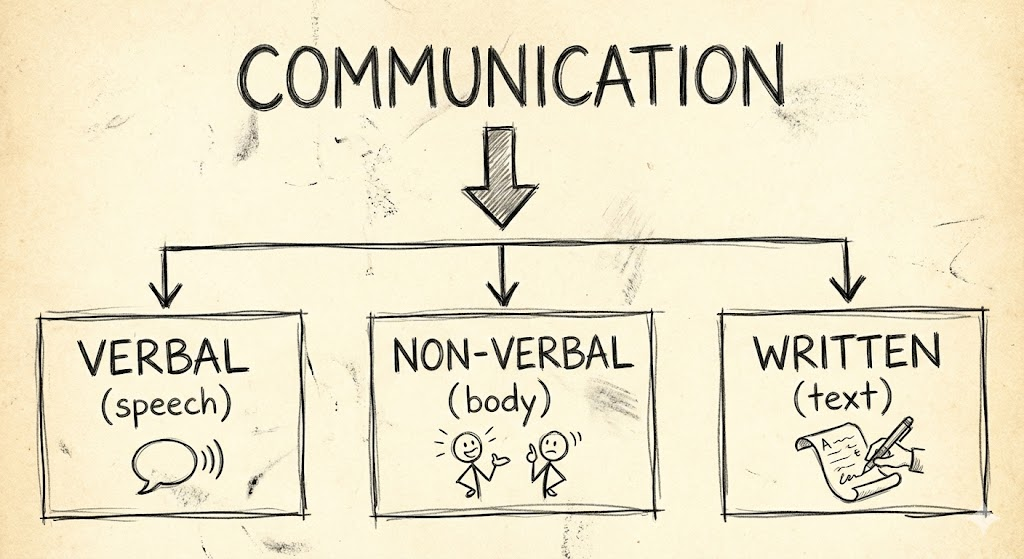
The chapter opens with a normal school day. The bell rings and students rush to English class for an ASL (Assessment of Speaking and Listening) session. Ms Rashmi explains that communication is important in every subject, not only languages, because it helps us express ourselves and understand others.
She tells students that communication can be:
- Verbal – spoken words.
- Non-verbal – body language, gestures, facial expressions, posture.
- Written – letters, notes, reports, messages.
overview:
To explain, she asks Disha and Ravi to introduce themselves.
- Disha speaks softly, looks serious, slouches to one side, and seems uncomfortable.
- Ravi stands straight, smiles, maintains eye contact, and speaks clearly about himself.
The class observes:
- Disha’s incomplete introduction and serious look show lack of comfort and low confidence.
- Ravi’s posture, eye contact, and clear voice show confidence and interest.
Ms Rashmi points out important body language cues:
- A smile shows friendliness.
- Steady eye contact shows honesty and attention.
- A firm handshake shows friendship.
- Straight posture suggests confidence and leadership.
She also warns about negative signals:
- Shrugging shoulders – indifference.
- Furrowed forehead – discomfort or worry.
- Pointing index finger – blame or accusation.
body language table:
| Positive Body Language | Negative Body Language |
|---|---|
| Smile (friendly) | ↓ Head down (low confidence) |
| Straight back (confidence) | Slouching (disinterest) |
| Steady eye contact (honest) | No eye contact (nervous) |
| Open hands (welcoming) | Pointing finger (accusation) |
Ms Rashmi reassures Disha, saying that with practice she can improve. Disha is advised to:
- Keep her chin up.
- Stand straight without swaying.
- Avoid fidgeting, rocking, and crossing arms.
- Try to be relaxed and natural.
She then notices Raj and Shaurya looking worried about their next PT period. Without them speaking, she already “reads” their expressions and body language. This is non-verbal communication: sending messages without words, just through looks and posture.
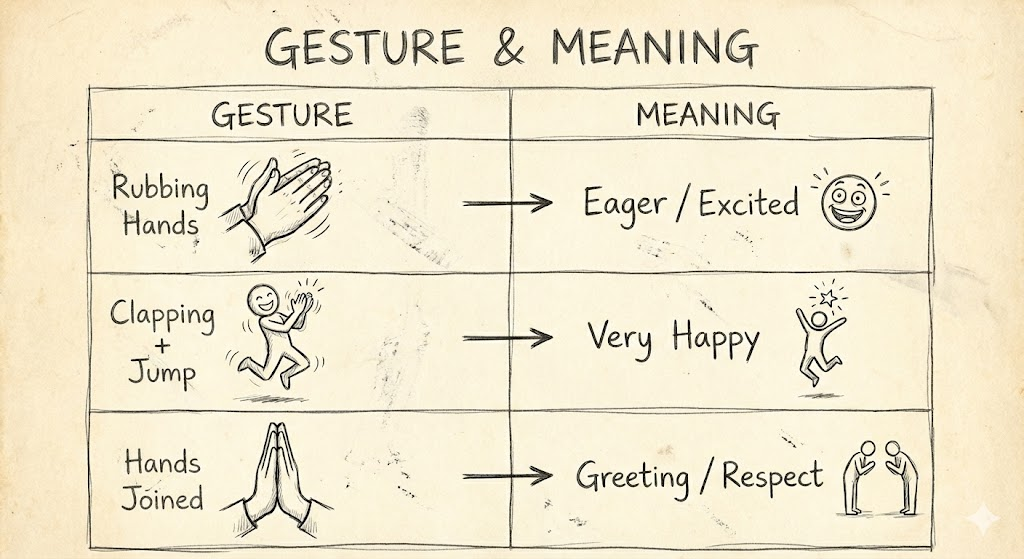
Later, the class has a video conference with students from Nepal. Both schools greet each other warmly. Disha leads an activity where Team India and Team Nepal show gestures and guess their meanings:
- Rubbing hands – excitement or happiness.
- Clapping and jumping – joy and celebration.
- Joining hands – greeting, especially used more during the COVID period.
gesture chart:
After the session, Ms Rashmi asks Ravi to write the main points of the interaction on the board in order. Ravi hesitates, thinking he will forget. She gently encourages him to try and promises to help if needed.
Ravi then writes:
- Greetings
- Interactive Game on Gestures
- Farewell
He realises he could do it, and his teacher explains that written communication is often the most accurate and dependable way to record important information.
Organizing Thoughts – Aryan’s Birthday
In the second story, Aryan is excited because his birthday is coming. He wants to throw a party. His parents and grandparents use this as a chance to teach him about planning, organising thoughts, and time management.
They suggest he should organise the party himself by following a checklist instead of others doing everything for him.
planning flow:
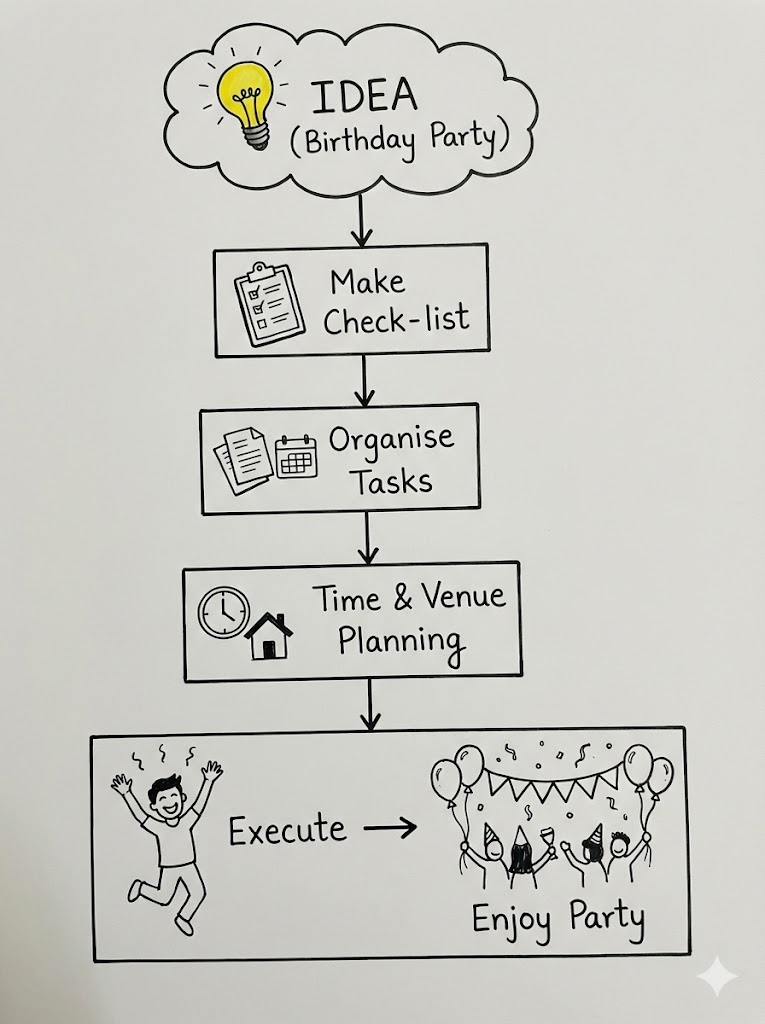
Aryan’s family guides him to include these points in his checklist:
- Guest List and Welcome – who to invite and how to greet them.
- Menu – snacks, main course, drinks, cake.
- Entertainment – games, music, activities.
- Venue and Time – where and when the party will be held.
- Return Gifts – what to give and how to pack them.
- Farewell and Dispersal – saying goodbye and giving gifts at the end.
His grandmother explains that a checklist helps ensure no important step is missed. It can be just a simple handwritten list in a diary or on a board.
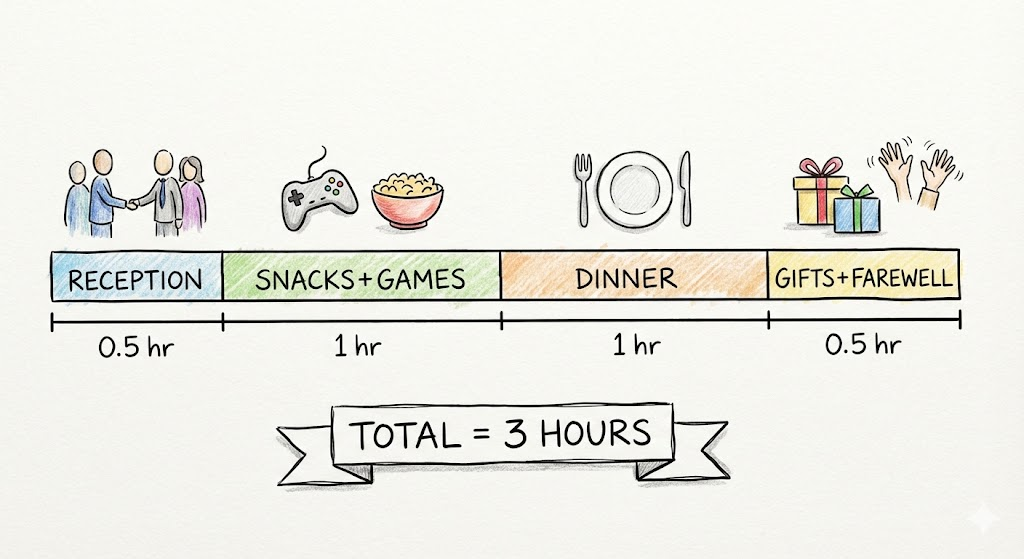
They also talk about time management. Aryan estimates:
- 30 minutes – receiving guests.
- 60 minutes – snacks and games.
- 60 minutes – dinner.
- 30 minutes – return gifts and dispersal.
Total party time: 3 hours.
time block:
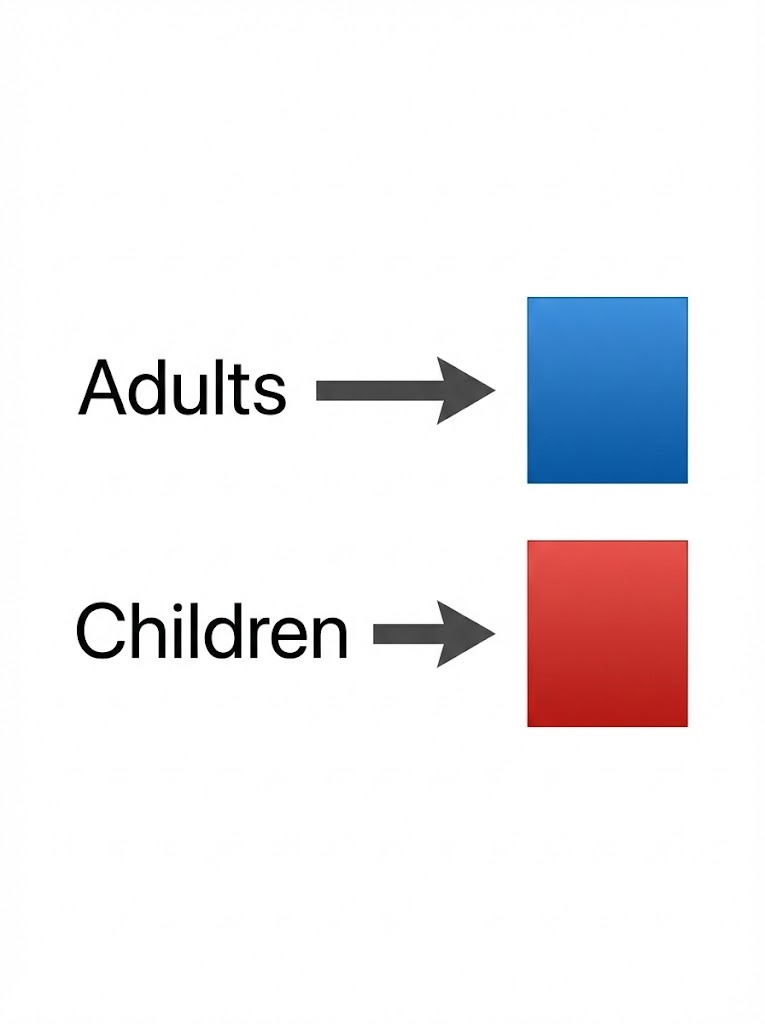
His father suggests using colour coding to manage different return gifts:
- Blue wrapping – gifts for adults.
- Red wrapping – gifts for children.
colour-coding idea:
Aryan also learns:
- To choose a suitable venue (home or hall) based on number of guests.
- To remember decoration and cleanliness to avoid last year’s mess.
- That thinking ahead leads to smoother events and less stress.
Confidence Building – Hesitation Removal
The third story focuses on hesitation and self-confidence.
Shaurya has practised guitar for a month for a competition but is now hesitant to perform. His grandmother and sister Soumya encourage him. He confesses that when he faces an audience, his confidence drops.
What is Hesitation?
Hesitation is:
- Being unwilling or afraid to do a task.
- Feeling unsure or indecisive.
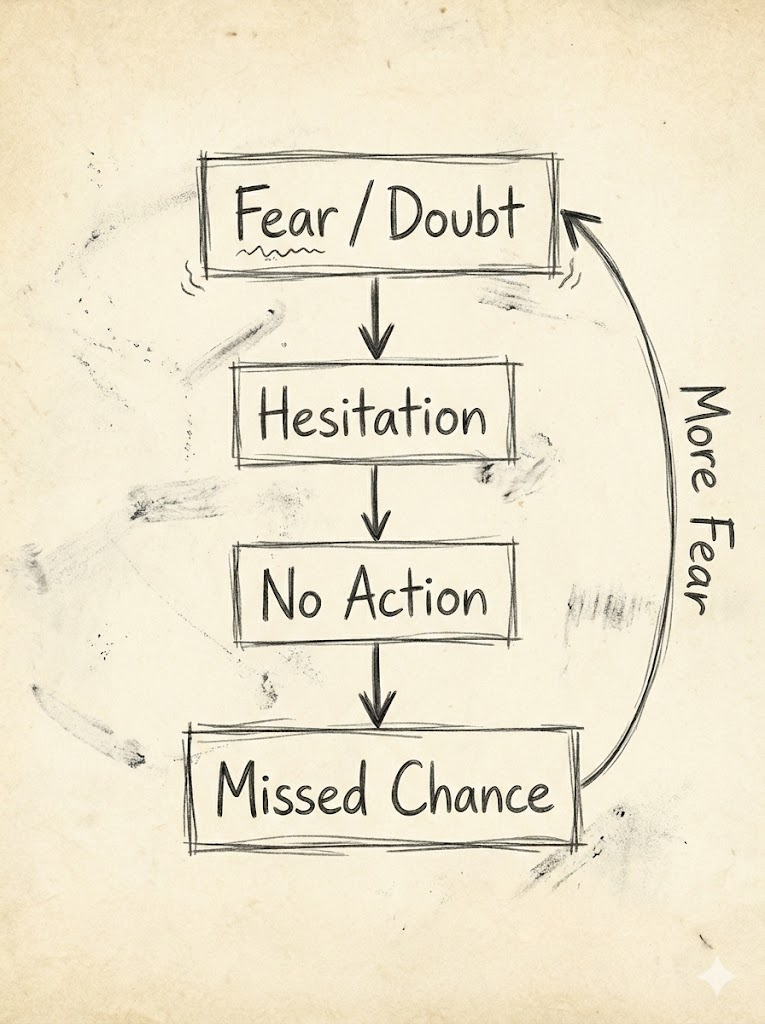
- Caused by fear and doubt.
It leads to delay in action and sometimes lifelong regret if we never even try.
hesitation cycle:
Hesitation Removal
Hesitation removal means:
- Building confidence.
- Taking initiative despite fear.
- Resisting peer pressure.
- Accepting that mistakes are part of learning.
Positive statements like “You can do it” and “You can learn” are more powerful than “You must” or “You should”.
Story of Sagar and Harshit
Shaurya’s grandmother tells a story:
- Sagar (10) and Harshit (12) go exploring near their village.
- Sagar falls into a well and cannot swim.
- Harshit panics at first but then sees a bucket with a rope.
- He throws the bucket in, asks Sagar to hold the rope, and pulls with all his strength until Sagar is safe.
When they tell the villagers, nobody believes Harshit could pull a boy out of a well because he seems too small and weak. Only Uncle Puri believes them. He explains:
- Harshit succeeded because at that moment nobody was there to tell him, “You cannot do it.”
- He did not have time to doubt himself.
- The only person who can truly empower you is yourself.
moral:
Belief "I CAN" → Action → Success → More Confidence
Belief "I CAN'T" → No Action → No Success → More Doubt
Shaurya realises he can perform if he believes in himself. His hesitation reduces and his confidence grows.
ASSESSMENT – OBJECTIVE QUESTIONS WITH ANSWERS
Tick the correct answer
Q1. We hesitate to answer in the classroom because…
a) We fear being judged as a result of the wrong answer.
b) We like to keep silent.
c) We don’t know how to handle the situation.
Answer: a) We fear being judged as a result of the wrong answer.
Q2. Appropriate posture while communicating with others:
Options:
a) Stand straight
b) Have eye contact
c) Do not fiddle or cross the legs
d) Speak confidently
- Both a and b
- Both b and c
- Both c and d
- All of the above
Answer: 4) All of the above
Q3. Habits that make you a smart communicator today:
a) Speaking loudly
b) Using appropriate language
c) Not slumping
d) Only speaking about oneself
- Both a and b
- Both b and c
- Both a and c
- All the above
Answer: 2) Both b and c
Q4. Signs of hesitation:
a) A person may be shy
b) He will not have eye contact
c) Both a and b
Answer: c) Both a and b
Q5. How can you communicate with others without hesitation?
a) With assertive and active voice
b) By writing on a notepad
c) Speaking directly without listening
- Only a
- Both a and c
- Both c and b
- All the above
Answer: 1) Only a
Q6. Non-Verbal Communication includes the following:
i. Visual and Audio
ii. Audio and Audio Visual
iii. Facial Expressions
iv. Visual, Audio and Audio Visual
Answer: iv. Visual, Audio and Audio Visual
Q7. Posture to be avoided during Non-Verbal Communication:
i. Standing straight
ii. Smiling face
iii. Tight-lipped
iv. Steady eye contact
Answer: iii. Tight-lipped
Q8. Better planning leads to __________.
i. Happiness
ii. Successful execution of the task
iii. Time management
iv. Organizing thoughts
Answer: ii. Successful execution of the task
Q9. Which of the following can boost confidence?
i. You should do it
ii. You must do it
iii. You can do it
iv. You may do it
Answer: iii. You can do it
Q10. Another word for ‘hesitation’ is:
i. Unwillingly
ii. Reluctance
iii. Certainty
iv. Readiness
Answer: ii. Reluctance
CROSSWORD – QUESTIONS AND ANSWERS
Down
- Very enthusiastic and eager. → EXCITED
- Inspiring delight, pleasure or admiration. → WONDERFUL
- A wish of well-being at parting or an occasion when someone says goodbye. → FAREWELL
Across
- Meeting between two or more people. → CONFERENCE
- Have one’s permanent home at a particular place. → RESIDE
- Come into sight; become visible or noticeable. → APPEAR
ASSESSMENT – DESCRIPTIVE QUESTIONS WITH ANSWERS
Q1. Answer the following
A. Why does Disha have a serious look?
Disha feels nervous and unsure while introducing herself, so she keeps a serious face, raises her eyebrows, and slouches, which shows lack of comfort and interest.
B. What tips did Disha’s teacher give her to overcome her weakness?
- Stand straight without slouching.
- Keep chin up and head held high.
- Avoid swaying, fidgeting, rocking, or crossing arms.
- Maintain eye contact and relax her face.
These steps gradually build positive body language and confidence.
C. What do you understand by the term ‘Self confidence’?
Self-confidence is believing in your own abilities and decisions, even when tasks are difficult or new, and being willing to try instead of giving up due to fear.
D. What is Time Management? Why is it important for a student?
Time management is planning and using time wisely so that all tasks are completed within available hours. For a student, it helps to:
- Finish homework and projects on time.
- Balance study, play, and rest.
- Reduce stress before exams or events.
E. What is a ‘Check-list’?
A checklist is a written list of steps, items, or tasks that need to be completed so you can tick them off and ensure nothing is forgotten.
F. You are planning to visit your grandparents to spend winter vacations. Make a check-list before you start your journey.
Sample checklist:
- Tickets booked (train/bus/flight).
- Inform grandparents about arrival time.
- Pack clothes and warm sweaters.
- Pack toiletries and medicines.
- Carry books, games, or diary.
- Keep ID card and school homework.
- Pack gifts for grandparents.
- Check money and emergency contacts.
Q2. Let us write
A. Letter to yourself: list your true personality traits.
Sample points a student could include:
- I am helpful and like supporting my friends.
- I am sometimes shy but try to speak up in class.
- I work hard when I set a goal.
- I enjoy learning new skills like music or drawing.
- I want to improve my time management and body language.
You can put these into a friendly letter format starting with “Dear Me,” and ending with “Yours sincerely”.
B. Which activities make you feel happy and why?
Examples:
- Playing football or cricket – keeps the body active and builds teamwork.
- Reading storybooks – increases imagination and relaxes the mind.
- Drawing or music – helps express feelings creatively.
Students should write 4–5 lines about their own interests.
C. Mention the people in your life who are supportive and help you nurture your dreams and goals.
List could include:
- Parents and grandparents who guide and encourage.
- Teachers who explain concepts and motivate you.
- Friends who practise and learn with you.
- Elder siblings or cousins who share advice.
D. Ask your family members to write two things about you that make them feel proud and read it aloud in class.
Sample responses family might give:
- “You are honest and always tell the truth.”
- “You complete your work on time and help at home.”
Students then read these lines aloud to build confidence and self-awareness.
IMPORTANT WORDS
| Word | Simple Meaning |
|---|---|
| Encouragement | Giving someone support, confidence, or hope. |
| Traditions | Customs and beliefs passed from one generation on. |
| Gestures | Movements of hands, head, or body to show meaning. |
| Scenic | Having beautiful natural views. |
| Reside | To live permanently in a particular place. |
Download Free Mind Map from the link below
This mind map contains all important topics of this chapter
Visit our Class 6 Skill Development page for free mind maps of all Chapters